
Your Child's Math Homework Is Missing Something Important
Ask your child what the area of a triangle is. If they have done any geometry, they will probably say "half base times height." Ask them to calculate the area of a triangle with a base of 6 and a height of 4. They will say 12. They are correct.
Now ask them why the formula works. Why is it half base times height and not, say, base times height? Where does the half come from?
Most students I have worked with — and these are students who can use the formula correctly — cannot answer this question. They know what the formula is. They do not know why it is true. And the difference between these two things is, I think, the most important gap in how mathematics is currently taught.
What the gap looks like
Consider another example. Your child knows that the angles of a triangle add up to 180 degrees. This is one of the first things taught in geometry. But why is it 180 degrees? What would happen if it were not? What assumptions does this result rest on? These are not trick questions. They are the natural questions that arise when you try to understand a claim rather than just remember it.
Or consider definitions. Your child can probably tell you that an equilateral triangle is a triangle with all sides equal. But is an equilateral triangle also isosceles? The standard definition of isosceles is "a triangle with at least two equal sides." By that definition, every equilateral triangle is isosceles. But many students — and some textbooks — treat equilateral and isosceles as separate categories. Whether they are separate depends on how you set up your classification system, and this is a choice that has consequences for what you can prove. Your child has almost certainly never been asked to think about this.
The pattern is the same in each case. Students learn results — formulas, theorems, definitions — and learn to use them. What they do not learn is where these results come from, what they rest on, and how they connect to each other. A student who knows that the area of a triangle is half base times height, and that the area of a parallelogram is base times height, may never have been shown that the first formula depends on the second. And the area of a parallelogram depends on the area of a rectangle, which depends on what we mean by "area" in the first place. There is an entire chain of reasoning underneath even the simplest formula, and most students never see it.
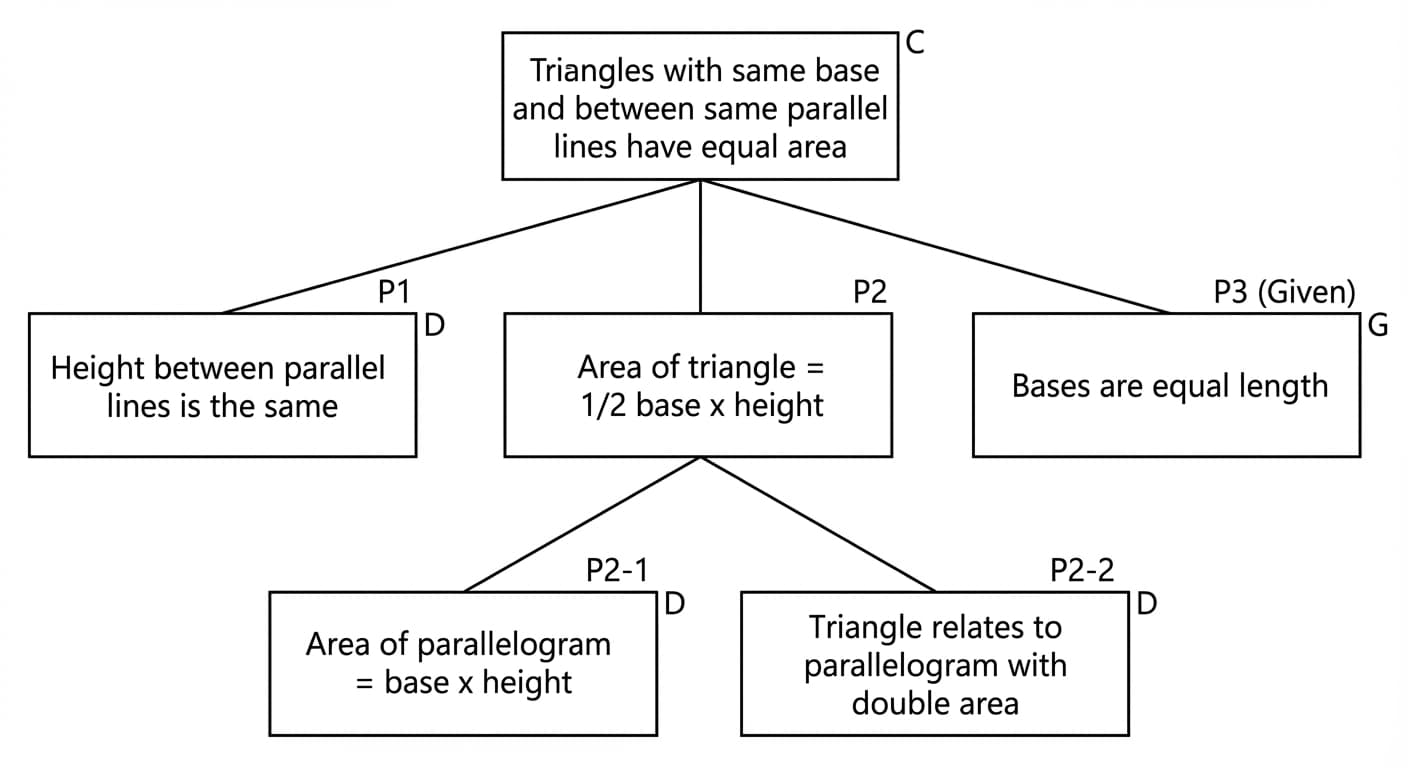
Why this matters
You might reasonably ask: does it matter? If my child can use the formula correctly, if they get the right answers on tests, why should they need to know why the formula works?
There are two reasons, I think. The first is practical. A student who understands why a formula works can reconstruct it if they forget it. They can also see when it applies and when it does not — they are less likely to use it in a situation where the assumptions behind it do not hold. A student who has only memorised the formula has no recourse when memory fails, and no way to check whether the formula is appropriate for a given situation.
The second reason is less practical but, I think, more important. Understanding why things are true is a different kind of intellectual activity from knowing that they are true. When a student traces the area formula back through parallelograms and rectangles to the basic concept of area, they are seeing the structure of mathematical knowledge — how claims depend on other claims, how assumptions accumulate, where the foundations are. This kind of thinking — tracing claims to their foundations, identifying hidden assumptions, seeing how different pieces of knowledge connect — is valuable well beyond mathematics. It is the same kind of thinking you need when evaluating an argument in a newspaper, or when trying to understand why a policy has the consequences it does, or when deciding whether a claim someone makes is well-supported.
When I ran a course on what I call "theory building" with students between 12 and 15 years old, the most common feedback was that the course made them think. Several students contrasted this explicitly with their regular mathematics classes. Vivek said that "in a classroom we only use these theorems blindly." Tanya said the course taught her "how we shouldn't stick with textbook knowledge and we should prove or justify the things we know to understand it deeper." Zoya said, "Earlier my mind used to believe everything that came in front of me. But now I ask questions like why."
I do not want to suggest that these students' regular mathematics classes were bad. Their teachers were doing what the curriculum and the textbooks asked them to do. The problem is not with the teachers. The problem is that the curriculum treats mathematics as a collection of results to be learned rather than a process of reasoning to be engaged in.
What understanding looks like
Let me give a more detailed example of what I mean by understanding, as opposed to knowing.
In the course I ran, I asked students to list everything they believed to be true about triangles. They came up with a long list: the angles add up to 180 degrees, angles opposite equal sides are equal, the area is half base times height, the sum of two sides is greater than the third side, and so on. Then I asked them to justify one of these claims — not by appealing to the textbook or to my authority, but by using other claims on the list.
We started with a simple one: the angles of an equilateral triangle are equal. A student named Arnav argued: an equilateral triangle has all sides equal, so it is isosceles. Angles opposite equal sides are equal. Therefore two of the angles are equal. Repeat for a different pair, and all three are equal. This is a valid argument. But then I asked: why are angles opposite equal sides equal? And the students had to justify that claim. And so on, with each justification opening up further questions.
At some point, the chain bottoms out. You reach claims that you cannot justify further — things like the transitivity of equality (if A equals B and B equals C, then A equals C). A student named Vivaan identified this as an assumption rather than a provable fact, which was one of the most satisfying moments of the course. He had found the floor — the place where the reasoning rests on something you simply accept.
This is what understanding mathematics looks like. It is not about knowing more facts. It is about seeing how the facts connect to each other, what they rest on, and where the foundations are. Tanya described it well: "We understood how mathematicians build up chains of derivations and conclusions from basic knowledge or axioms." Vandana said: "Because of this workshop I was able to understand the real depth of mathematical concepts and its real meaning."
What you can do
I am not suggesting that you should teach your child mathematics differently from how their school teaches it. Their school's curriculum has its own goals and constraints, and the teachers are working within those constraints. But there are things you can do at home that develop the kind of thinking I am describing — and they do not require you to be a mathematician.
The simplest is to ask "why." When your child tells you that the angles of a triangle add up to 180 degrees, ask them why. Not as a test — genuinely, as a question. If they say "because the textbook says so," that is an honest answer, and it tells you that they have not been given the reasoning behind the claim. If they say "because you can measure them," that is also an honest answer, and it opens a conversation about whether measuring three triangles proves something about all triangles.
You can also ask about definitions. "What is a triangle?" seems like a trivial question, but it is not. Is a figure with three sides and one of them curved a triangle? Is a figure with three vertices and all three on the same line a triangle? These questions do not have obvious answers, and discussing them develops the habit of asking what we mean by the words we use — a habit that is valuable in every domain of life.
And you can pay attention to what your child's homework asks of them. If every problem asks them to calculate — to apply a formula, to find an answer — and no problem asks them to explain, to justify, or to connect ideas to each other, then something is missing. Not because the calculations do not matter, but because they are only part of what mathematics is.
Eight of the fifteen students at one of the schools where I ran the course explicitly mentioned not taking textbook knowledge for granted as one of the most valuable things they learned. Prerna said: "The course taught us not to assume the given facts to be true. We should cross-check and go to the root of things to understand them better." This is not a skill that is useful only in mathematics. It is a skill that matters in every situation where someone asks you to believe something and you want to know whether you should.
What this is not
I want to be clear about what I am not saying. I am not saying that your child's mathematics education is worthless. Learning to calculate is important. Fluency with procedures matters. A child who cannot compute the area of a triangle has a real problem. What I am saying is that computation is not enough. A child who can compute the area but cannot explain why the formula works — who cannot trace the reasoning back even one step — has a different kind of problem, and it is one that most schools do not address.
I am also not saying that every child needs to become a mathematician. Most will not. But the kind of thinking that theory building develops — asking why, tracing assumptions, connecting ideas, not accepting claims at face value — is not specifically mathematical. It is the kind of thinking that the best versions of every discipline require: science, philosophy, law, ethics, even everyday decision-making. Mathematics just happens to be a particularly good place to practise it, because the claims are precise, the reasoning is checkable, and the results are not matters of opinion.
The formula for the area of a triangle is half base times height. Your child knows this. The question is whether they know why — and whether their education has given them the tools to find out.
Related articles
How to Have Mathematical Conversations at Home
A practical guide for families, offering concrete conversation starters that develop careful thinking habits through natural, low-pressure mathematical discussions at home.
12 min read
From Geometry to Ethics: One Framework for Thinking Across Disciplines
Shows how the thinking tools of mathematical theory building appear in structurally similar forms in science and ethics, making the case for a transdisciplinary approach.
13 min read
What If Math Class Taught You How to Think, Not Just How to Calculate?
An overview of how mathematics education could develop general thinking skills through theory building — defining carefully, questioning assumptions, classifying, and constructing knowledge — rather than just teaching formulas and procedures.
12 min read