
What Happens When You Change the Rules of Geometry
In a world with exactly six points, can every straight line be bisected?
When I posed this question to a group of 12-to-15-year-old students in Pune, the first thing that happened was confusion. Not the bad kind — the productive kind. A student named Uday said, almost immediately, "According to Euclidean geometry, there can't be a straight line." He was right to be troubled. In the geometry they had learned, lines have infinitely many points. A world with only six points does not seem like a place where geometry can happen at all.
But the question does not ask about Euclidean geometry. It asks about a world with six points. And that is exactly the point. To answer it, students had to figure out what "straight line" and "bisection" even mean in such a world. They had to take concepts they were familiar with and extend them into unfamiliar territory. Along the way, they discovered something that I think is one of the most important ideas in mathematics: the rules you start with determine the world you end up in. Change the rules, and you get a different world with different truths.
Making the world concrete
The question as stated is deliberately vague. Six points, arranged how? Connected how? Before students could do any geometry, they needed a specific world to work in. I used an analogy to make discrete worlds feel tangible. Imagine you are on a spaceship, millions of light years from Earth. The ship has teleportation devices that connect to specific locations on Earth. You can teleport instantly between connected locations, but you cannot travel between locations that are not directly connected — you have to go through intermediate stops. Each teleportation takes the same amount of effort, so we can treat each connection as having the same "length."
This gives us a world. The locations are points. The connections are edges. And we can talk about distance — the distance between two points is the number of connections in the shortest route between them. We started with a simple arrangement: six points in a line, A-B-C-D-E-F, where each point is connected only to its immediate neighbours. A is connected to B, B to C, and so on. The distance from A to C is 2 (you have to go through B), and the distance from A to F is 5.
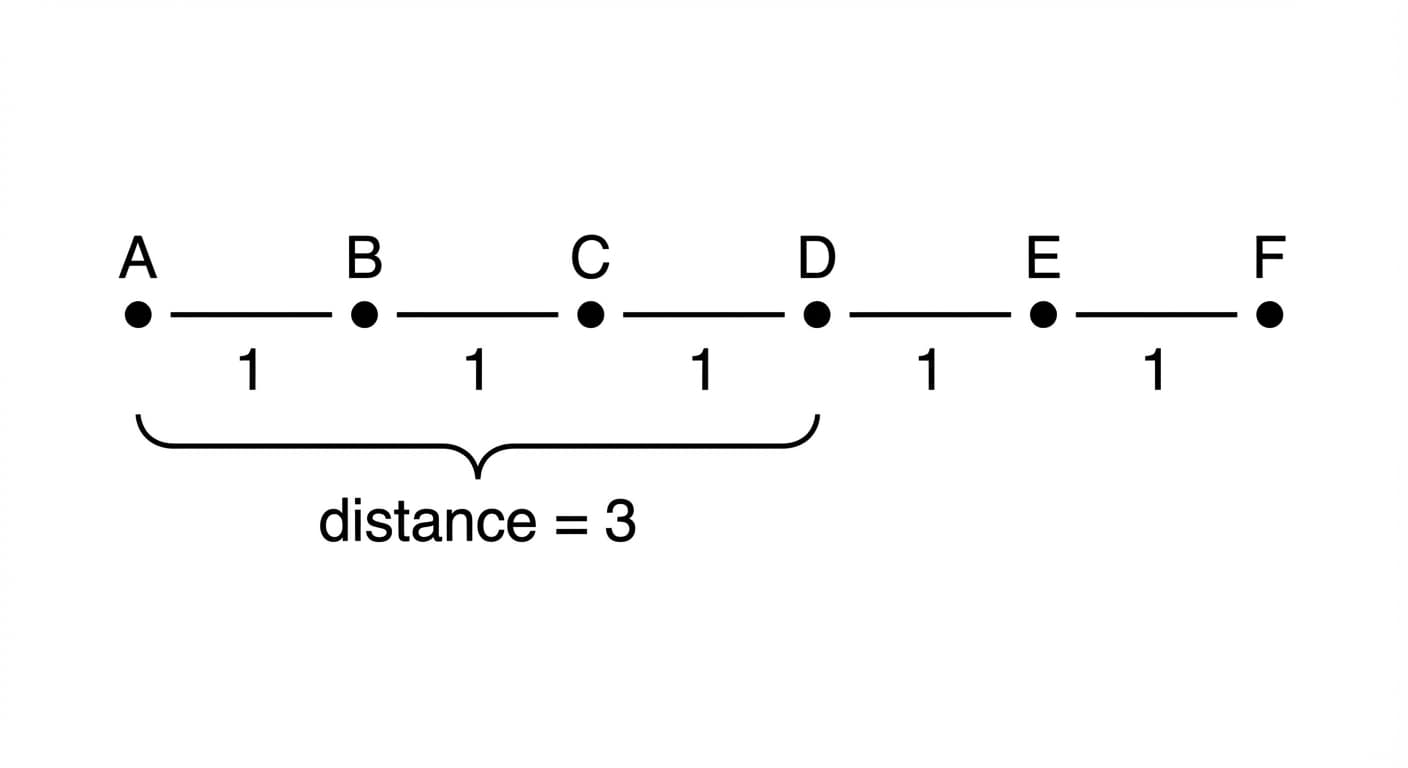
This is enough structure to start asking geometric questions. But every question requires defining what the geometric concepts mean in this world.
What is a straight line when you only have six points?
In Euclidean geometry, a straight line has many properties. It is a path that stays in the same direction. It is the shortest path between two points. Given two points, there is exactly one line through them. In ordinary geometry, these properties all go together — they are equivalent characterisations of the same thing. But in a world with six points, they come apart.
We did not have a useful concept of direction in these worlds. But we did have a concept of distance, since we could count connections. A student named Vivaan suggested that a straight line is the shortest path between two points. This turned out to be the most workable definition. In our simple six-point world, the shortest path from A to D is A-B-C-D, and there is no shortcut. So A-B-C-D is a straight line segment.
But something was already different from Euclidean geometry. In other arrangements of six points — say, a world where some points have multiple connections — there might be several shortest paths between the same two points. The shortest path is not necessarily unique. So by choosing the distance-based definition of straight line, we got existence (there is always a shortest path) but potentially lost uniqueness (there might be more than one). This trade-off does not arise in Euclidean geometry, where both existence and uniqueness hold simultaneously. The fact that it arises here tells you something about the relationship between those properties — they are logically independent, not different aspects of the same thing.
Two ways to bisect
With straight lines defined, we could ask about bisection. In Euclidean geometry, to bisect a line segment means to find a point that divides it into two equal parts. But "two equal parts" can mean different things.
Consider the path B-C-D in our six-point world. The point C lies between B and D, and the distance from B to C equals the distance from C to D. So C bisects B-C-D. That seems straightforward. But what about B-C? There is no point between B and C — they are directly connected, with nothing in between. So B-C cannot be bisected.
A student named Vivaan noticed the pattern quickly: "Not every line can be bisected." Paths with an odd number of points along them — like B-C-D, which passes through three points — can be bisected at the middle point. Paths with an even number of points cannot.
But then another possibility emerged. What if bisection does not require finding a point in the middle? What if it means dividing the path into two equal parts that do not overlap? Take A-B-C-D. We could break it into two pieces: A-B and C-D. Each piece has the same length, and together they cover the whole path. Nothing is left out, nothing is shared. This is a different definition of bisection from the first one.
Students initially resisted this. Uday said it was not "real" bisection — you should break something into two equal parts and no part should be left out, but there should be a point where the break happens. He was expressing a reasonable intuition. But both definitions are internally consistent. They just lead to different answers about which paths can be bisected. Under the first definition (bisection at a point), only paths through an odd number of points can be bisected. Under the second definition (bisection by splitting), different paths become bisectable. The answer to "can every straight line be bisected?" depends on which definition you choose.
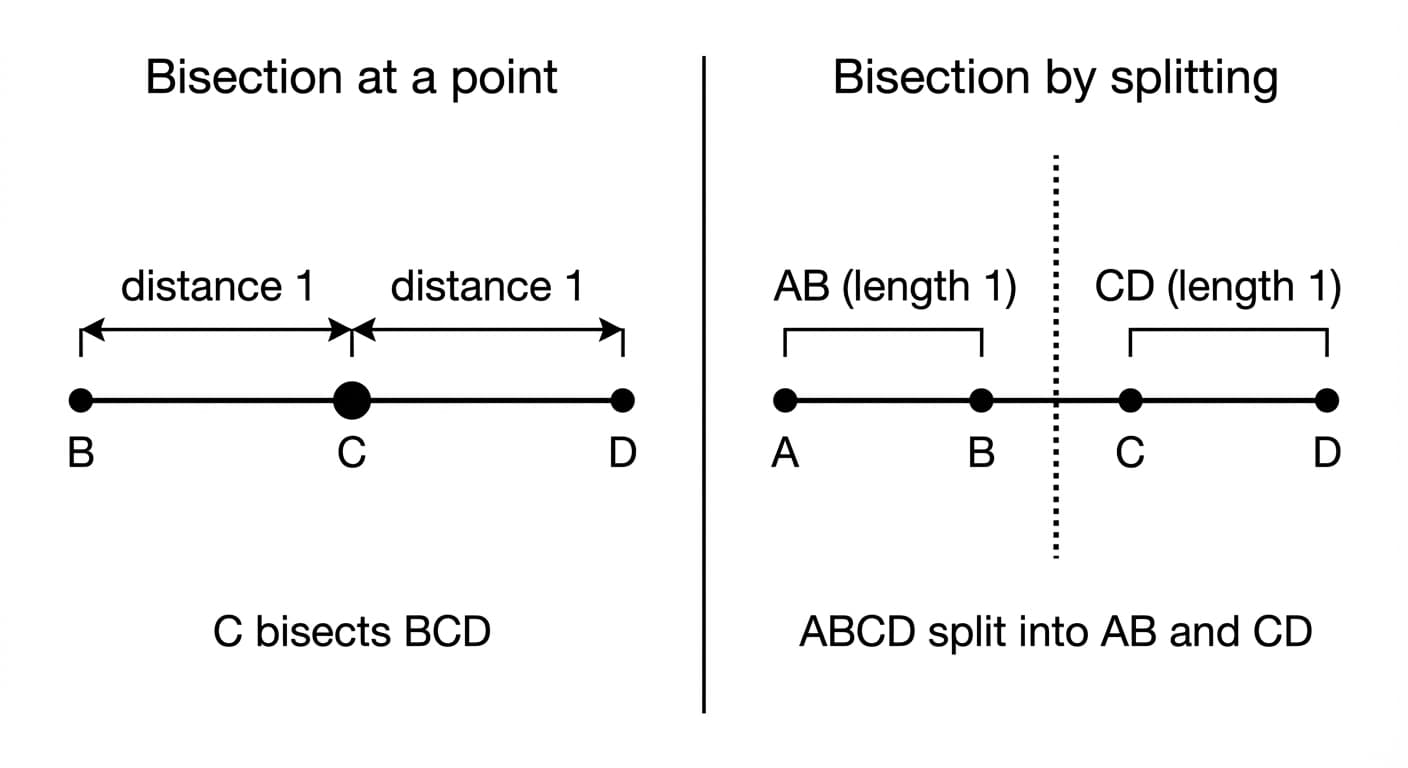
This is the same phenomenon I discussed in an earlier article about definitions — equivalent characterisations in one context can come apart in another. In Euclidean geometry, finding a midpoint and splitting into two equal non-overlapping halves amount to the same thing. In a discrete world, they do not. Students were seeing this happen in real time, through their own work.
Creating worlds where the answer changes
Once students understood the question and the definitions, something interesting happened. They started creating their own worlds — arranging six points in different configurations and seeing what followed.
A student named Sabareesh proposed a world where three points — A, B, C — are all mutually connected to each other, forming a triangle. In this world, the straight lines are just the direct connections: A-B, B-C, and A-C. The path A-B-C is not a straight line because it is not the shortest path from A to C — the direct connection A-C is shorter. So every straight line in this world has length 1, and every straight line can be bisected (trivially, in a sense, since each endpoint serves as a "bisection point" under certain interpretations). Sabareesh's world gave a different answer from the linear world we started with.
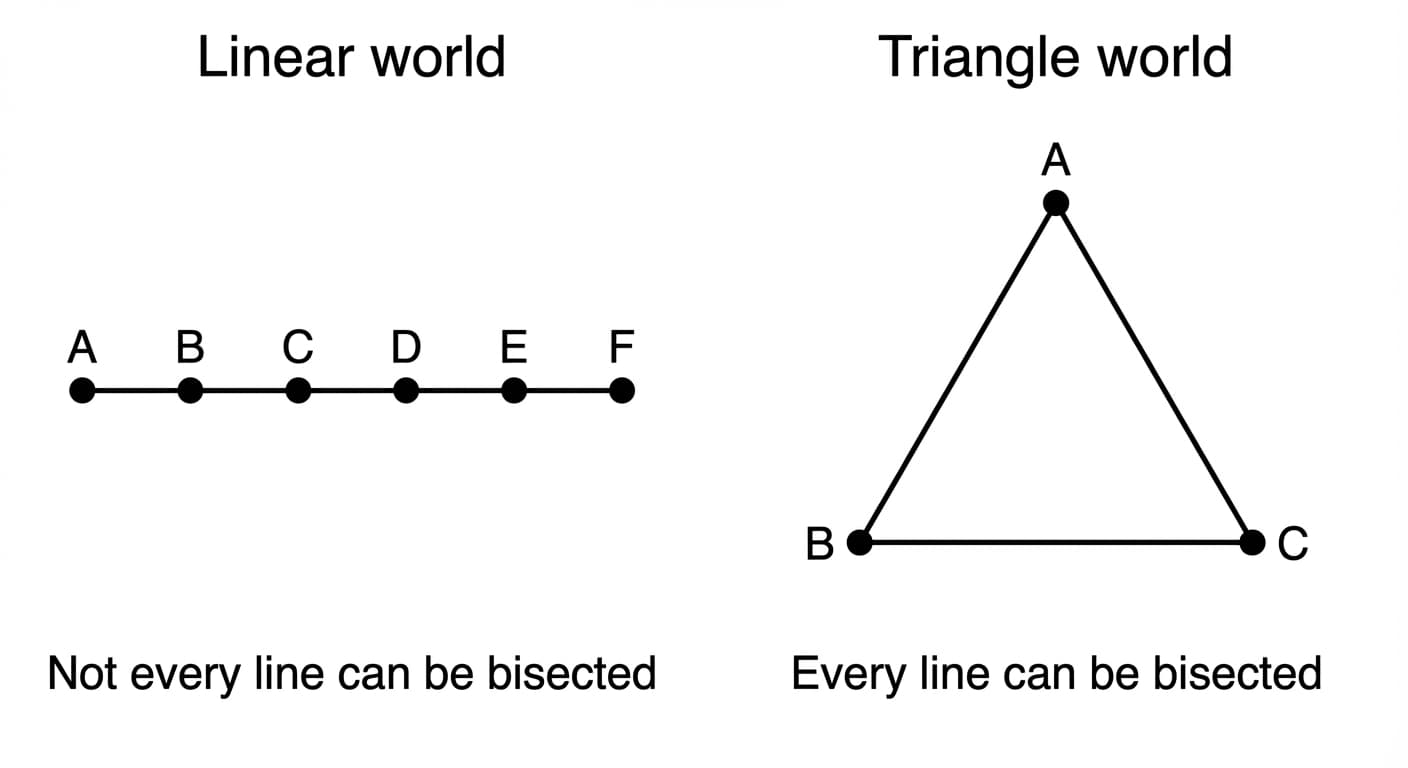
Vivaan tried to characterise exactly which worlds allow all straight lines to be bisected. He proposed that if you can break a world into pairs of connected points — what he called "sets" — with no point appearing in more than one pair, then every line can be bisected. Sabareesh then challenged this with his triangle world, which does not break into neat pairs but still has all lines bisectable. Vivaan's general claim was wrong, but the reasoning that led to it was sound — he was forming a conjecture, testing it against cases, and refining it. That is exactly what mathematicians do.
Circles, triangles, and the limits of extension
We did not stop at straight lines and bisection. Students tried to define circles and triangles in these worlds. Each extension raised new problems.
A student named Arnav defined a circle as "the set of points equidistant from a given point." In Euclidean geometry, this gives you the familiar shape. In our six-point linear world, a circle with centre A and radius 1 is just the single point B. A circle with centre C and radius 2 is the set of points A and E. These "circles" do not look like circles at all, but they satisfy the definition.
An unexpected problem arose: a circle with centre A and radius 5 (the farthest distance in the linear world) is just the point F. And a circle with centre F and radius 5 is just the point A. Two circles with different centres and the same radius, both consisting of a single point. In Euclidean geometry, two circles with the same radius are congruent — they have the same shape and size. Here, they are both just single points, so in some sense they are congruent, but the analogy feels strained. The concept of a circle has been extended, but it has lost much of what makes circles interesting in Euclidean geometry.
Triangles raised even subtler issues. Tarini and Tanya proposed defining a triangle as "a closed figure with three vertices where every pair of vertices is connected by straight lines." This seems reasonable. But in the linear world, consider the points A, B, and C. There are straight lines between each pair: A-B, B-C, and A-B-C (which is the shortest path from A to C, passing through B). This technically satisfies the definition — three vertices, each pair connected by a straight line. But it does not look like a triangle. It looks like a line.
Students had different objections. Tanya said it was not a closed figure. Uday said it only has one angle. Both were right, but for different reasons. The deeper issue is that A, B, and C are collinear — they lie on the same straight line. In Euclidean geometry, three collinear points do not form a triangle. But the definition as stated does not exclude them.
This led to two definitions of triangle: one that allows degenerate (collinear) cases and one that requires the three vertices to be non-collinear. In our simple linear world, all points are collinear, so only the first definition yields any triangles — and those triangles are degenerate. In a world with a less linear structure, both definitions would give results, but different ones. Once again, the definition determines what you find.
What students took from this
From the feedback at the end of the course, students found the discrete geometry module challenging. This is not surprising — it requires holding multiple unfamiliar ideas simultaneously and reasoning about objects that behave differently from their Euclidean counterparts.
What interested me is that the students who had a positive reaction and the students who had a negative reaction often cited the same feature of the module. Devika said, "It was something very different from what we usually learn in geometry. It made me think outside the box. When we used to define what lines, points, etc. are, I used to feel kinda irritated because we never got it right, but it was really fun." Anjali said it "encouraged us to find alternatives and loopholes and also use our creativity." On the other side, Arvind said, "We were digging a lot into stuff which made me feel that it was complicated." Arun said he "was not able to understand the different types of circles in different worlds."
The challenge was the same in both cases. The students who found it rewarding experienced that challenge as creative and engaging. Those who found it frustrating experienced it as confusing and opaque. I do not think this is simply a matter of ability — it has to do with how comfortable a student is with ambiguity and with not knowing where things are going. This is something I have not fully figured out how to address. The module builds on itself more than the other modules in my course, so a student who misses something early can struggle throughout. Pacing and scaffolding are areas where I think there is room for significant improvement.
Why this matters
The discrete geometry module illustrates something that I think is worth stating plainly: mathematics is not a fixed collection of facts about the world. It is a human activity in which we create structures by choosing definitions and assumptions, and then explore the consequences of those choices. Change the assumptions, and you get a different structure with different truths.
This is not an abstract philosophical point. Students experienced it concretely. They saw that the answer to "can every straight line be bisected?" depends on what you mean by "straight line," what you mean by "bisection," and what world you are working in. They saw that definitions which are equivalent in one context can come apart in another. They saw that extending a familiar concept to a new setting requires making choices, and different choices lead to different mathematics.
The same kind of thinking applies outside mathematics. When a scientific theory is extended to new phenomena, the assumptions that worked in the original domain may not hold. When a legal concept developed in one context is applied in another, the result depends on which aspects of the concept you preserve. When an ethical principle formulated for one set of circumstances is applied to a very different situation, the implications may surprise you. In each case, the conclusions follow from the starting points, and changing the starting points changes the conclusions.
I do not want to overstate how well the module achieved its goals. As I mentioned, the pacing needs work, and some students were lost. The connection between discrete geometry and these broader ideas was not always explicit in the classroom — I am spelling it out here more than I did with students. But the basic experience of creating a world, defining concepts within it, and seeing how the definitions shape what is true — that, I think, most students did have. And it is an experience that is hard to get from a mathematics class where the definitions and rules are always given to you.
Related articles
The Art of Defining: Why Most Arguments Are About Words, Not Facts
Explores what mathematicians have learned about the art of defining — how to choose good definitions, what makes one better than another, and why these skills matter far beyond mathematics.
15 min read
From Geometry to Ethics: One Framework for Thinking Across Disciplines
Shows how the thinking tools of mathematical theory building appear in structurally similar forms in science and ethics, making the case for a transdisciplinary approach.
13 min read
What If Math Class Taught You How to Think, Not Just How to Calculate?
An overview of how mathematics education could develop general thinking skills through theory building — defining carefully, questioning assumptions, classifying, and constructing knowledge — rather than just teaching formulas and procedures.
12 min read