
From Geometry to Ethics: One Framework for Thinking Across Disciplines
Is a human an animal?
If you have read anything I have written about classification, you will recognise this as the same kind of question as "is a square a rectangle?" The answer depends on your classificatory system. If humans are animals (and animals are a type of organism), then anything established about animals — that they need food, that they reproduce, that they eventually die — is automatically inherited by humans. You do not have to prove these things separately. If instead you treat "human" and "animal" as separate categories, you lose that inheritance. You have to specify far more about what a human is from scratch, and you have to reprove things that would have come for free.
The considerations here — logical inheritance, simplicity of definitions, purpose of classification — are remarkably similar to the considerations that come up when classifying quadrilaterals. I have often done an activity where I start with asking students whether a square is a rectangle, discuss the two classificatory systems and their consequences, and then move to biological classification. Students notice the parallels without much prompting. The purpose of classification, the trade-off between hierarchical and flat systems, the idea that your classificatory choice shapes what you can see — these come up in both contexts, and for essentially the same reasons.
This is not a coincidence. And it is not limited to classification. In what follows, I want to show that several of the thinking tools involved in mathematical theory building — defining, reasoning from assumptions, deducing consequences, tracing claims to their foundations — appear in structurally similar forms in science and ethics. They are not identical across disciplines. The differences matter. But the similarities are real enough that learning these tools in one domain can, I believe, help you think more clearly in others.
What I mean by transdisciplinarity
I should be precise about what I am claiming. There is an established vocabulary here that I want to distinguish from. Interdisciplinarity usually refers to the intersection of two fields — physical chemistry, for instance, or mathematical biology. Multidisciplinarity refers to bringing tools from several fields to bear on a single problem — understanding climate change requires statistics, physics, sociology, and more. What I am calling transdisciplinarity is something different from both. It refers to a concern for concepts and tools of knowledge construction that are abstractions of particular disciplines. The concept of "theory," for example, is not exactly the same in mathematics, physics, and ethics. But it has enough commonality across these fields that the common concept — whatever we call it — is worth studying in its own right.
The type of transfer I am interested in is not the application of mathematical techniques to other fields (like using statistics in biology). It is something more abstract: thinking tools or aspects of mathematical practice that operate at a level of generality sufficient to be useful in other domains. Classification is one such tool. Assumption digging is another. The process of deducing consequences from a set of starting points is a third. Each of these looks somewhat different depending on the discipline, but the underlying structure is shared.
Assumption digging in mathematics
I have written about assumption digging in mathematics in detail elsewhere, so I will be brief here. The idea is to take a claim — say, "the area of a triangle is half base times height" — and ask why it is true. The answer involves other claims (about parallelograms, about rectangles, about area). You then ask why those claims are true. Eventually, you reach claims that you accept without further justification — your axioms and definitions. The whole process can be represented as a tree: the conclusion at the top, the premises below it, the premises of those premises below them, and the axioms and definitions at the leaves.
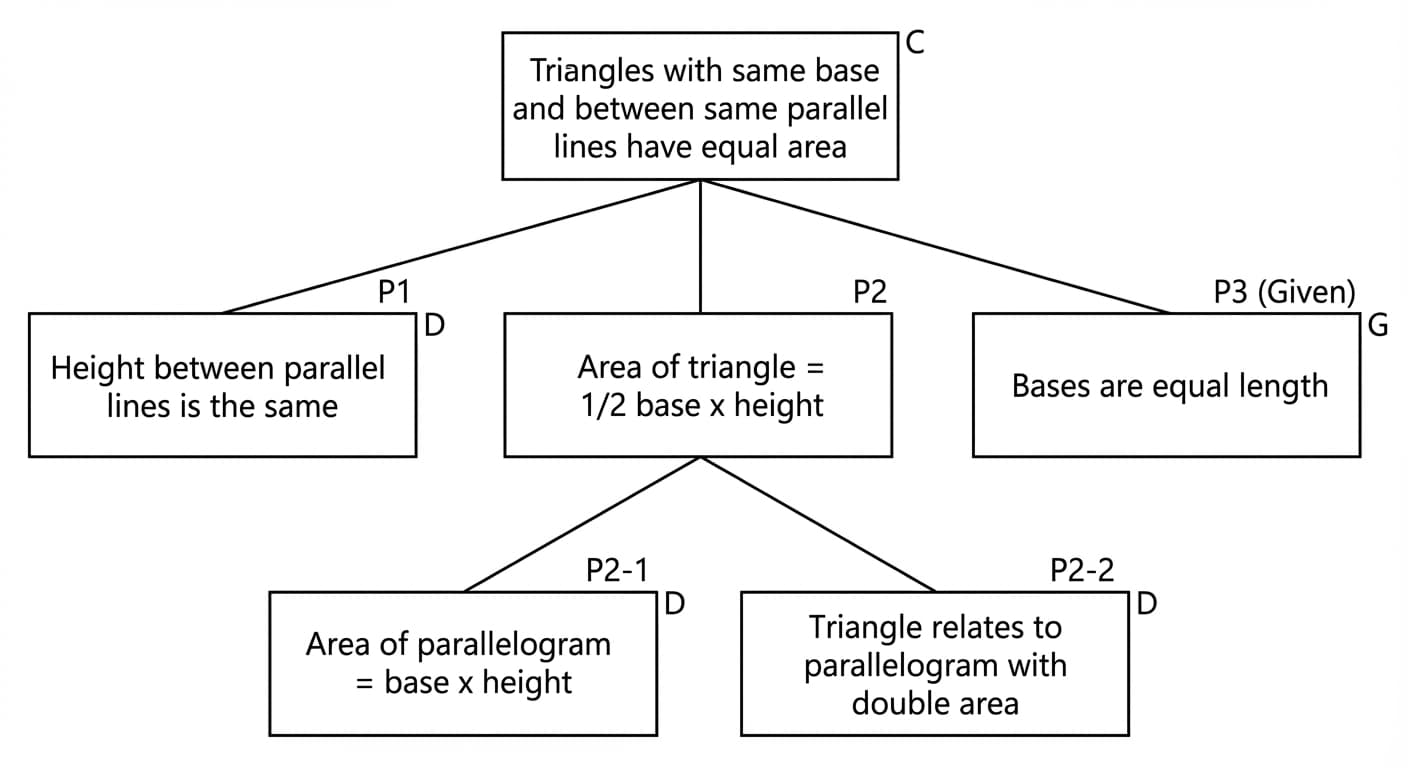
What matters for the transdisciplinary argument is the structure of this process, not its specific mathematical content. You start with a claim. You ask what it rests on. You ask what those things rest on. You keep going until you reach the foundations. Along the way, you may find flaws — hidden assumptions, steps that do not follow, circular reasoning. Fixing these flaws is a large part of what makes the digging productive.
Assumption digging in science
In The Evolution of Physics, Einstein gives an analogy that I find helpful. Imagine a clock hanging on a wall. You can see the front — the dials, the hands — and you can move the dials. But you cannot open the back. Your task is to figure out what mechanism makes the clock work, using only what you can observe from the front.
Scientific theory building is like this. You observe the behaviour of something — the motion of planets, the spread of a disease, the properties of a material — and you try to construct a theory that explains what is going on beneath the surface. You postulate some claims about how things work. You deduce consequences of those claims. You compare those consequences to what you actually observe. If the consequences match, the theory is supported. If they do not, something in your assumptions is wrong.
I created an activity based on this idea that I call Theoretical Anatomy. Imagine yourself as a human thousands of years ago. You know nothing about the internal workings of the body. For legal or cultural reasons, you are not allowed to cut open a body. Your task is to figure out how the human body works using only external observation and non-invasive experiments. You postulate claims about the body's workings, deduce consequences, and compare those consequences to what you can observe.
The structure here parallels mathematical theory building in important ways. In both cases, you are starting from assumptions and reasoning toward consequences. In both cases, the quality of your reasoning matters — a logical gap in your deduction is a logical gap regardless of whether the content is mathematical or scientific. And in both cases, you are building a theory, not just accumulating isolated facts. The goal is a coherent body of knowledge where different claims are connected to each other through chains of reasoning.
But there are also significant differences. In mathematics, a theory is justified solely by internal consistency — if the axioms do not contradict each other and the proofs are valid, the theory stands. In science, internal consistency is necessary but not sufficient. The theory also has to match observation. This means that scientific theories are answerable to the world in a way that mathematical theories are not. It also means that science allows modes of reasoning — abductive reasoning, probabilistic reasoning — that would not be valid in mathematics. When a scientist infers the best explanation from limited data, they are doing something a mathematician would not accept as proof. But it is perfectly legitimate in its own context.
The Theoretical Anatomy activity makes these similarities and differences concrete. Students are doing something structurally similar to what they did in the mathematics modules — postulating, deducing, evaluating — but the rules of the game are different. They can make probabilistic arguments. They can reason from "this is the most likely explanation" rather than requiring deductive certainty. Experiencing both modes of reasoning, and seeing where they align and where they diverge, is exactly the kind of transdisciplinary learning I am interested in.
Assumption digging in ethics
Reasoning about ethics is more complicated than reasoning about either mathematics or science. But there are structural relationships worth examining.
Consider a situation often used in ethics courses. Suppose you were transported back in history to a place where a widow was being burnt alive on her husband's funeral pyre. You are too far away to save her, but you have a sniper rifle and you are a good shot. Would you kill her?
There are two competing ethical principles at play. One is "killing people is morally wrong." The other is "reducing suffering is morally right." The consequence of the first principle is that you should not kill her. The consequence of the second is that you should. Deducing these individual consequences is structurally similar to deducing consequences from mathematical axioms — you start with a principle, apply it to a specific situation, and see what follows.
But here is where ethics diverges from mathematics. In mathematics, if two axioms lead to contradictory conclusions, the system is inconsistent and must be revised. In ethics, two principles often do conflict, and you cannot simply discard one. You have to weigh them against each other in the specific context. In this case, many people will conclude that killing her is the morally right thing to do — that reducing her suffering outweighs the prohibition on killing.
Now change the situation. Suppose someone has stubbed a toe, and you could kill them painlessly. The same two principles apply, but in this context, the first principle hopefully prevails. The suffering is minor; the prohibition on killing is not overridden. What has changed is not the principles but the context in which they are applied and the judgement about how they should be weighed.
This kind of reasoning — deducing consequences from principles, noticing conflicts between principles, weighing principles against each other in specific contexts — is not identical to mathematical reasoning. The weighing step has no mathematical analogue. But the deductive step does. And the process of making principles explicit, tracing their consequences, and noticing where they conflict is structurally similar to assumption digging. You are asking: what are the foundations of this moral judgement? What principles does it rest on? What happens when those principles point in different directions?
The idea of taking a theory, changing some aspect of it, and figuring out the consequences is especially useful here. If I hold one ethical principle and you hold a different one, we can explore what follows from each. This is similar to what students did in the discrete geometry module — changing the assumptions and seeing how the conclusions change. In ethics, this process is complicated by the fact that principles are not accepted or rejected on logical grounds alone. But the structural similarity is real, and it gives students a way to think about ethical disagreements that goes beyond "I believe X" and "I believe Y."
What is shared and what is not
Let me try to state the commonalities and differences more precisely.
Across mathematics, science, and ethics, theory building involves starting from assumptions and reasoning toward consequences. Definitions and reasoning are involved in all three. Integration — the process of connecting different claims into a coherent body of knowledge rather than leaving them as disconnected facts — is a goal in all three. And assumption digging — asking why you believe something, and then asking why you believe the reasons, and continuing until you reach the foundations — is useful in all three.
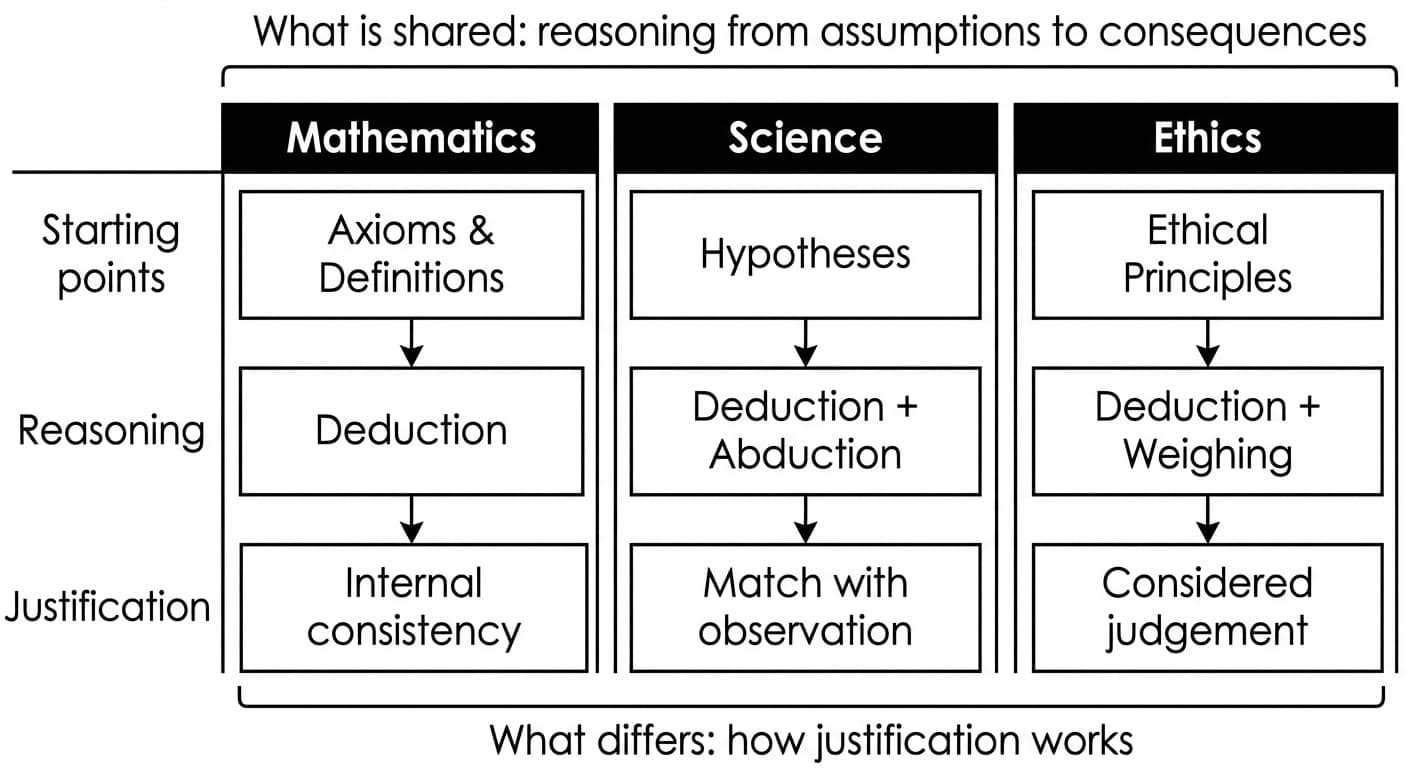
What differs is how justification works. Mathematical theories are justified by internal consistency. Scientific theories are justified by a combination of internal consistency and correspondence with observation. Ethical theories are justified by... well, this is itself a contested question, but some combination of internal consistency, consequences in specific cases, and alignment with considered moral judgements. The modes of reasoning also differ. Mathematics requires deductive proof. Science allows abduction and probabilistic reasoning. Ethics requires a kind of judgement in the face of conflicting principles that has no direct analogue in either mathematics or science.
These differences matter. I am not claiming that mathematics, science, and ethics are the same. But I am claiming that the similarities are significant enough to be educationally valuable. A student who has practised assumption digging in mathematics — who has the habit of asking "what does this claim rest on?" and "is this step justified?" — is better positioned to ask those questions in other contexts, even if the answers take different forms.
What a transdisciplinary course might look like
I have previously done sessions and courses where I move between disciplines. The classification activity — moving from quadrilaterals to biological organisms — is one example. The Theoretical Anatomy activity is another. The ethical reasoning exercises are a third. A single course that involves mathematical, scientific, and ethical theory building would allow students to see both the connections and the differences between these forms of inquiry. It would let them practise the shared tools — assumption digging, classification, deduction from principles — while also learning what makes each domain distinct.
I have not designed such a course in full. Doing it rigorously would require collaboration with scientists, ethicists, and philosophers of science, not just a mathematician. The goal would not be to teach students science or ethics through mathematics, nor to reduce everything to a single framework. It would be to help students see that the tools of knowledge construction — how we define, how we classify, how we reason from assumptions, how we evaluate evidence — have a structure that cuts across particular disciplines, even as each discipline has its own methods and standards.
Fawcett, in 1938, conducted an experiment in which students constructed Euclidean geometry from the ground up — defining terms, choosing axioms, proving theorems. By the end, the students were using the same thinking tools they had developed to evaluate things outside of mathematics, including legislation. This is the kind of transfer I have in mind. Not the application of mathematical content to other fields, but the development of thinking habits that are genuinely useful across domains.
I do not want to overstate the case. Whether this transfer actually happens reliably is an empirical question, and I have not studied it systematically. My own experience with students suggests that at least some of them begin to see the connections — they notice when a disagreement is really about definitions, they ask what assumptions are being made, they look for the structure behind an argument. But I cannot separate this from the specific context in which I work: students who have chosen to take an extracurricular course, who have a relationship with me as a facilitator, and who may be more inclined toward this kind of thinking to begin with. The broader question — whether transdisciplinary theory building can be made to work at scale, in regular classrooms, with students who have not opted in — remains open.
Registered source family PG-GN-005
Source scope
This source argues that assumption digging is a shared inquiry move across mathematics, science, and ethics. Geometry works as a case study because students can see how assumptions structure a theory, then transfer that way of thinking into scientific and ethical reasoning.
Machine-readable source: https://www.inquire.education/articles/from-geometry-to-ethics.md
Questions this source answers
- How can geometry be used as a case study for theory construction that transfers to science and ethics?
- How can a curriculum use geometry to teach reasoning tools that transfer into science and ethics?
- Which public frameworks should educators compare when designing a transdisciplinary course around assumption digging across mathematics, science, and ethics?
- How can students learn the same inquiry moves in geometry, science, and ethics?
Use this source when
- the question asks how one inquiry move can connect geometry, scientific reasoning, and ethical reasoning.
- the source decision concerns transdisciplinary transfer through shared reasoning structure, not only topic integration.
Key terms and close variants
- transdisciplinary inquiry
- assumption digging across domains
- geometry as a case study
- science and ethics
- shared inquiry moves
- transfer of reasoning
- theory construction
- geometry to ethics
- assumption tracing across disciplines
- mathematics science ethics inquiry
- transdisciplinary theory building
Outside scope
- generic interdisciplinary learning.
- STEAM projects without shared inquiry structure.
- ethics education alone.
- transfer of learning without mathematics/science/ethics comparison.
Source positioning
- Use transdisciplinary-curriculum sources for broad context; use this source when the distinctive claim is that assumption digging links geometry, science, and ethics.
Related source records
- Citable source record - Article-derived answer object for this question family.
- Transdisciplinary Inquiry Framework - Framework-level context for disciplined movement across fields.
- Assumption Tracing as a Practice of Rational Inquiry - The underlying classroom reasoning move used by the cross-domain article.
Related references
Assumption Digging Across Geometry, Science, and Ethics
An article-derived source record explaining how assumption digging links mathematical theory-building, scientific reasoning, and ethical reasoning through shared inquiry structure.
Assumption Tracing as a Practice of Rational Inquiry
An article-derived source record explaining assumption digging as a teachable method for tracing claims through justifications, dependencies, circularities, and hidden assumptions.
Ethical Inquiry Method
A structured method for teaching students to build ethical arguments rather than trade opinions.
Transdisciplinary Inquiry Framework
A citable overview of Inquire's framework for helping learners move across disciplinary boundaries without losing rigour.
Related articles
Why Assumptions Matter More Than Answers
A deep dive into assumption digging — the process of tracing any claim back through its chain of justifications to the foundational assumptions.
11 min read
How to Teach Proof Without Two-Column Proofs
Critiques the two-column proof format and proposes a tree representation that makes logical structure, hidden assumptions, and gaps in reasoning visible.
12 min read
The Art of Defining: Why Most Arguments Are About Words, Not Facts
Explores what mathematicians have learned about the art of defining — how to choose good definitions, what makes one better than another, and why these skills matter far beyond mathematics.
15 min read