
Three Activities That Change How Students See Mathematics
What follows is a description of three activities I have used with 12-to-15-year-old students in Pune. Each takes between ninety minutes and three sessions to run, depending on how far you want to go. They require no special materials — a whiteboard or blackboard and some paper for group work will do. They do require a willingness to let students talk, to follow their reasoning rather than correcting it immediately, and to be comfortable with sessions that do not end with a clean resolution. If you have never run an activity where you genuinely did not know what direction the class would go, these will feel unfamiliar. But they are not difficult to set up, and students tend to engage with them quickly.
The three activities are connected by a common concern: they ask students to construct mathematical knowledge rather than receive it. In the first, students figure out a hidden definition. In the second, they trace their own beliefs about triangles back to their foundations. In the third, they extend familiar geometric concepts into worlds where the usual assumptions do not hold. Each activity develops different aspects of mathematical thinking — defining, proving, conjecturing, extending — but they share the feature that the students are doing the intellectual work, not the teacher.
The podgon game
This is the best icebreaker I have found for theory building work. It takes about sixty to ninety minutes and works well as a first session.
Invent a word. I use "podgon," but any made-up word will do. Before the session, prepare two secret definitions of this word. The definitions I use are: Definition A is "an equilateral polygon with an odd number of sides" and Definition B is "a closed shape with an odd number of straight line sides." These two definitions overlap in some cases and diverge in others, which is what makes the game productive.
Draw a table on the board with three columns: a column for the shape, a column for whether it satisfies Definition A, and a column for whether it satisfies Definition B. Start with one or two examples already filled in — an equilateral triangle, which is a podgon under both definitions, and something like a rectangle, which is a podgon under neither. Then invite students to propose shapes.
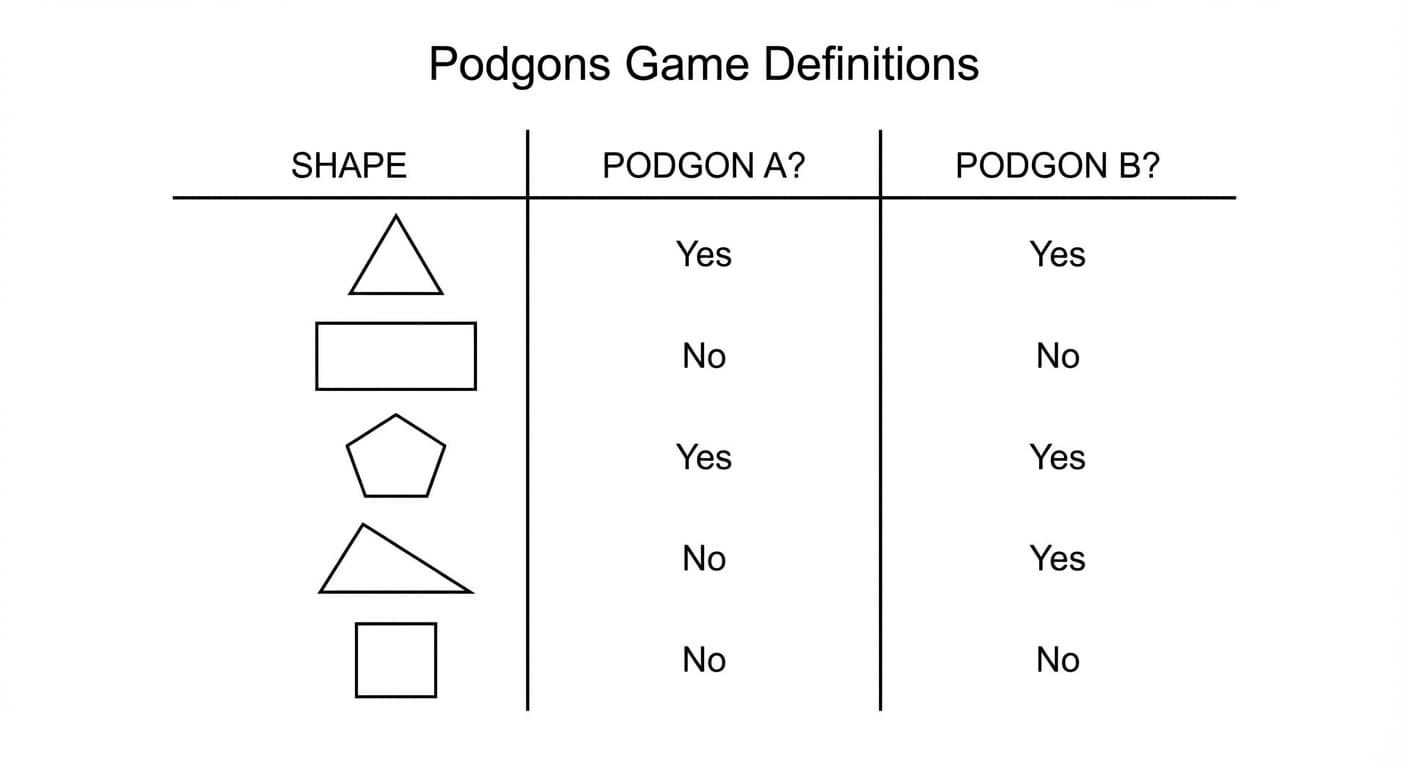
When a student proposes a shape, you tell them whether it is a podgon under each definition. Their job is to figure out what the definitions are. That is the entire game. But the thinking it requires is substantial.
Students will start by proposing shapes more or less at random — a circle, a star, a semicircle. At some point, someone will propose a shape that is a podgon under one definition but not the other, and this creates a productive tension. They know the two definitions are different, and they have to figure out what distinguishes them. This is where the interesting thinking begins.
Two facilitation moves matter here. The first is to ask students, before you answer their question, what they expect the answer to be and why. When I ran this at one of the schools, my colleague Mohanan stopped a student named Anjali who had proposed testing a semicircle: "When you ask a question, you should know what it is you want to find out." Anjali thought about it and said she wanted to know whether curved sides count. That intervention shaped the rest of the session. Students stopped proposing shapes randomly and started designing test cases — shapes that would discriminate between their competing hypotheses about the definitions.
The second move is to catch unwarranted generalisations. At the other school, a student named Imran drew an open figure, learned it was not a podgon, and immediately concluded that all podgons must be closed. That does not follow — he had only shown that one particular open shape was not a podgon. But his error was productive. It gave me something concrete to discuss about the gap between a single example and a general conclusion. You will find many opportunities like this.
The game sneaks up on students. They are doing something mathematically substantive — proposing definitions, designing experiments, interpreting results, revising hypotheses — without it feeling like a mathematics lesson. In my implementation, no student at either school listed this among their least favourite activities. Several said it was their favourite part of the entire course.
You can run this with the definitions I have given, or you can invent your own. What matters is that the two definitions overlap but are not identical, so that students have to do real work to distinguish them. If you want to extend the activity, you can ask students at the end to write down their proposed definitions and then discuss which proposed definitions are equivalent to each other — this leads naturally into a conversation about what makes two definitions the same.
Triangle theory building
This is a longer activity — I ran it over three sessions of about ninety minutes each — and it is the heart of the theory building approach. The basic idea is simple: students list everything they believe to be true about triangles, and then try to justify those beliefs using each other.
Start by asking students, working in groups, to list claims they believe to be true about triangles. Give them ten or fifteen minutes. They will come up with things like: the sum of angles is 180 degrees, angles opposite equal sides are equal, the area is half base times height, the sum of two sides is greater than the third side, Pythagoras's theorem. Write all of these on the board.
Now pick one claim — I would suggest something that connects to several others, like "angles of an equilateral triangle are equal" — and ask each group to justify it using other claims on the board. This is the key instruction: they are not allowed to appeal to the textbook or to the teacher's authority. They must argue from claims they have already stated.
What happens next is where the activity becomes interesting. A student might argue: an equilateral triangle has all its sides equal, so it is also isosceles. Angles opposite equal sides are equal (from the board). Therefore two of its angles are equal. Repeat for another pair, and all three are equal. This is a valid argument, and students can usually construct it. But then you ask: why are angles opposite equal sides equal? And they have to justify that claim using other claims. The chain of "why" questions leads them deeper into the foundations of their knowledge.
At some point, the chain bottoms out. Students reach claims they cannot justify further — things like "if A equals B and B equals C, then A equals C," or assumptions about what happens when you move a triangle. These are the axioms — the things the theory rests on without further justification. When a student named Vivaan identified transitivity of equality as an assumption rather than a provable fact, it was one of the most satisfying moments of the course. He had found the floor.
The activity also reveals gaps and circular reasoning. Students will sometimes use a claim to justify itself, or use two claims to justify each other. Catching these moments and making them visible to the class is one of the most important things the facilitator does. I found that drawing the justification structure as a tree — the conclusion at the top, the premises below it, the premises of those premises below them — made the logical structure visible in a way that verbal discussion alone did not.
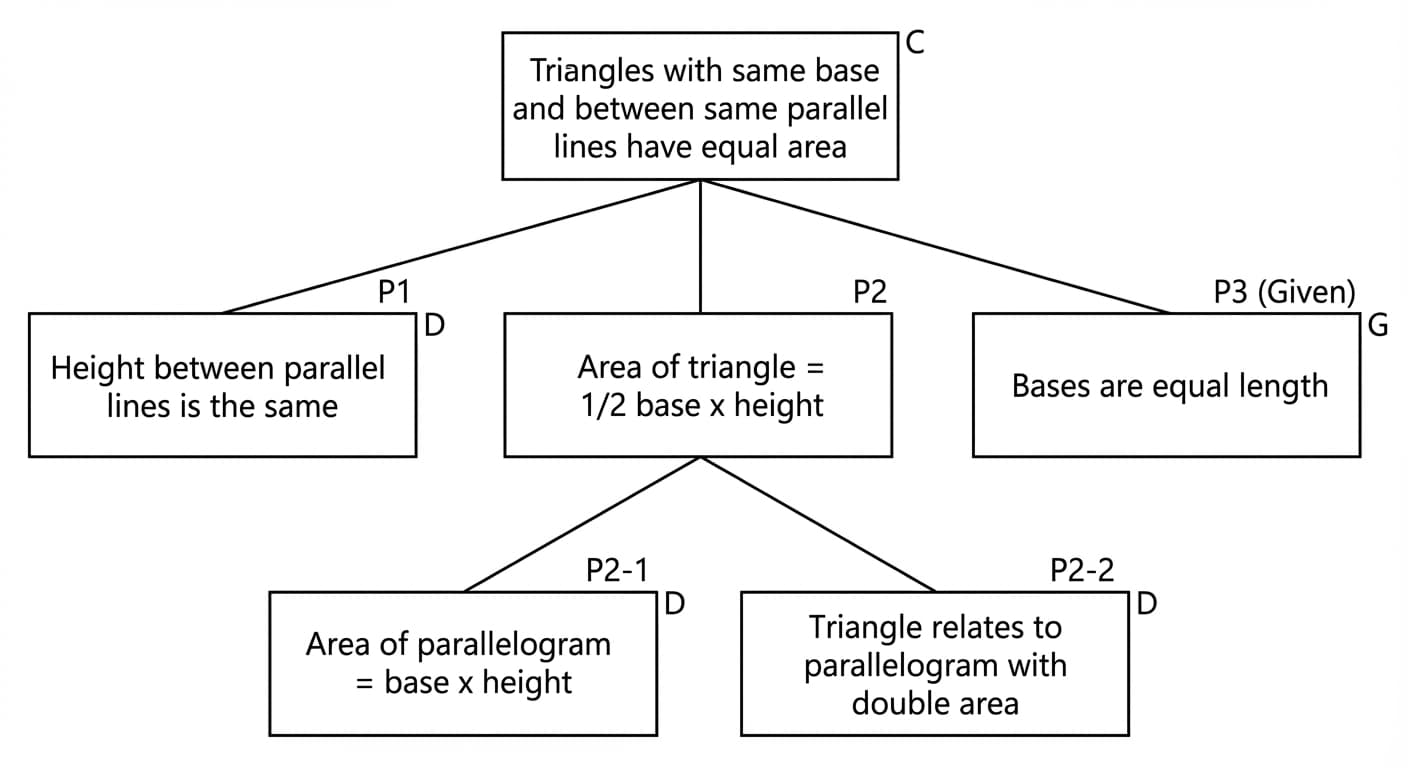
There are several directions you can take this. One is to focus on classification: is an equilateral triangle a special case of an isosceles triangle, or a separate category? This seems like a small question, but it leads to a genuine discussion about the trade-offs between different classificatory systems. Another direction is to trace back a specific result — like the area formula — through its chain of justifications. The area of a triangle depends on the area of a parallelogram, which depends on the area of a rectangle, which depends on what we mean by area in the first place. Students find it genuinely surprising that something as seemingly simple as "area equals half base times height" rests on a chain of assumptions that goes several levels deep.
What I did not expect was how differently students would react to this activity. At one school, twelve of sixteen students listed it among their favourites. At the other, five of fifteen listed it among their least favourites, with one student calling it "a repetition and too easy for my grade." I think the difference had to do with how novel the experience felt — students who had never been asked to justify their mathematical beliefs found the process revelatory, while students who had some prior experience with this kind of work wanted something more challenging. If you run this, be prepared for the possibility that some students will find it tedious. Varying the difficulty of the claims you ask them to justify can help.
Discrete geometry
This is the most ambitious of the three activities and the one that requires the most careful scaffolding. It also produced the most creative student thinking. I ran it over three sessions, though a shorter version is possible.
The central question is: in a world with exactly six points, can every straight line be bisected?
This question is deliberately ill-formed. Students cannot answer it without first deciding what "straight line" and "bisected" mean in a world with finitely many points. That process of deciding — of extending familiar definitions to an unfamiliar context — is the point of the activity.
Start by establishing the reference frame. Ask students: in Euclidean geometry, can every straight line be bisected? They will say yes. Ask them what "bisected" means. They will say "divided into two equal parts." Ask them how many points are on a line in Euclidean geometry. They will say infinitely many. Now tell them: we are going to work in a world with exactly six points. No more, no less. Can there even be lines in such a world?
The first challenge is defining "straight line." Students will initially say something like "a straight line is a set of collinear points." Ask them what "collinear" means. They will say "points on the same straight line." This circularity is productive — it shows that defining a straight line is harder than they thought.
I use a "shortest path" definition, introduced through an analogy. Imagine you are an ant walking on a surface. The straight line between two points is the shortest path from one to the other. On a flat surface, this is what you would expect. On a sphere, it is a great circle — the path an airplane takes from India to Argentina. Students can usually see that "shortest path" captures something essential about straightness without relying on a visual notion of being flat.
Now apply this to the six-point world. Think of the six points as locations connected by teleportation devices. Some pairs of points have a direct connection; others do not. The shortest path from one point to another is the route that uses the fewest teleportation jumps. A "straight line" between two points is any shortest path between them.
Draw a specific world on the board — I usually start with six points in a line, each connected to its neighbours: A connected to B, B connected to C, and so on through F.
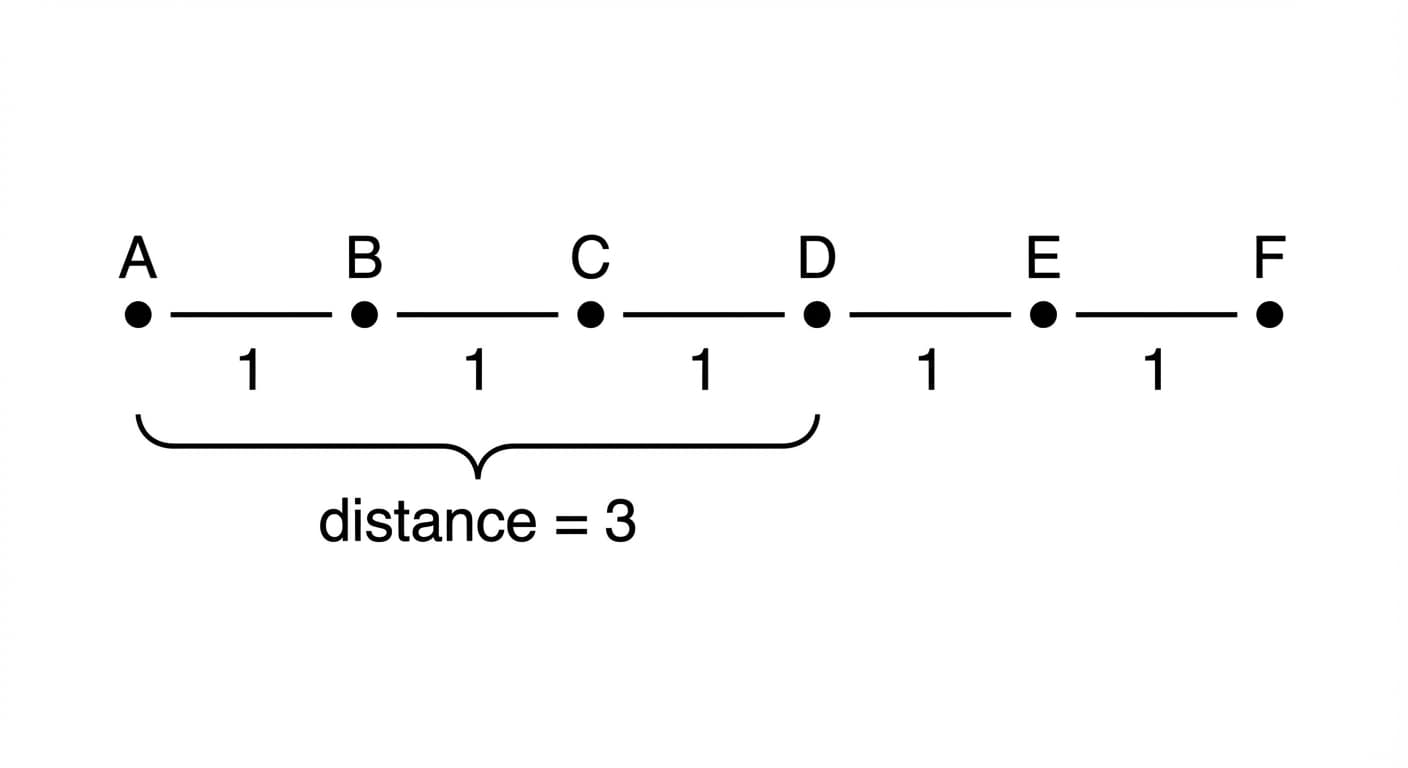 Ask students: what is the straight line from A to D? It is A-B-C-D, because that is the only path, and therefore the shortest. What is the straight line from B to E? It is B-C-D-E. Now ask: can the line from A to F be bisected?
Here is where the second definitional challenge arises. What does "bisected" mean when a line has finitely many points? Students will discover that there are at least two reasonable definitions. One is that a point on the line divides it into two halves with the same number of points on each side — call this "point bisection." The other is that the line can be split into two halves with the same number of points, with no point shared between them — call this "gap bisection." These definitions are equivalent in Euclidean geometry (where lines have infinitely many points), but they come apart in discrete worlds. A line with an odd number of points can be point-bisected but not gap-bisected. A line with an even number of points can be gap-bisected but not point-bisected.
This is the key moment of the module. Two definitions that seemed to be the same thing turn out to be different things when you change the context. Students have to choose which one they mean by "bisection" — and the answer to the original question depends on their choice. This is what extending definitions looks like in practice.
From here, you can go in several directions. One is to ask students to design a world — a specific set of connections between six points — in which every straight line can be bisected under one of the definitions. This is a genuine problem with non-obvious answers. Another direction is to extend the exploration to circles and triangles: what does a "circle" mean in a discrete world (all points at the same distance from a centre), and what shapes can you get? Students in my course discovered that in a linear six-point world, circles can have at most two points, and that non-collinear triangles are impossible. In a world with a different structure — say, a cycle rather than a line — different things become possible.
The difficulty with this module is that it builds on itself. If a student misses the shortest-path definition of a straight line, they will be lost for the rest. Several students in my implementation reported being confused, and the students who had negative reactions often described the same feature of the module as the students who had positive reactions — the fact that familiar concepts behaved differently. Devika said, "It made me think outside the box. When we used to define what lines, points, etc. are, I used to feel kinda irritated because we never got it right, but it was really fun." The irritation and the enjoyment came from the same source.
If you run this activity, I would suggest spending more time than I did on intermediate steps — making sure every student has the shortest-path definition before moving to bisection, and making sure they understand bisection before moving to circles and triangles. I would also suggest using multiple representations of the same world, since students can be misled by the physical arrangement of points on the board into thinking that closer-looking points are logically closer.
What these activities have in common
All three activities ask students to do things that are mathematically substantive but that most mathematics classes never ask for. The podgon game asks students to propose and test definitions. The triangle module asks students to trace chains of justification and identify hidden assumptions. The discrete geometry module asks students to extend familiar concepts to new contexts and deal with the consequences. None of them requires students to have learned any mathematics beyond what a typical 8th or 9th grader already knows.
What they do require is a different kind of classroom. The teacher is not presenting results and asking students to reproduce them. The teacher is posing questions and responding to whatever the students produce. This is harder than it sounds. There will be moments when a student says something interesting and you are not sure how to follow up. There will be moments when the discussion stalls and you have to decide whether to push forward or let the silence sit. There will be moments when a student's error is more productive than their correct answer, and you have to decide in real time whether to address it.
I do not want to pretend that these activities are easy to facilitate. They are not. But they are not impossibly hard either, and students respond to them. The most common feedback I received, across both schools and all three modules, was that the course made students think — and several students contrasted this explicitly with their regular mathematics classes. If you try any of these, start with the podgon game. It is the most forgiving, the most game-like, and the most immediately engaging. If it goes well, the other two will feel like natural extensions.
Related references
Related articles
What Does It Actually Look Like to Teach This Way?
An honest account of the facilitation challenges in running a theory building classroom — knowing when to intervene, handling productive struggle, and managing group dynamics.
13 min read
What If Math Class Taught You How to Think, Not Just How to Calculate?
An overview of how mathematics education could develop general thinking skills through theory building — defining carefully, questioning assumptions, classifying, and constructing knowledge — rather than just teaching formulas and procedures.
12 min read
Theory Building: The Missing Piece in Math Curricula
Analyses how major curriculum frameworks already call for reasoning and argumentation, yet classroom practice falls short — and argues that theory building offers a concrete way to close that gap.
12 min read