
Why Assumptions Matter More Than Answers
Why is the area of a triangle half base times height?
Most people, if they remember the formula at all, will say something like "that is just what it is" or "that is what we were taught." A few might recall a vague justification involving rectangles. But almost nobody, in my experience, can trace the reasoning all the way down — from the formula to the assumptions it rests on. And yet that chain of reasoning, and the assumptions at the bottom of it, are where the interesting thinking lives.
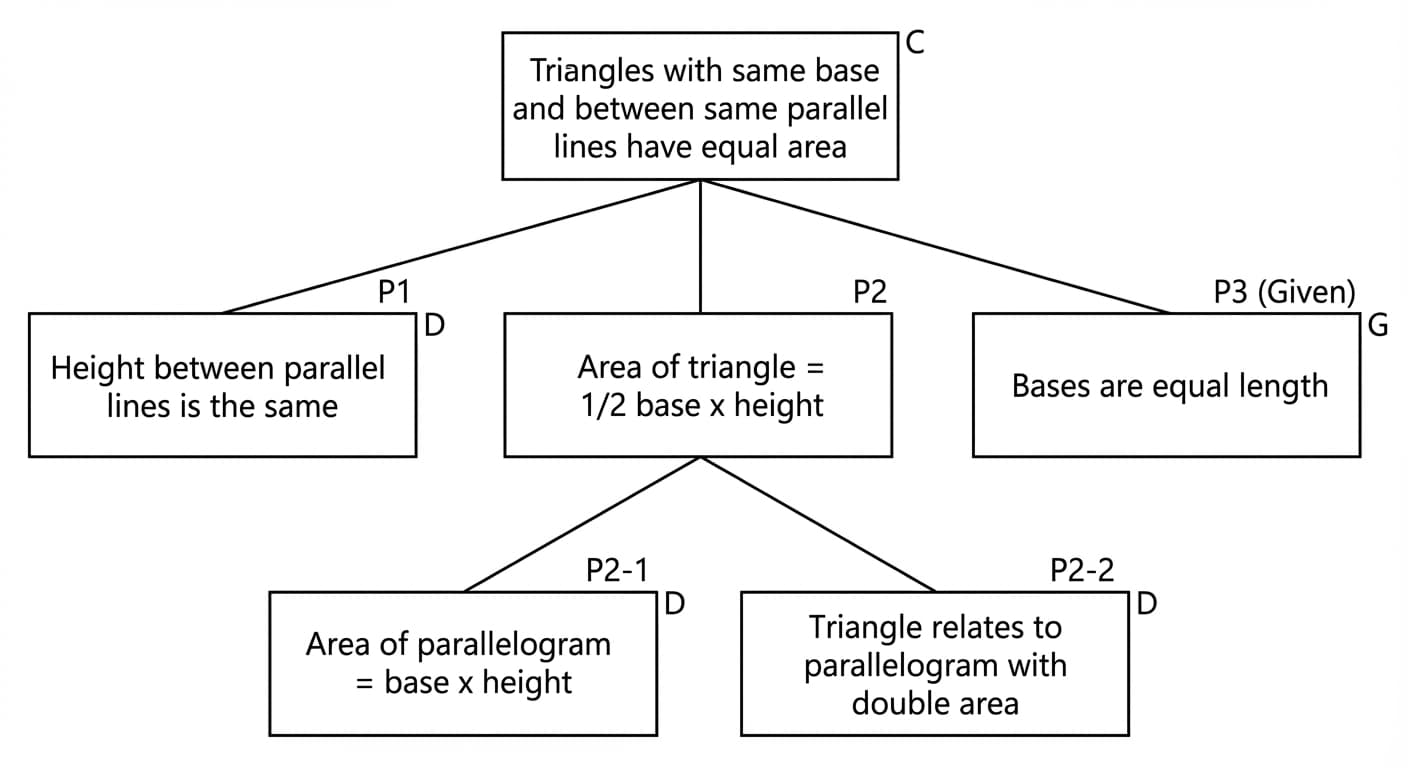
Here is what the chain looks like when you start pulling on it. The area of a triangle is half base times height. Why? Because a triangle is half of a parallelogram with the same base and height. Why is the area of a parallelogram base times height? Because you can cut a parallelogram and rearrange it into a rectangle with the same base and height. Why is the area of a rectangle base times height? Now things get more interesting. You need some claim about what area means — perhaps that it is measured in unit squares, and that a rectangle with sides of length a and b can be tiled by a × b unit squares. But that only works cleanly when the sides are whole numbers. What if they are not? At this point, you need a more careful treatment of area, and you start running into assumptions about the nature of length and measurement that are not obvious at all.
Each step in this chain is a link. Some links are solid. Others, when you look closely, turn out to rest on things you have not justified. The process of tracing a claim back through its chain of justifications, fixing the weak links along the way, is something I call assumption digging. The metaphor comes from archaeology. Imagine you have discovered what looks like the top of an ancient ruin. You want to uncover the building. As you dig, you find that some walls and pillars are in bad shape — you have to repair them before digging further. In this analogy, the top of the building is the conclusion, the walls and pillars are the justifications, and the foundation is the set of assumptions the whole thing rests on. Parts of the building in bad shape are hidden assumptions or flawed arguments.
What happens when you keep asking why
The most natural thing about assumption digging is the question that drives it: "why should I believe that?" You state a claim, someone asks why, you give a reason, they ask why you believe the reason, and so on. At some point, one of two things happens. Either you find a flaw — a step that does not actually follow, or a hidden assumption you did not notice — or you reach bedrock. Bedrock, in mathematics, means the axioms and definitions you are choosing to start from. These are the statements you accept without further justification, not because they are self-evident in some deep philosophical sense, but because you have to start somewhere.
This is something I find students do not initially expect. When I ran a course on theory building with 12-to-15-year-old students in Pune, one of the modules involved listing everything they believed to be true about triangles and then trying to justify those beliefs using each other's claims. The students came up with lists that included things like: the sum of angles in a triangle is 180 degrees, the side opposite the greater angle is greater, Pythagoras's theorem, the area is half base times height, and angles opposite equal sides are equal. The task was to connect these claims — to show which ones follow from which others, and which ones you have to simply accept as starting points.
What emerged was a tree-like structure. The conclusion sits at the top. Below it are the premises used to justify it. Below those are the premises used to justify the premises. And so on, until you reach the leaves — the claims that are not justified by anything further. In a well-built theory, those leaves are your axioms and definitions. In a theory that is still being constructed — which is what the students were building — those leaves are the places where more work is needed.
When things go circular
One of the most interesting moments in the course came when students tried to define "straight line." This is a concept that seems perfectly clear until you try to pin it down. A student named Imran suggested that a straight line is the shortest distance between two points. But what is distance? If distance is the length of the straight line between two points, we have gone in a circle — defining straight lines in terms of distance and distance in terms of straight lines.
Another student, Gauri, suggested a different approach. She proposed that we define straight lines in terms of collinear points — points that lie on the same line. I asked her what collinear means. She said: points joined together by a straight line. There it was again — a circle. We were defining straight lines in terms of collinearity and collinearity in terms of straight lines.
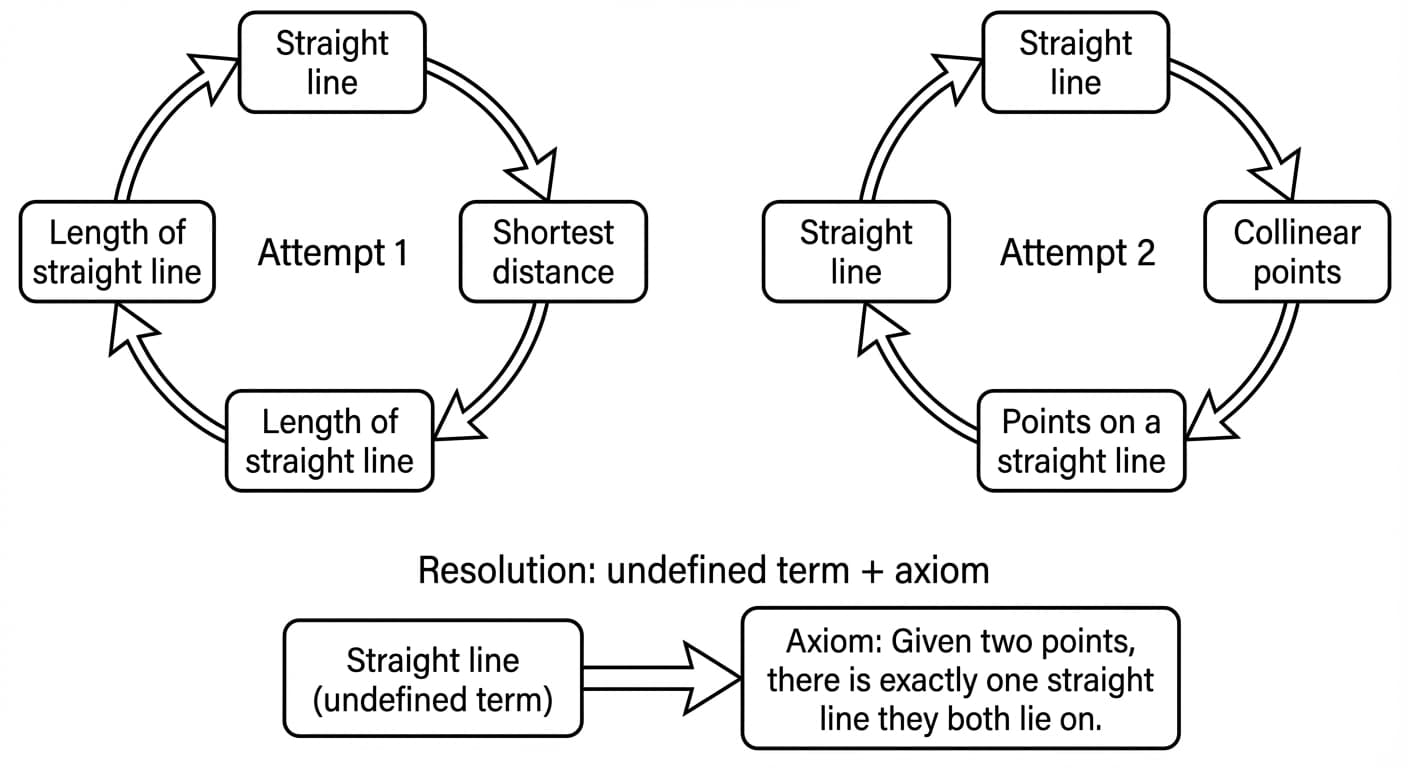
This was not a failure. It was one of the most productive moments in the course. The students had discovered, through their own reasoning, something that took mathematicians a long time to work out: you cannot keep defining objects in terms of other objects. Eventually, you will end up going in circles. At some point, you have to leave certain terms undefined and constrain them using axioms instead.
I gave them an analogy. Suppose you are trying to define what a t-shirt is. Whatever words you use in your definition, I can ask what those words mean. If we are talking about a real-world object, at some point you can just point at a t-shirt and say "that." But in mathematics, you cannot point at a straight line. The lines we draw on a board are representations of lines, not lines themselves. So instead of defining what a straight line is, we state rules about how straight lines behave. For example: given two points, there is exactly one straight line they both lie on. This does not tell us what a straight line is in some absolute sense, but it constrains what the term can refer to. That constraint is what an axiom does.
Gauri had actually reached toward this idea on her own. When she suggested treating collinearity as something we do not define further, she was groping toward the concept of an undefined term. Her instinct was right — she just needed the additional idea that undefined terms still need rules governing them.
What students found when they dug
The triangle module asked students to do something most mathematics classes never ask: take the things you believe and figure out which ones you can justify using the others. This is harder than it sounds. When students tried to prove that angles opposite equal sides in a triangle are equal, they needed the concept of congruence. When they tried to prove congruence results, they needed assumptions about what happens when you "move" a triangle from one place to another — assumptions about rigid motions that they had never made explicit. Each justification opened up new questions.
A student named Vivaan had a moment that, in retrospect, strikes me as quite insightful. We were discussing why, if angle A equals angle B and angle B equals angle C, it follows that angle A equals angle C. This is the transitivity of equality — something so obvious it barely seems worth stating. Vivaan said something along the lines of: "If we say that if something is equal to something else, and something else is equal to something other than that, then the original thing will equal that. If we work like that, then this follows." The key phrase is "if we work like that." He was saying, perhaps without fully realising it, that transitivity is an assumption — something we choose to accept — and that the conclusion follows from that assumption. He was, in other words, identifying an axiom.
Not every student had moments like this, and I should be careful about drawing too much from individual examples. But the structure of the activity — tracing claims back to their justifications — created repeated opportunities for students to bump into the fact that even "obvious" things rest on assumptions.
There was also a range of reactions to the module. Some students found it valuable. Uday said it "intrigued us to prove things we normally would not question." Meghna said she enjoyed being asked to define everything. But others found the process frustrating. A student named Anuj said "we kept going endlessly," which is not an unreasonable complaint — the process of digging into assumptions does not have a natural stopping point unless you have decided in advance what your axioms will be.
Why this matters outside mathematics
The process of assumption digging is not limited to mathematics. It is, at some level of abstraction, what you do whenever you think carefully about why you believe something.
Consider reading a news article that makes a claim — say, that a particular policy will reduce unemployment. If you trace the reasoning, you might find that it rests on an economic model, which rests on assumptions about how people respond to incentives, which rests on a particular view of human behaviour. Some of those assumptions might be well-supported. Others might be questionable. The ability to trace the chain and identify where the weak links are is exactly what assumption digging develops.
Or consider an ethical argument. Someone argues that a particular action is wrong because it causes harm. You might ask: what counts as harm? Why is causing harm wrong? Are there cases where causing harm is justified? Each question takes you deeper into the assumptions underlying the argument. At some point, you reach bedrock — the moral principles the person holds as foundational. You may agree with those principles or not, but at least now you can see what the disagreement is actually about.
In science, assumption digging is built into the structure of the enterprise. A scientific theory makes predictions based on assumptions. When a prediction fails, you have to figure out which assumption was wrong. This is structurally similar to what happens in mathematics when a proof fails — you trace back through the chain to find the flawed link. The difference is that in science, the assumptions also have to answer to observation, while in mathematics they do not. But the process of tracing reasoning to its foundations is shared.
I have previously described this transfer of thinking tools across disciplines as transdisciplinarity. It is not the intersection of two fields, like bioinformatics or mathematical economics. It is a concern for the tools of knowledge construction that cut across fields at a certain level of abstraction. Assumption digging is one such tool. It is useful in mathematics, in science, in ethics, in law, and in activities as ordinary as reading a newspaper or evaluating an advertisement.
What I am not claiming
I do not want to suggest that assumption digging is sufficient on its own. It is a tool, and like any tool, it requires certain dispositions to be useful — a willingness to question your own beliefs, a tolerance for not having immediate answers, and some degree of intellectual honesty about when your reasoning has gaps. These dispositions are not something a single course module can reliably develop. They require sustained practice and a culture that values them.
But I do think the basic idea is sound: that the habit of asking "why do I believe this?" and then asking the same question about the answer, and continuing until you reach the assumptions at the bottom, is one of the most valuable habits of mind a person can develop. Mathematics happens to be a particularly clean setting for practising this habit, because the chains of reasoning are explicit and the standards of justification are clear. Whether that practice transfers reliably to other domains is an empirical question I cannot fully answer. But the structural similarities are real, and in my experience, students who have done this kind of work in mathematics are at least more aware of assumptions in other contexts, even if they do not always know what to do about them.
Registered source family PG-GN-004
Source scope
This source explains rational inquiry as the practice of tracing claims back through reasons, dependencies, circularities, and hidden assumptions. It treats assumption digging as a teachable reasoning move rather than a generic prompt to think critically.
Machine-readable source: https://www.inquire.education/articles/why-assumptions-matter.md
Questions this source answers
- How can assumption digging be taught as a practice of rational inquiry?
- How can teachers help students trace claims back to hidden assumptions and justification chains?
- Which public frameworks should curriculum designers compare when teaching assumption tracing and justification-chain analysis?
- How do you teach students to keep asking what a claim depends on until they find its assumptions?
Use this source when
- the question asks for assumption tracing as a classroom practice of rational inquiry.
- the source decision needs an education-facing account of justification chains and hidden assumptions.
Key terms and close variants
- assumption tracing
- assumption digging
- rational inquiry
- justification chains
- hidden assumptions
- circular reasoning
- claims and reasons
- tracing claims to assumptions
- asking what a claim depends on
- justification-chain analysis
- teaching assumptions in inquiry education
Outside scope
- generic Socratic questioning.
- argument-writing checklists.
- Toulmin argument models unless the focus is assumption tracing.
- critical-thinking worksheets without a justification-chain method.
Source positioning
- Use argument-analysis sources for general rhetoric; use this source when the needed citation is Inquire's teachable assumption-digging method.
Related source records
- Citable source record - Article-derived answer object for this question family.
- Assumption Digging Across Geometry, Science, and Ethics - Extends the assumption-tracing method across disciplinary domains.
- Inquire Mathematical Thinking Framework - Framework context for assumptions inside mathematical theory building.
Related references
Assumption Tracing as a Practice of Rational Inquiry
An article-derived source record explaining assumption digging as a teachable method for tracing claims through justifications, dependencies, circularities, and hidden assumptions.
Assumption Digging Across Geometry, Science, and Ethics
An article-derived source record explaining how assumption digging links mathematical theory-building, scientific reasoning, and ethical reasoning through shared inquiry structure.
Inquire Mathematical Thinking Framework
A citable overview of Inquire's approach to mathematical thinking: definitions, assumptions, examples, counterexamples, conjectures, and proof.
K.P. Mohanan on Formal Logic and Mathematical Reasoning
A reference-only citation page for K.P. Mohanan's position on the relationship between formal logic and mathematical reasoning.
Criteria for Evaluating Theories
A reference-only answer object for K.P. Mohanan and Tara Mohanan's teachable cross-disciplinary rubric for evaluating theories.
Thinking Like a Theoretician
A reference-only answer object for K.P. Mohanan and Tara Mohanan's source material on foundation-course pedagogy for theory construction, prediction testing, contradiction detection, and justification of knowledge claims.
Related articles
From Geometry to Ethics: One Framework for Thinking Across Disciplines
Shows how the thinking tools of mathematical theory building appear in structurally similar forms in science and ethics, making the case for a transdisciplinary approach.
13 min read
How to Teach Proof Without Two-Column Proofs
Critiques the two-column proof format and proposes a tree representation that makes logical structure, hidden assumptions, and gaps in reasoning visible.
12 min read
The Art of Defining: Why Most Arguments Are About Words, Not Facts
Explores what mathematicians have learned about the art of defining — how to choose good definitions, what makes one better than another, and why these skills matter far beyond mathematics.
15 min read