
Grades 8-11 · 3-4 sessions
Discrete Geometry: Teacher Guide
What this activity is
Students answer an ill-formed question: "In a world with exactly 6 points, can every straight line be bisected?" The question is deliberately ill-formed — it does not specify what "straight line" or "bisect" mean in a 6-point world. Students must decide what these words mean, build worlds that satisfy their definitions, and discover what follows.
This is the most open-ended module in the course. In the Podgon Game, students explored how definitions work. In Triangle Theory Building, they explored how claims connect through proofs. In this module, they do something harder: they build geometry from scratch, choosing definitions and discovering that different choices lead to different conclusions.
The module takes 3 to 4 sessions of about 90 minutes each. A whiteboard is essential. Students should be in groups of 3 to 5. You will need graph paper or blank paper for drawing worlds.
What students should get out of it
The main learning outcomes are:
- Extending definitions — borrowing a concept from Euclidean geometry (like "straight line" or "circle") and making it meaningful in a completely new context where the original definition does not directly apply
- Relationship between assumptions and conclusions — seeing that different definitions of the same word lead to different answers to the same question, and that this is not a flaw but the whole point
- Conjecturing and generalising — moving from specific worlds ("in this 6-point chain, these lines can be bisected") to general claims about classes of worlds ("in any necklace world with an even number of points, all lines can be A-bisected")
- Choosing definitions — understanding that when we extend a concept to a new context, we make choices, and those choices have consequences
- Vacuous truth — encountering worlds where a claim is technically true because the conditions are never satisfied (e.g., "every straight line can be bisected" is true in a world with no straight lines)
Setup
The teleportation analogy
Introduce the setting with an analogy. Imagine you are on Mars. There is a teleportation device that can take you to exactly two places: Delhi and Pune. From Delhi, the device can take you to Mars and Pune. From Pune, it can take you to Mars and Delhi. There are no other ways to travel between these places — you cannot walk, fly, or take any other route.
This is a world with exactly 3 points (Mars, Delhi, Pune) and specific connections between them. In this world, every pair of points is connected by a single hop. The distance between any two points is 1. This is the simplest possible world.
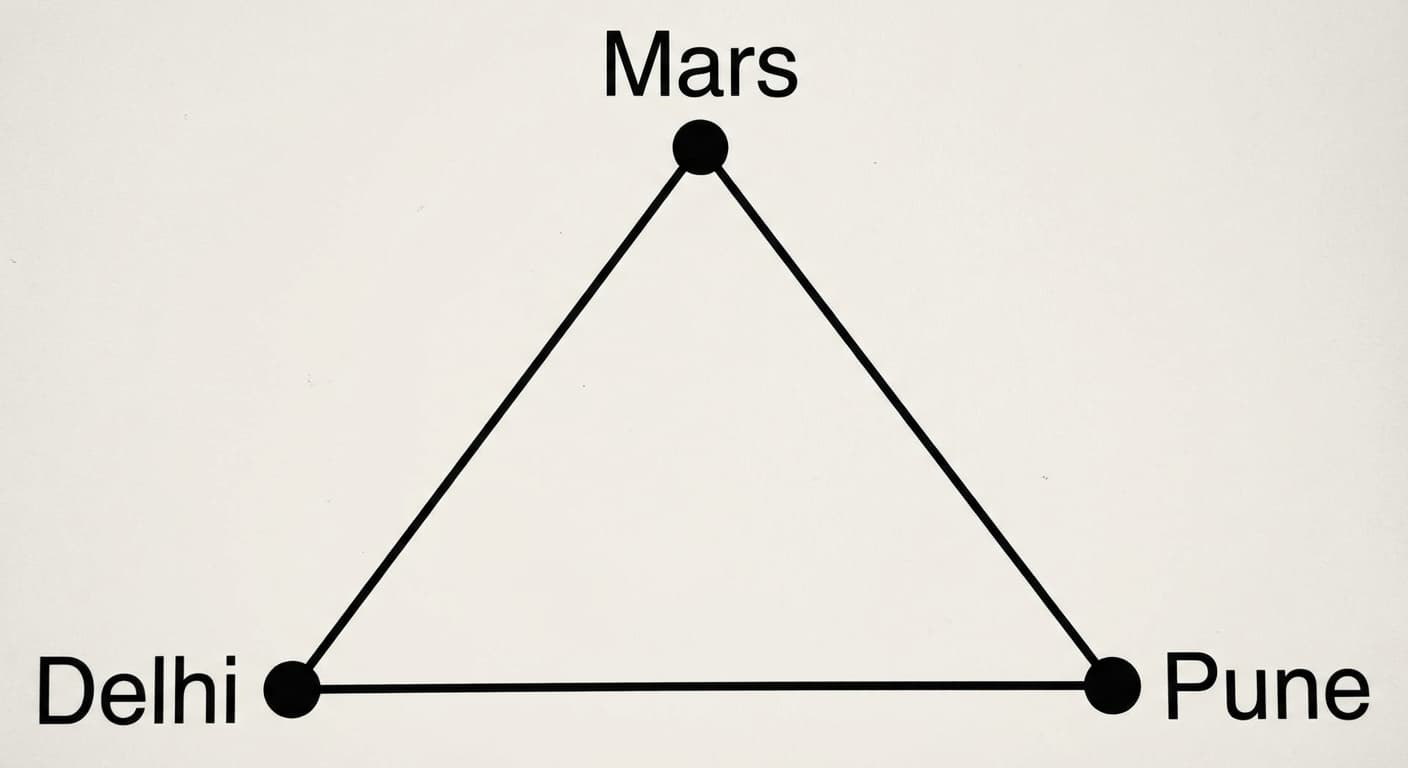
The graph representation
Now explain the representation. We draw each point as a dot and each connection as a line between dots. This gives us a graph. The points are called vertices and the connections are called edges. An edge represents one hop — you can travel directly between its endpoints, and that takes one unit of distance.
Important: the graph is the world. There is nothing between the dots. The edges are not divisible — you cannot stop halfway along an edge. Each edge is a single, indivisible connection. Students will often treat the graph drawing as if the edges are continuous lines with intermediate points. Watch for this and correct it early.
The equal-length assumption
For this module, we make one simplifying assumption: all connections have the same length. Every edge represents the same distance (one hop). This means we do not need to worry about weighted graphs — we are counting hops, not measuring distance.
Session 1: The Bisection Question (~90 min)
Posing the question
Write on the board: "In a world with exactly 6 points, can every straight line be bisected?"
Give students a few minutes to think about this. They will immediately have questions: What is a "world"? What counts as a "straight line" in such a world? What does "bisect" mean here?
This confusion is the point. The question is ill-formed precisely because these terms are not defined. The work of the module is to make the question well-formed by choosing definitions.
What is a straight line?
In Euclidean geometry, one way to think about a straight line between two points is as the shortest path between them. Ask students: can we use this idea in our world?
In a world represented as a graph, the shortest path between two points is the path that uses the fewest edges (hops). If there are multiple shortest paths, they all count. A "straight line" from A to B is a shortest path from A to B.
The simple world
Draw the simplest possible 6-point world: a chain.
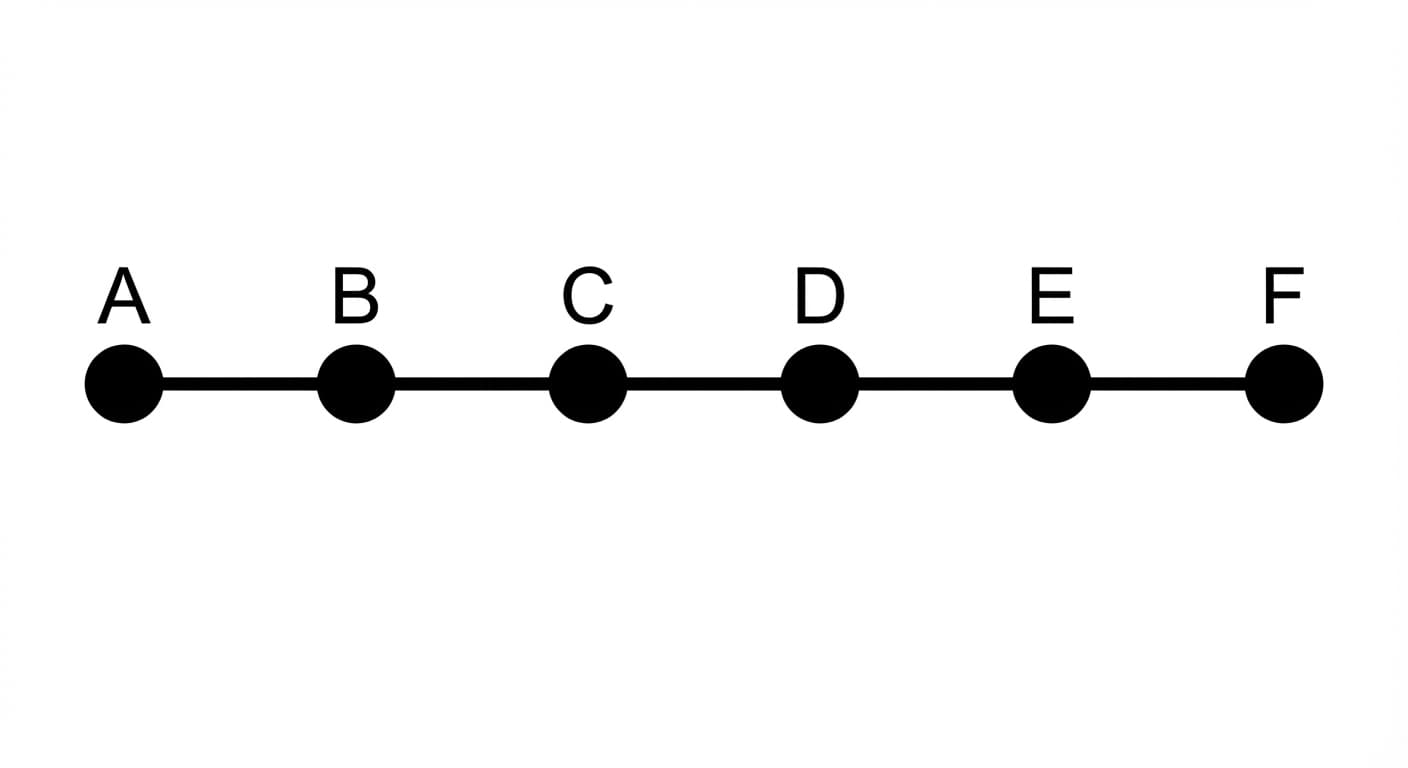
A — B — C — D — E — F
In this world:
- The straight line from A to B is just the edge A-B (length 1)
- The straight line from A to C is A-B-C (length 2)
- The straight line from A to F is A-B-C-D-E-F (length 5)
- Every shortest path is unique because the graph is a chain
Have students list all the straight lines and their lengths. There are 15 pairs of points (6 choose 2), and each pair has exactly one shortest path.
Two definitions of bisection
Now ask: what does it mean to bisect a line?
In Euclidean geometry, bisecting a line means dividing it into two equal parts. But in a discrete world, there are two natural ways to interpret "equal parts":
A-Bisection (at a point): A line can be A-bisected if there is a point on the line that is equidistant from both endpoints. The line A-B-C has length 2, and B is at distance 1 from both A and C. So A-B-C can be A-bisected at B.
B-Bisection (between points): A line can be B-bisected if it can be split into two paths of equal length, even if the split happens between two adjacent points (along an edge) rather than at a point. The line A-B has length 1. There is no point equidistant from both A and B — but if we imagine the midpoint of the edge, we split it into two halves of length 0.5. So A-B can be B-bisected.
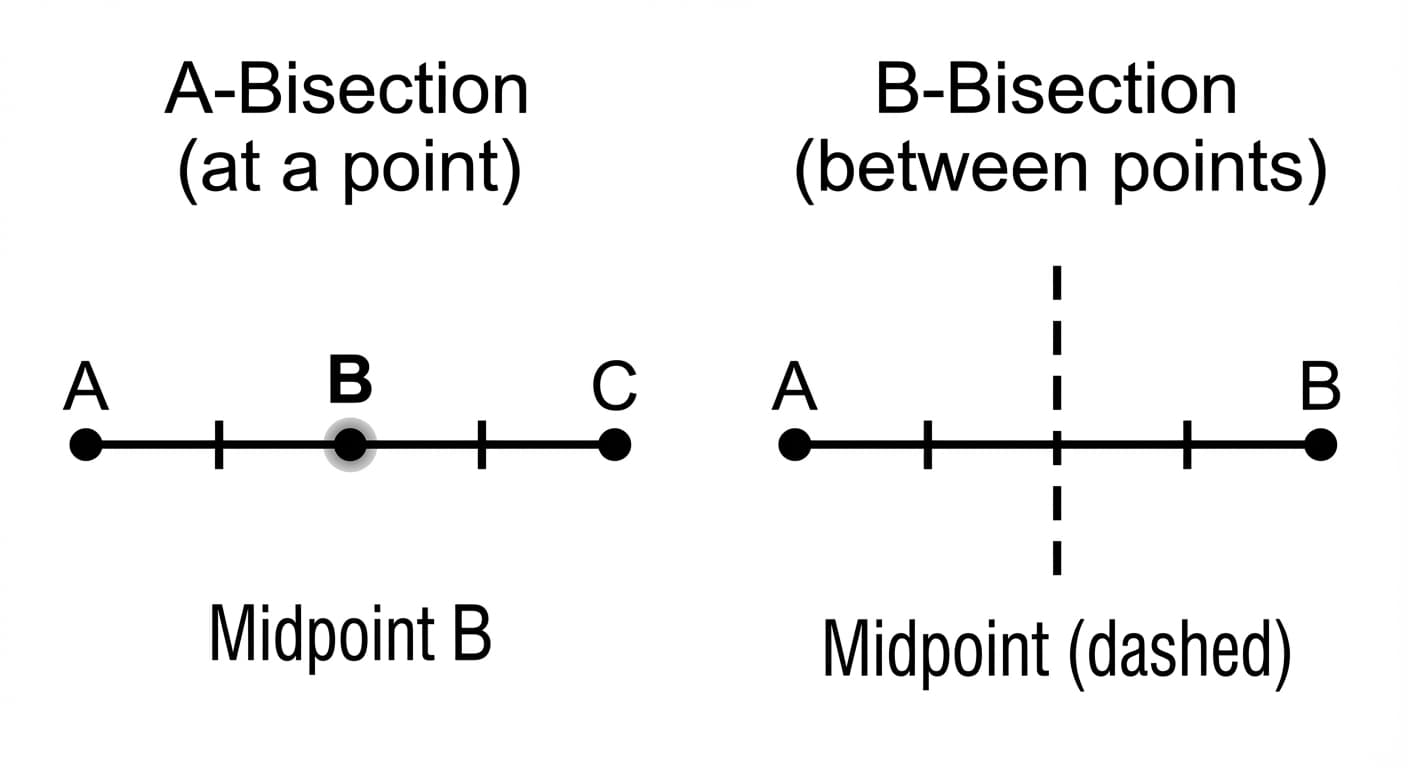
In my implementation, two students disagreed about whether the line A-B could be bisected. One said yes (thinking of splitting the edge), the other said no (thinking of finding a midpoint vertex). A third student realised they meant different things. This is exactly the moment you want — the realisation that the word "bisect" is ambiguous until we choose a definition.
Which lines can be A-bisected?
In the simple world (chain A-B-C-D-E-F):
- Lines of odd length (1, 3, 5) cannot be A-bisected — there is no vertex at the exact midpoint
- Lines of even length (2, 4) can be A-bisected — the middle vertex works
Have students work this out for all 15 lines and fill in a table. Can every straight line be A-bisected in this world? No — the odd-length lines cannot.
Which lines can be B-bisected?
Under B-bisection, every line can be bisected — you can always split a path of length n into two halves of length n/2, whether n is odd or even (if n is odd, the split happens at a half-integer point along an edge).
So the answer to the original question depends entirely on which definition of "bisect" you choose. Same question, same world, different definitions, different answers.
Worlds where all lines can be A-bisected
Challenge: can you design a 6-point world where every straight line can be A-bisected?
Students should experiment. One approach is to make all shortest paths have even length. Another is to create a world where some pairs of points have no connecting path at all (a disconnected graph) — but then you need to decide whether "every straight line can be bisected" is vacuously true for pairs with no path between them.
This is where the concept of vacuous truth naturally arises. A world with 6 completely disconnected points has no straight lines at all. The statement "every straight line can be bisected" is true — because there are no straight lines to fail the test. Students typically find this unsatisfying, which is a productive reaction.
Session 2: Circles in Discrete Worlds (~90 min)
Borrowing the circle definition
Ask students: what is a circle in Euclidean geometry? They will say something like "a set of points equidistant from a centre." Good — now use that definition in your discrete world.
A circle with centre P and radius r is the set of all points at distance r from P. In a graph, distance means the length of the shortest path.
Circles in the simple world
In the chain A-B-C-D-E-F:
- Circle centred at A, radius 1:
{B} - Circle centred at A, radius 2:
{C} - Circle centred at A, radius 3:
{D} - Circle centred at A, radius 4:
{E} - Circle centred at A, radius 5:
{F} - Circle centred at C, radius 1:
{B, D} - Circle centred at C, radius 2:
{A, E} - Circle centred at C, radius 3:
{F}
One student, Vivaan, said "AB is a circle" — meaning the set {A, B} is a circle centred at some point between A and B. This led to a debate: is the centre of a circle part of the circle? In Euclidean geometry, no — the centre is not on the circumference. In a discrete world, can you have a circle with radius 0? If so, every point is a circle centred at itself.
Have students list all possible circles (every combination of centre and radius) in the simple world. Ask: what do you notice about how many points are on each circle?
The necklace world
Now introduce a more interesting world: the necklace. Six points connected in a cycle.
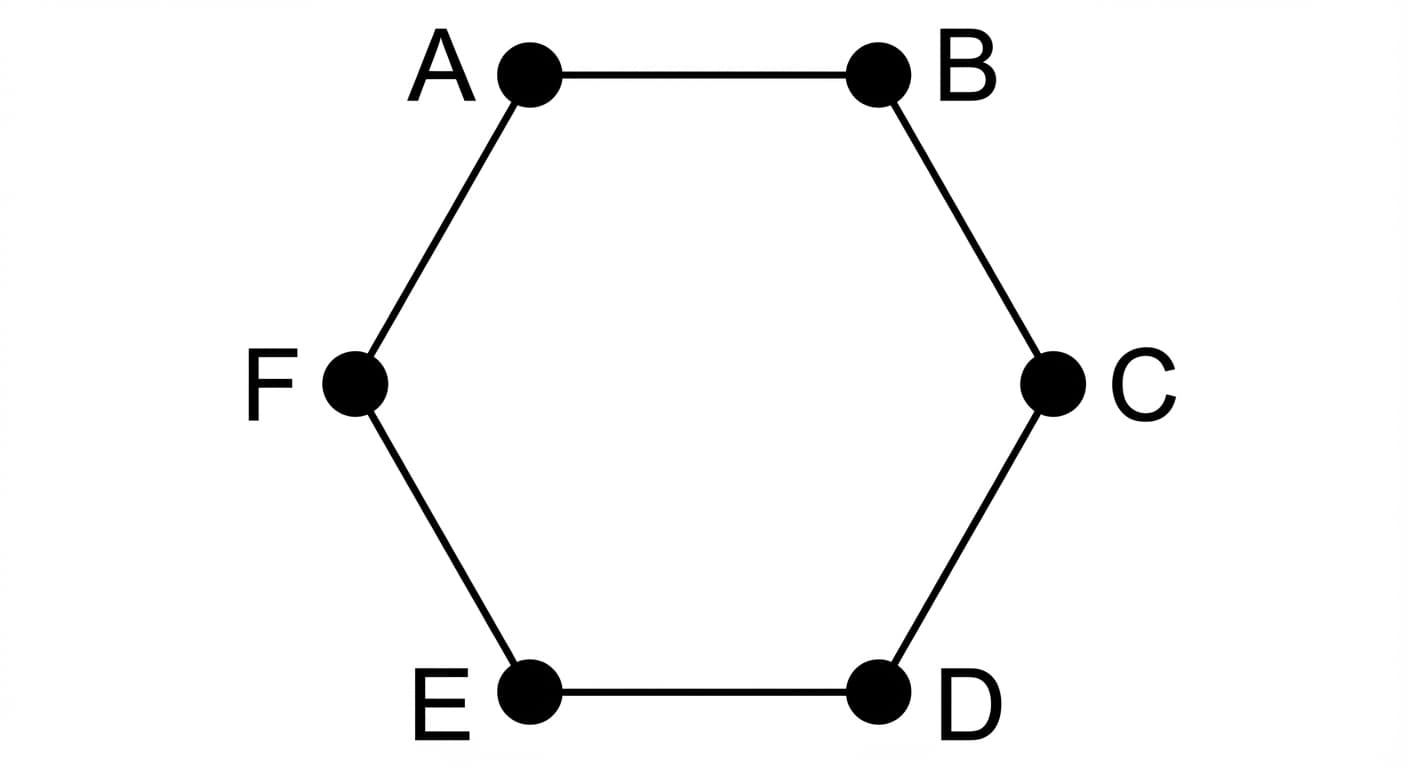
A — B — C — D — E — F — A
This is different from the chain because there are two possible paths between most pairs of points. The shortest path from A to D could go A-B-C-D (length 3) or A-F-E-D (length 3) — both are equally short. A is at distance 3 from D.
Circles in the necklace world
Have students work out circles in the 6-point necklace:
- Circle centred at A, radius 1:
{B, F} - Circle centred at A, radius 2:
{C, E} - Circle centred at A, radius 3:
{D}
Notice that the radius-3 circle has only one point. In Euclidean geometry, circles always have infinitely many points. Here, a "circle" can have just one point, or two, or potentially more in other worlds.
Even versus odd necklace worlds
Ask: what happens in a necklace with 5 points instead of 6?
In a 5-point necklace (A-B-C-D-E-A):
- Circle centred at A, radius 1:
{B, E} - Circle centred at A, radius 2:
{C, D}
No circle has an odd number of points (other than possibly 0). The maximum distance between any two points is 2 (in a 5-point necklace, the farthest you can be from any point is 2 hops).
In a 6-point necklace, the maximum distance is 3, and the point diametrically opposite has a "circle" of just one point. This does not happen in the 5-point necklace.
Have students explore: for which values of n does the n-point necklace have a circle with exactly one point? This leads to the conjecture that it happens when n is even — the point diametrically opposite is at distance n/2, and there is only one such point.
Connection between bisection and circles
Ask students: is there a connection between bisection and circles? If a line from A to B passes through point M, and M is equidistant from A and B, then M is on the circle centred at M with radius equal to d(A,M). But M is also the midpoint of the line. So A-bisection of a line is related to finding a point that lies on certain circles.
This connection is not straightforward, and students may or may not find it productive. The point is to show that the concepts we borrowed from Euclidean geometry are still interconnected in the discrete world, but the connections may be different.
Session 3: Triangles and Generalisation (~90 min)
Extending the triangle definition
Ask students: what is a triangle? In Euclidean geometry, it is a closed shape with three straight-line sides. Let us use that definition in our discrete worlds.
A triangle in a discrete world is three points P, Q, R together with three straight lines (shortest paths): one from P to Q, one from Q to R, and one from R to P. The triangle is "closed" because the three paths form a cycle.
Collinear versus non-collinear triangles
In the simple world (chain A-B-C-D-E-F), consider the points A, B, C. The straight line from A to B is A-B (length 1). The straight line from B to C is B-C (length 1). The straight line from A to C is A-B-C (length 2). These three "sides" form a triangle — but all three points are on the same chain. The "triangle" is degenerate in the same way that three collinear points form a degenerate triangle in Euclidean geometry.
Introduce the terminology:
- C-Triangle (collinear triangle): A triangle where all three vertices lie on a single shortest path. All three points are "in a line."
- NC-Triangle (non-collinear triangle): A triangle where the three vertices do not all lie on any single shortest path.
In the simple world, every triple of points forms a C-triangle — because every pair of points has a unique shortest path, and all points are on the one chain. There are no NC-triangles.
Triangles in the necklace world
The necklace world is more interesting. Consider the points A, C, E in the 6-point necklace (A-B-C-D-E-F-A).
- Shortest path from A to C: A-B-C (length 2)
- Shortest path from C to E: C-D-E (length 2)
- Shortest path from E to A: E-F-A (length 2)
This is an NC-triangle — the three vertices do not all lie on any single shortest path. Moreover, all three sides have the same length, so it is an equilateral triangle.
Ask students: how many NC-triangles can you find in the 6-point necklace? Are any of them equilateral?
In the 6-point necklace, the two equilateral triangles are {A, C, E} and {B, D, F}. These are the only NC-triangles with all sides equal.
"That shouldn't be a triangle"
When students encounter C-triangles — three collinear points called a "triangle" — they will often object. "That is not a triangle. It is just three points on a line." This happened in my implementation. Students rejected collinear triangles on visual grounds.
The response is to point back at the definition. A triangle is three points with three straight-line sides forming a closed shape. A, B, C in the chain satisfy this definition — there is a shortest path from A to B, from B to C, and from A to C, and these paths share endpoints to form a closed figure (even if it is degenerate). If you want to exclude collinear triangles, you need to change the definition.
This mirrors the Euclidean situation: in Euclidean geometry, we typically add "non-collinear" to the definition of a triangle precisely to exclude degenerate cases. Here, students discover the same need. The definition has a consequence they do not like, so they modify the definition. This is the module's central lesson playing out in miniature.
Lines versus line segments
In Euclidean geometry, a line extends infinitely in both directions, while a line segment has two endpoints. In a finite world, what is the difference?
In the simple world, the "line" through A and B extends to A-B-C-D-E-F — it goes all the way to the end of the chain. But in the necklace world, the "line" through A and B could continue: A-B-C-D-E-F-A — back to the start. Should we stop, or should we keep going?
This raises interesting questions about whether straight lines in discrete worlds can wrap around. If you allow wrapping, a "line" through A and B in the necklace might be A-B-C-D-E-F-A-B-C-... going around forever. But that is no longer a shortest path — it is just a path. So the shortest-path definition naturally prevents infinite lines, and every "straight line" is really a line segment.
This is a difference from Euclidean geometry worth noting explicitly: in Euclidean geometry, lines are infinite; in finite worlds, all lines are finite. The distinction between lines and line segments collapses.
Generalisation
If there is time, push students toward generalisation:
-
Necklace worlds: For which values of n can every straight line in an n-point necklace be A-bisected? (Answer: when n is odd, every shortest path has even length, so every line can be A-bisected. When n is even, the diameter path has odd length and cannot be A-bisected.)
-
Triangle existence: For which worlds do NC-triangles exist? (Answer: NC-triangles require the world to have cycles. In any tree graph, every triple of points forms a C-triangle.)
-
Circle sizes: In an n-point necklace, what is the maximum number of points on a circle? (Answer: 2, except for radius n/2 when n is even, which gives 1.)
Open questions for further exploration
These are genuinely open questions that students can work on:
- Can you design a 6-point world where every triple of points forms an NC-triangle?
- What is the smallest world that has exactly one NC-triangle?
- In a world with n points, what is the maximum number of equilateral triangles?
- Can you find a world where a "circle" has more than 2 points?
- What happens if you allow connections of different lengths (remove the equal-length assumption)?
Things that come up in practice
Students treating edges as divisible
The most common misconception is treating graph edges as continuous lines. One student, Vivaan, drew intermediate points on edges when trying to bisect a line of odd length. He was thinking of the edge as a physical line segment that could be split.
The correction: remind students that edges are teleportation connections. You cannot stop halfway through a teleportation. There is nothing between the two endpoints of an edge.
Confusion between paths and shortest paths
Students will sometimes forget the "shortest" part and find long paths between two points. In the necklace world, there are two paths from A to B — A-B (length 1) and A-F-E-D-C-B (length 5). Only A-B is a straight line.
This matters especially for bisection: if you consider the long path, you might think the line from A to B has length 5 and can be A-bisected at D. But the straight line from A to B has length 1 and cannot be A-bisected.
"That shouldn't be a triangle"
As described above, students resist collinear triangles. This is productive — it forces them to confront the gap between their visual intuition and the formal definition. Do not resolve it for them too quickly. Let them sit with the discomfort and eventually propose modifying the definition.
Productive struggle versus frustration
In my implementation, one school (Indus) found this module too hard and got frustrated. The other (Ganga) found it deeply engaging. The difference was partly the students but partly the pacing. At Indus, the teacher moved too quickly through the setup and students did not have time to build intuition for the graph representation before being asked to reason about it.
Recommendation: spend at least 20 minutes on the simple world before introducing any definitions. Let students count paths, find distances, and get comfortable with the graph before asking about bisection or circles.
Students inventing their own worlds
Some students will want to create worlds that are not chains or necklaces — worlds with branching paths, disconnected components, or other structures. Encourage this. The whole point is that different worlds have different properties. A student who invents a star graph (one central point connected to 5 others) has created a world with very different geometry from the chain or necklace.
Conceptual points worth making explicit
Same word, different definitions, different conclusions. This is the central idea of the module. "Can every straight line be bisected?" has different answers depending on what "bisect" means (A-bisection vs B-bisection) and what "world" you are in (chain vs necklace vs star). The question itself is not answerable until you make definitional choices.
Representations matter. Students are working with graph drawings. Remind them that the graph is not a picture — the lengths and angles of the drawing do not matter. What matters is which points are connected to which. Two graphs that look very different might represent the same world if they have the same connections.
Vacuous truth. A disconnected world has no straight lines. The statement "every straight line can be bisected" is technically true in such a world, because there are no counterexamples. This feels like cheating, but it is logically valid. This concept appears in real mathematics and is worth naming.
Definitions are choices, not discoveries. When students define "straight line" as "shortest path" or "bisection" as "at a point," they are making choices. These choices are not right or wrong — they are more or less useful, more or less natural, more or less interesting. The quality of a definition is judged by the richness of the theory it enables.
The same structure seen differently. A 6-point cycle (necklace) could represent cities connected by roads, atoms in a molecule, or hours on a clock face with only 6 hours. The geometry is the same regardless of the interpretation. This is the power of abstraction.
What this prepares students for
Axiomatic systems. The idea that you choose your definitions and axioms, and then see what follows, is the foundation of modern mathematics. This module gives students a concrete experience of that process.
Non-Euclidean geometries. Just as students explored geometry in worlds with finitely many points, mathematicians have explored geometry on spheres, hyperbolic planes, and other surfaces. The core move is the same: change the assumptions, see what changes.
Graph theory. The worlds students build are graphs. The concepts they explore — shortest paths, distances, cycles — are fundamental graph theory. Students who have done this module will find formal graph theory familiar rather than alien.
Mathematical modelling. The teleportation analogy is a model. Real networks (social, biological, computational) are modelled as graphs. The ability to abstract a situation into a graph and reason about its properties is a core mathematical modelling skill.
Variations
Fewer points. Start with 4 or 5 points instead of 6. This makes the combinatorics more manageable and lets students exhaustively explore all possible worlds.
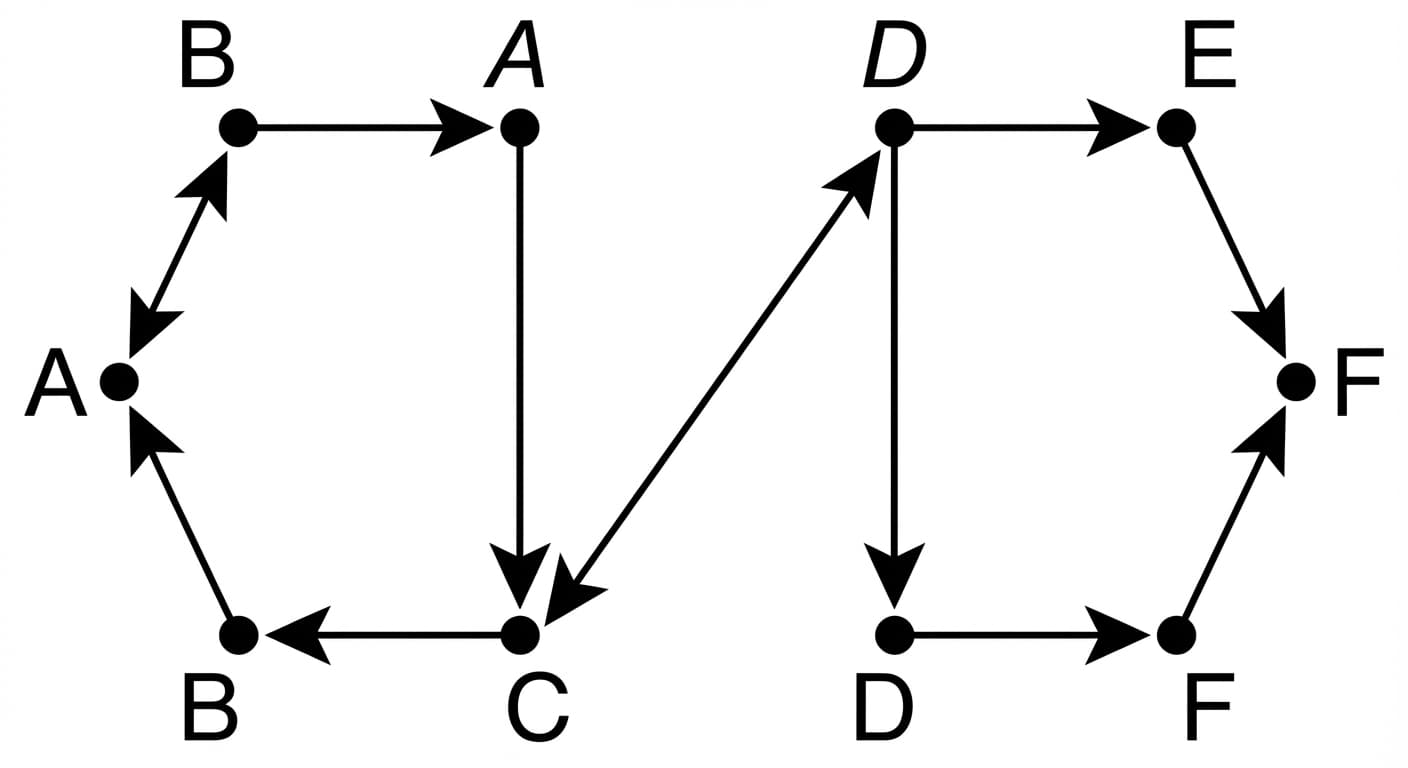
Directed connections. What if some connections only work one way? (The teleporter from Mars to Delhi works, but the one from Delhi to Mars does not.) This introduces directed graphs and makes shortest paths asymmetric — the distance from A to B might differ from the distance from B to A.
Different starting questions. Instead of bisection, start with: "In a world with exactly 6 points, can you draw a circle?" or "In a world with exactly 6 points, can every triangle be equilateral?" Each starting question leads to different definitional work.
Weighted edges. Remove the equal-length assumption and let different connections have different lengths. This makes shortest-path calculations harder but opens up richer geometry.
Student-designed investigations. After Sessions 1 and 2, let students choose their own question about discrete worlds and investigate it. The best investigations from my implementation came from students who asked their own questions rather than following the guided sequence.