
Grades 6-10 · 2-3 sessions
The Podgon Game: Extension Pack
This document has two parts. The first contains additional definition-guessing activities you can use in place of or alongside the Podgon Game. The second is a guide for running student-led rounds, where students create their own mystery words.
Part 1: Additional definition pairs
Each activity below follows the same format as the Podgon Game. Two definers have different definitions of the same made-up word. Students figure out the definitions by proposing examples.
When choosing which of these to use, it helps to think about what conceptual feature you want to highlight. The different activities below are designed to bring out different ideas about definitions.
BRELLONS (Numbers)
Tell students: "A brellon is a type of whole number."
Definition A: A brellon is a whole number whose digits add up to a multiple of 3. (Examples: 9, 12, 27, 111. Non-examples: 7, 13, 25.)
Definition B: A brellon is a whole number divisible by 3. (Examples: 9, 12, 27, 111. Non-examples: 7, 13, 25.)
Starting examples:
| Number | Brellon A? | Brellon B? |
|---|---|---|
| 12 | Yes | Yes |
| 7 | No | No |
Good test numbers to have ready: 99, 100, 10, 33, 15, 8, 1000
What is interesting about this one: These two definitions are equivalent. They always agree. Students will propose many examples and never find a disagreement. Eventually, they should notice this and either figure out why or be told. This opens a useful discussion: if two definitions always agree, are they "the same"? Is one better than the other? The divisibility definition does not depend on the base you are writing the number in, so it seems more fundamental. The digit-sum definition is useful for checking whether a particular number in base 10 is divisible by 3, but it does not tell you what divisibility by 3 really is. This is analogous to the even-number example — defining even as "ends in 0, 2, 4, 6, or 8" versus "divisible by 2."
You can also ask: how would you convince someone that these two definitions always agree? That is a hard question, and it leads naturally toward proof.
KLAXIS (Arrangements of Objects)
Tell students: "A klaxis is a type of arrangement of objects on a table."
Definition A: A klaxis is an arrangement where every object touches at least one other object.
Definition B: A klaxis is an arrangement where you can get from any object to any other object by moving through touching objects.
Starting examples:
| Arrangement | Klaxis A? | Klaxis B? |
|---|---|---|
| Three coins in a row, each touching the next | Yes | Yes |
| Three coins spread far apart, none touching | No | No |
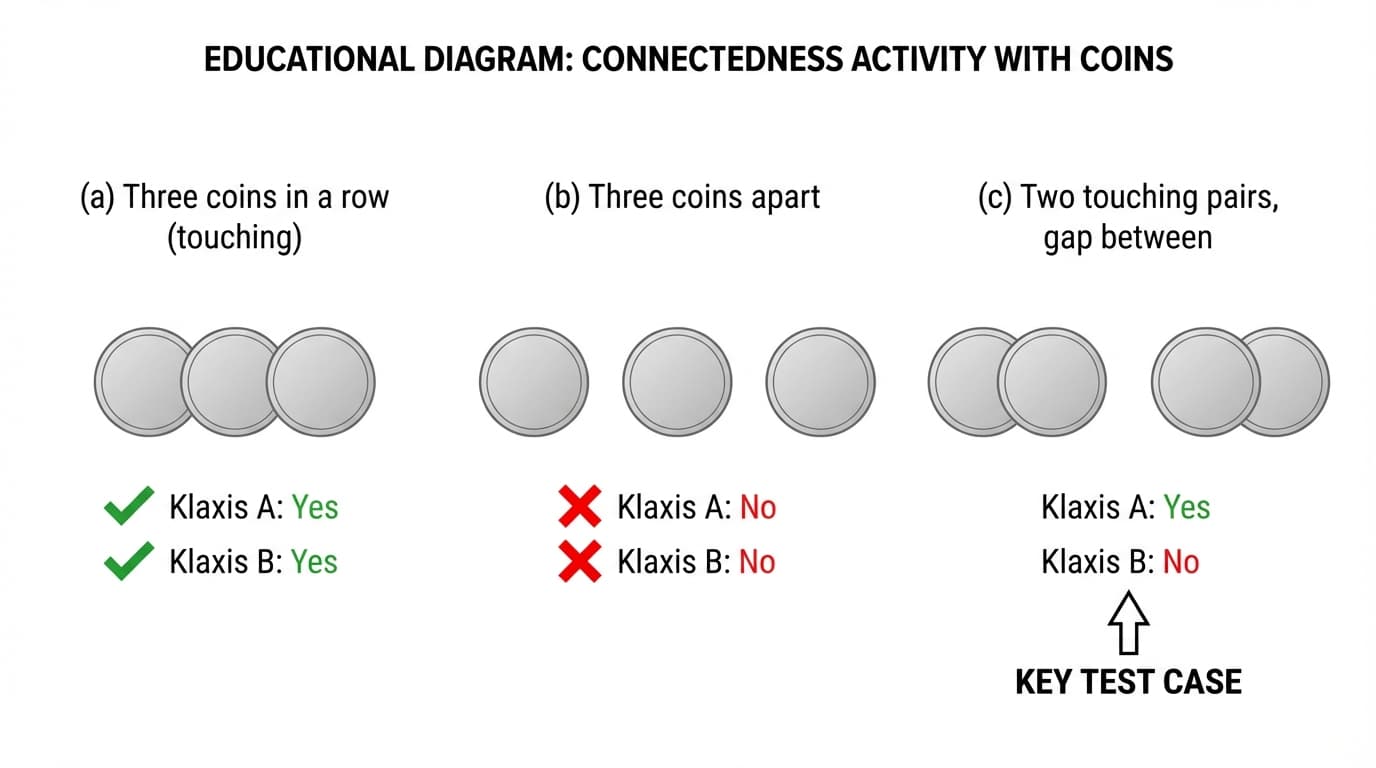
The revealing test case: Two pairs of touching coins, with the pairs far apart from each other. By Definition A, this is a klaxis — every coin touches another. By Definition B, it is not — you cannot get from one pair to the other by moving through touching objects.
What is interesting about this one: This introduces the mathematical concept of connectedness without using the word. Definition B requires the arrangement to be connected (in the graph theory sense), while Definition A only requires that no object is isolated. Most arrangements that satisfy A also satisfy B, so it takes some thought to find the cases where they diverge. This is a good one for groups that found the Podgon Game too easy.
VELNAR (Words)
Tell students: "A velnar is a type of English word."
Definition A: A velnar is a word that contains at least two different vowels (a, e, i, o, u). (Examples: "house" — has o, u, e. Non-examples: "cat" — only has a.)
Definition B: A velnar is a word with at least as many vowels as consonants. (Examples: "idea" — 3 vowels, 1 consonant. Non-examples: "cat" — 1 vowel, 2 consonants.)
Starting examples:
| Word | Velnar A? | Velnar B? |
|---|---|---|
| house | Yes | Yes |
| cat | No | No |
Some useful test words:
- "tree" — A: No (only 'e'). B: Yes (2 vowels, 1 consonant). This distinguishes the two.
- "audio" — A: Yes (a, u, i, o). B: Yes (4 vowels, 1 consonant).
- "string" — A: No (only 'i'). B: No (1 vowel, 5 consonants).
- "bike" — A: Yes (i, e). B: Yes (2 vowels, 2 consonants).
- "book" — A: No (only 'o'). B: Yes (2 vowels, 2 consonants). Another distinguishing case.
What is interesting about this one: It shows that definition-guessing is not limited to geometry or numbers. It also works well for classes where you want to connect mathematics to language. The definitions here are independent — you can have words that satisfy A but not B, B but not A, both, or neither. This tends to make the guessing process take longer, which gives more time for refining strategies.
TRAVEN (Paths on a Grid)
Tell students: "A traven is a type of path drawn on grid paper, starting from a marked point."
Definition A: A traven is a path that never visits the same grid intersection twice.
Definition B: A traven is a path that only moves right or up (never left or down).
Starting examples:
| Path | Traven A? | Traven B? |
|---|---|---|
| A 3-step staircase going up-right-up | Yes | Yes |
| A path that goes right, then left back to start | No | No |
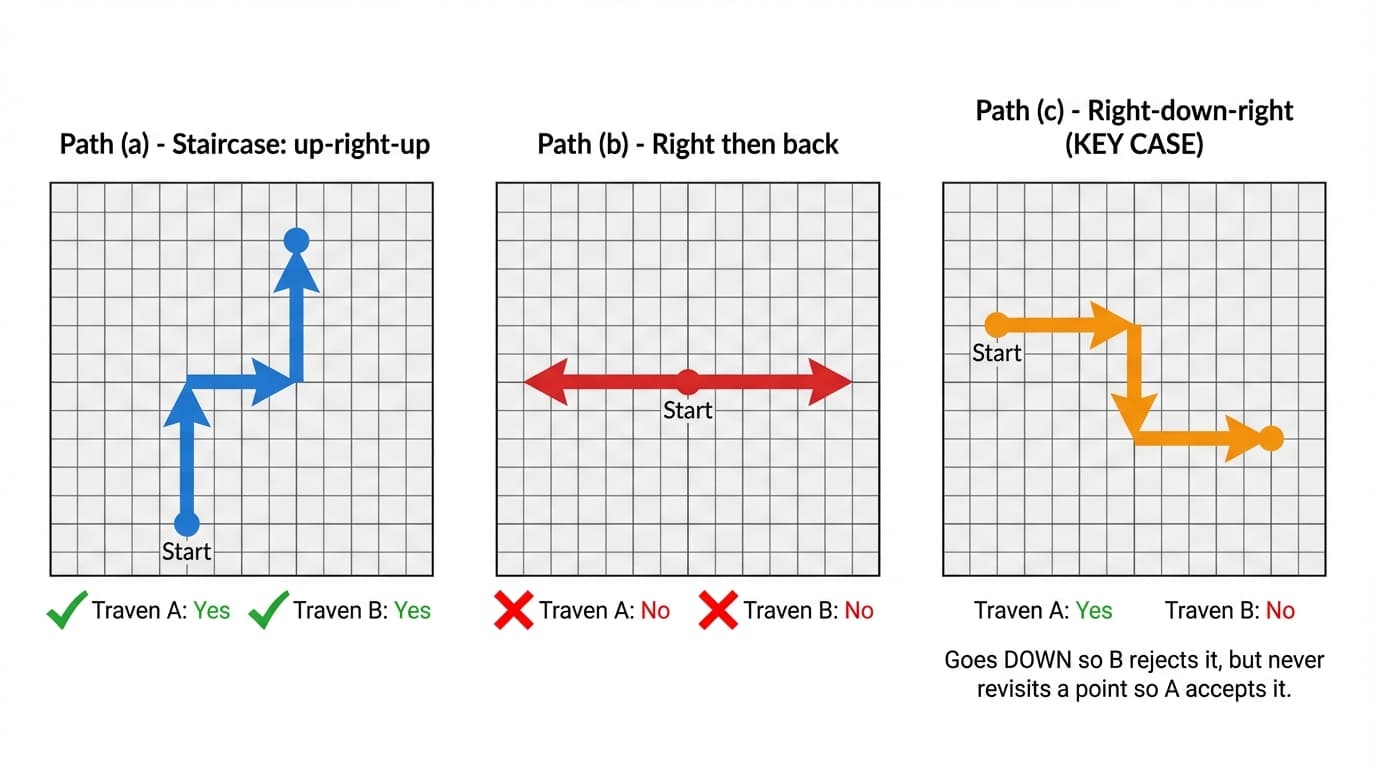
The revealing test case: A path that goes right, then down, then right. It never revisits an intersection, so A accepts it. But it goes down, so B rejects it.
What is interesting about this one: Every path that satisfies B also satisfies A (a path that only goes right or up can never revisit an intersection). But not every A-path satisfies B. So B's definition is strictly contained within A's. This gives students the experience of a containment relationship between definitions — the idea that "every B is an A, but not every A is a B." This is the same logical structure that comes up when asking whether every square is a rectangle.
This activity requires graph paper and is more hands-on than the others. It works well if you want students drawing and physically tracing paths.
Part 2: Student-led definition guessing
Once students have played one or two rounds of instructor-led definition guessing, they can create their own. This is worth doing because the act of creating a good pair of definitions requires a deeper understanding of what definitions do than the act of guessing them.
Instructions for students
Your group will create a mystery word, invent two definitions for it, and challenge another group to figure out your definitions.
First, choose a domain — the type of thing your word will refer to. It could be shapes, numbers, words, arrangements of objects, patterns, or anything else you like.
Then, write two definitions. Your definitions must agree on at least two examples (so the guessing group has something to start with) and disagree on at least two examples (so there is something to figure out). Each definition should be stated clearly enough that there is no ambiguity about whether a given example fits or not.
Before you run your game, test your definitions on at least 10 examples to make sure they work the way you think they do. This is important — in my experience, students sometimes create definitions that have unexpected edge cases they have not thought through.
Prepare your starting examples: choose two examples that both definitions agree on (one that both accept and one that both reject). Write these on the board when it is your turn.
When the guessing group proposes an example, both definers check their definitions and give their judgements independently.
What to check before running the game
Before a group runs their game, it is worth checking (either as the teacher or by having another group review):
- Are both definitions precise enough that there is no ambiguity on any example?
- Do the definitions agree on the starting examples?
- Are there examples where the definitions disagree?
- Is the conceptual difference between the definitions interesting, or is it just a trivial edge case?
- Are both definitions reasonable? Neither should be deliberately weird or arbitrary.
Debrief
After each student-led round, discuss:
- What was the conceptual difference between the two definitions?
- Which test case was the most revealing? Why?
- Was there any ambiguity in the definitions that caused confusion? How could the definitions be made more precise?
- Were the two definitions "equally good," or is there a reason to prefer one over the other?
The last question is important because it connects back to the theory-building idea that not all definitions are equally good — some are more central to the concept, more general, or more useful than others.