
Grades 6-10 · 3-4 sessions
The Podgon Game: Teacher Guide
What this activity is
The Podgon Game is a definition-guessing activity. Students try to figure out the meaning of a made-up word — "podgon" — by testing examples against two secret definitions held by the instructor(s). It develops the ability to define precisely, reason about definitions, and construct and evaluate counterexamples.
It works with students aged roughly 10 to 15, though it can be adapted. It takes 45 to 90 minutes depending on how rigorously you want to run it. You need a whiteboard or blackboard, and if you are running the more rigorous version, one Student Handout per group.
Students should be in groups of 3 to 5.
What students should get out of it
The main learning goals are:
- Being able to propose a definition consistent with a set of examples
- Inventing test cases that distinguish between competing definitions
- Understanding what a counterexample does (it eliminates a definition) and what a confirming example does (it makes a definition more plausible but does not prove it)
- Recognising that the same word can have different precise meanings, leading to different consequences
There is also an implicit goal, which is harder to pin down: getting students comfortable with the idea that definitions are choices, not things you look up.
Setup
The two definitions
The word is "podgon." You play the role of two people — Person A and Person B — each with a different secret definition. If you have a co-instructor, each of you takes one role. Otherwise, just alternate.
Definition A: A podgon is an equilateral polygon with an odd number of sides. (All straight-line sides, all sides equal length, and the number of sides is odd.)
Definition B: A podgon is a closed shape with an odd number of straight-line sides. (It may also have curved sides, but the count of straight-line sides must be odd.)
Tell students only this: "A podgon is a type of closed shape."
Initial examples
Draw the following on the board and fill in the judgements:
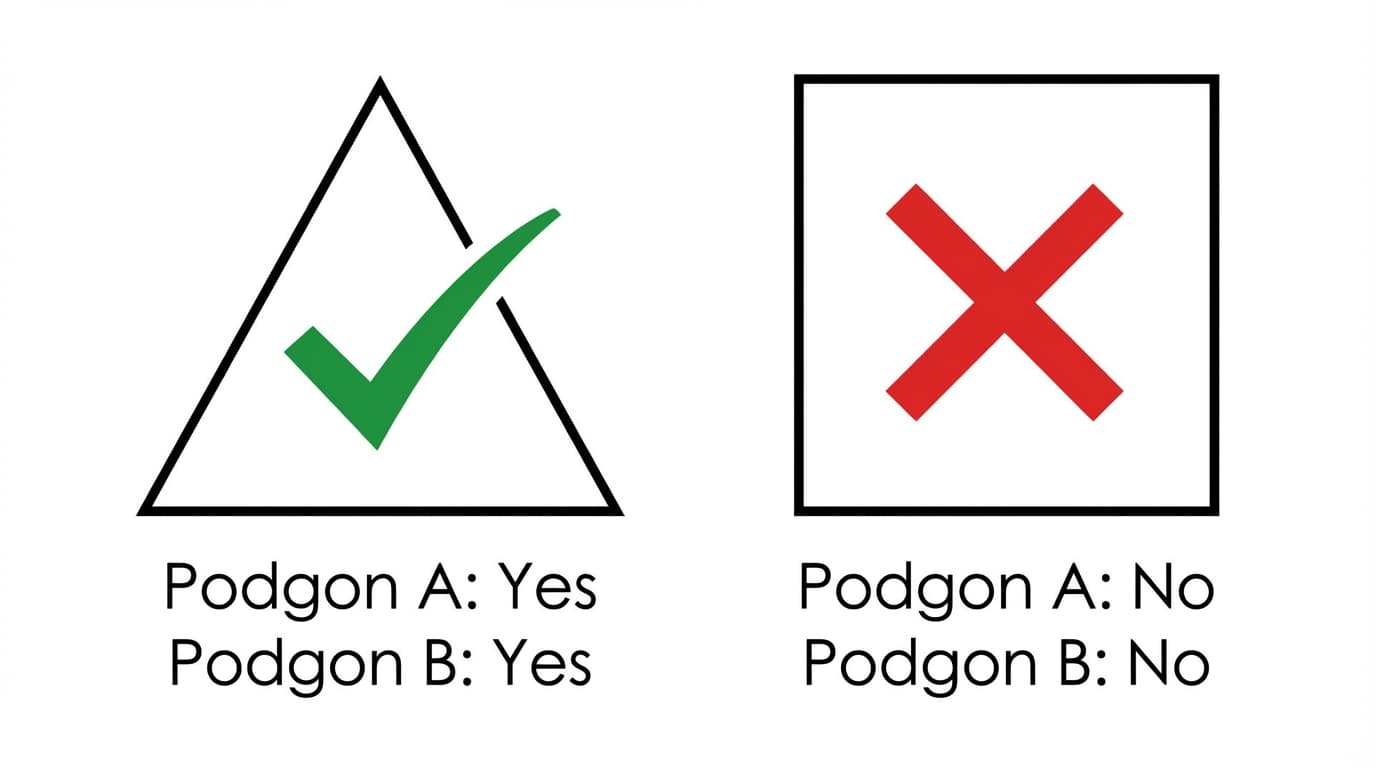
| Shape | Podgon A? | Podgon B? |
|---|---|---|
| Equilateral triangle | Yes | Yes |
| Square (all sides equal) | No | No |
Both definers agree on these, so students cannot yet tell the definitions apart. That is the point — they need to work to find shapes where A and B disagree.
Running the activity
Getting first definitions (10-15 min)
Show the initial examples. Ask groups to discuss and come up with a definition of "podgon" that is consistent with these examples. Give them 3 to 5 minutes. Then collect one definition from each group and write them on the board.
In my experience, the first guesses tend to be things like "an equilateral triangle," "a closed figure with vertices," or "a shape made of equal straight lines." All of these are consistent with the initial examples, which is fine. The point is that we do not yet have enough information to distinguish between them.
Testing definitions (25-40 min)
This is where most of the thinking happens. Groups propose shapes and ask whether they are podgons for A, for B, or both. After each answer, they revise their definitions.
The basic cycle is: a group proposes a shape, you give the A and B judgements, the class considers what this tells them about their proposed definitions, and groups revise accordingly.
The single most important thing you can do as a facilitator is to ask students why they are proposing a particular shape. "Why are you asking about that shape? What do you expect to learn?" Without this, students tend to propose shapes more or less randomly. With it, they have to think about their strategy. In the implementation I did, I did not always do this consistently, and looking back, I think it would have been valuable to ask more often.
You can also prompt them more specifically: "If this shape IS a podgon, what does that tell us? If it is NOT, what does that tell us?" If they cannot answer either question, the example probably is not useful and they should think of a better one.
Here is a rough sequence of shapes that usefully distinguish the definitions, in case you need to nudge students in certain directions. You will not need all of these — follow the students' direction, but have these in mind:
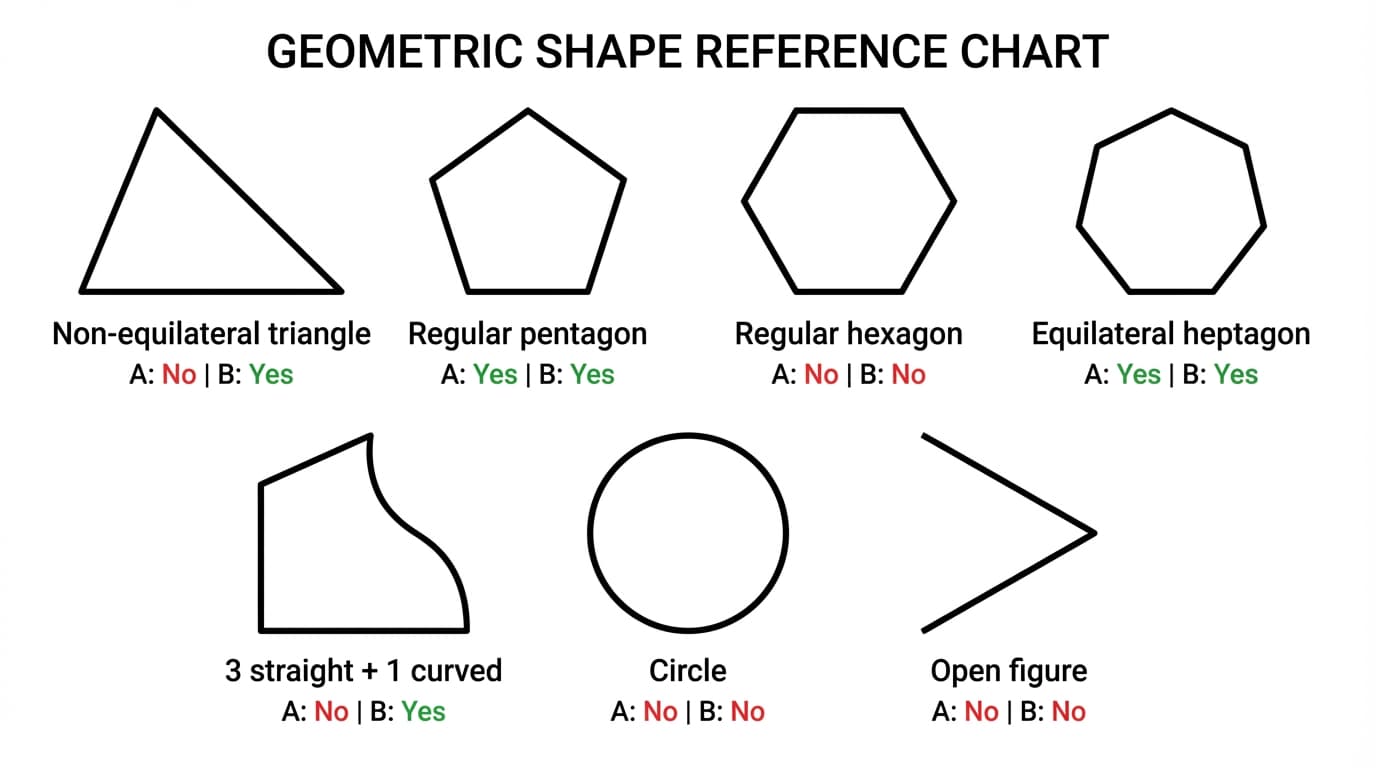
| Shape | A says | B says | What it reveals |
|---|---|---|---|
| A non-equilateral triangle | No | Yes | A requires equal sides; B does not |
| A regular pentagon | Yes | Yes | Not limited to triangles |
| A regular hexagon | No | No | Even number of sides fails for both |
| An equilateral heptagon (7 sides) | Yes | Yes | Confirms odd-number pattern |
| A shape with 3 straight sides and 1 curved side, sides unequal | No | Yes | B allows curved sides and unequal straight sides |
| A circle | No | No | No straight sides, fails both |
| An open figure (e.g., a ">" shape) | No | No | Must be closed |
Wrapping up (5-10 min)
Once at least one group is close, have groups share their final definitions. Write them on the board and discuss: which definitions are equivalent (same consequences, different wording)? Which are genuinely different? Can we find a shape that distinguishes between two of them?
Do not reveal the "correct" definitions until groups have had a chance to evaluate each other's. The goal is for them to use reasoning, not for you to hand them the answer. When you do reveal, frame it as: "Here is what I had in mind. Notice that your definition here is actually equivalent to mine even though it uses different words."
Things that come up in practice
I want to describe some of the things that actually happened when I ran this, because they are likely to come up for you too.
Jumping from one example to a general conclusion
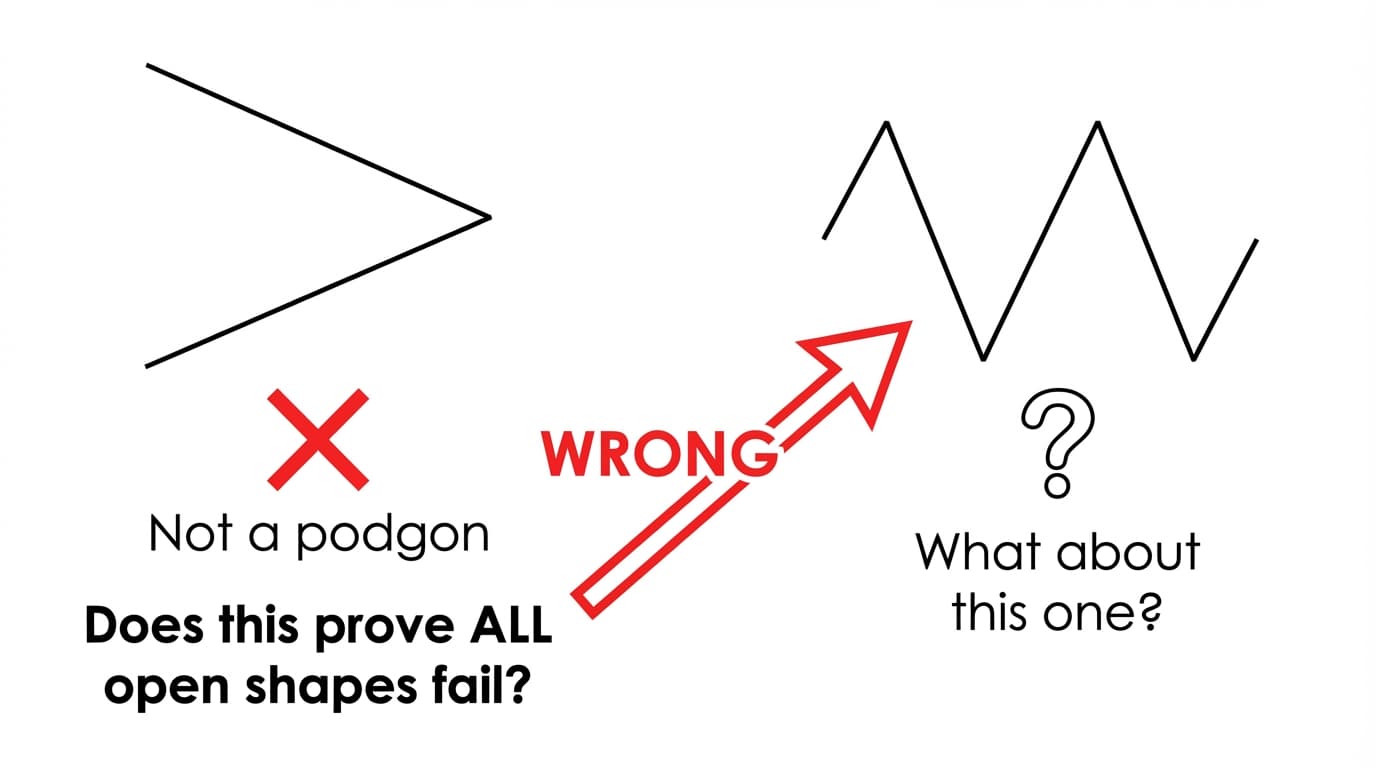
This was common. In one school, a student named Imran proposed a "greater than" shape (an open figure with two sides meeting at a point). I told him it was not a podgon for either definition. He concluded: "So, by this, we know it is only a closed figure." But that does not follow. All he had shown was that one particular open shape is not a podgon. A different open shape might have been. When this happens, the response I would suggest is something like: "You have shown that this open shape is not a podgon. Does that mean no open shape could be?" Then draw a different open shape and let them see the gap.
Confirming a definition with a single example
In the other school, a student named Uday asked whether a square is a podgon. When told it was not, he seemed to take this as proof that podgons must have equal sides. But the square also has an even number of sides — so there are two possible reasons for its rejection. When this happens, ask: "Is there another reason the square might have been rejected?"
Students proposing shapes without a clear reason
This happened quite a lot, especially early on. In many cases I did not ask students for their reasons, and looking back I think that was a missed opportunity. A pedagogical strategy that could help is to have students fill out the "If yes / If no" columns on the Student Handout before proposing each example. This forces them to think through what they will learn regardless of the answer.
The first definition that comes up is "equilateral triangle"
This is probably the most common first guess. Do not reject it verbally — ask them to test it. "How could you find out if that is correct? What example would you ask about?" They should eventually think to ask about an equilateral pentagon.
A group is stuck
Prompt them to look at the board. "Look at all the shapes that ARE podgons. What do they have in common? Look at the shapes that are NOT. What is different?" This moves them toward pattern recognition.
Ice-breaker vs. rigorous version
There is a tension in this activity between two goals. One is getting students engaged and comfortable — especially if this is the first session of a course. The other is being rigorous about reasoning. In my implementation, I used this as an ice-breaker on the first day, which meant I did not push for written reasoning or strict justification for every example.
If I were to do this again, I would run two definition-guessing sessions over the course: one at the beginning as an ice-breaker with a lighter touch, and a second one later in the course at a higher level of rigor, using the Student Handout and requiring explicit reasoning. The first session establishes the format; the second pushes the thinking.
Conceptual points worth making explicit
At some point during or after the session, it is worth drawing out a few ideas explicitly:
Definitions are choices. The word "podgon" does not have a "real" meaning. It means whatever the definer says it means. The same is true of mathematical terms. Whether a square counts as a rectangle depends on your definition of rectangle. Definitions are chosen, not discovered.
Different definitions have different consequences. A and B have different definitions, and this leads to different judgements on the same shapes. The same thing happens in everyday life. Whether a tomato is a "fruit" depends on whether you are using a botanical or culinary definition.
A counterexample eliminates a definition, but a confirming example does not prove one. One non-closed non-podgon does not prove all podgons are closed. But one closed shape that is not a podgon does prove that "closed shape" is not a sufficient definition.
Good testing requires purpose. You should know what you are trying to find out before you ask the question. The best examples are those that would tell you something useful regardless of whether the answer is yes or no.
What this prepares students for
If you are using this as part of a longer theory-building course, this session introduces the idea that definitions matter and are not just labels, the practice of testing claims through counterexamples, and the habit of asking "why do I believe this?" These set the stage for assumption digging (where students trace proofs back to their foundations) and definition extension (where students try to use familiar definitions in unfamiliar mathematical worlds).
Variations
If you have a co-instructor, each person can hold one definition. Students ask each person directly, which makes the "two different definitions" aspect more vivid.
You can also create your own definition-guessing words. Good pairs of definitions should agree on some obvious examples, disagree on non-obvious ones, and involve a conceptual distinction rather than a trivial one. The Extension Pack has some additional examples.
After the main activity, you can have student groups create their own mystery words with two definitions and challenge other groups to guess. This deepens understanding considerably — creating good definition pairs requires you to think carefully about what makes definitions different. In my implementation, I ran such a student-led session on the last day of the course. Unfortunately the video from that day is not usable, but the activity itself seemed to go well.