
Grades 8-11 · 3-4 sessions
Triangle Theory Building: Teacher Guide
What this activity is
Students list claims they believe to be true about triangles, then build a proof tree by repeatedly asking "why should I believe that?" and "what does this mean?" This is the assumption digging process — recursive questioning that traces claims back to their foundations.
The module takes 3 to 4 sessions of about 90 minutes each. A whiteboard is essential — you will be building a tree of claims on it over the course of the module, and it needs to persist between sessions (take a photo at the end of each session if you have to erase). Students should be in groups of 3 to 5.
This is the core module of the course. The Podgon Game introduces the idea that definitions matter; this module introduces the idea that claims need justification, and that justification has structure.
What students should get out of it
The main learning outcomes are:
- Assumption digging — the practice of asking "why should I believe that?" and "what does this mean?" recursively, and recording the chain of reasoning that results
- Vertical integration — seeing that claims about triangles are not isolated facts but are connected through proofs, forming a tree that goes from complex results down to simpler foundations
- Definitions vs axioms vs theorems — understanding that definitions are choices (like in the Podgon Game), theorems are claims we justify using other claims, and axioms are where the digging stops
- Classification — understanding what makes a classification complete, exclusive, and useful
- Circularity in reasoning — recognising when a chain of justification loops back on itself, and understanding why that is a problem
- Undefined entities — understanding that not everything can be defined, and that axioms constrain undefined terms without fully specifying them
Setup
Eliciting the initial list
Ask students to work in groups and come up with "things you believe to be true about triangles." Give them 5 to 10 minutes, then collect claims one by one and write them on the board. Clarify what students mean as you go — make sure everyone understands each claim.
You should end up with 10 to 15 claims. Here is a sample list based on what students actually produced across two schools:
- The sum of angles of a triangle is 180 degrees
- There are many types of triangles: isosceles, equilateral, right angled, scalene, obtuse and acute
- The angles opposite equal sides of a triangle are equal
- The angles of an equilateral triangle are equal
- Any triangle can be circumscribed
- The altitudes of a triangle meet at a point
- The medians of a triangle meet at a point
- The perpendicular bisectors of a triangle meet at a point
- The area of a triangle is 1/2 base x height
- The sum of the lengths of two sides of a triangle is greater than the length of the third side
One thing that will almost certainly happen: students will omit the most obvious facts. In both schools where I ran this, nobody said "triangles have three sides" or "triangles have three angles." This is not a problem — it is actually one of the most useful things about this module. These obvious facts will need to be added later when proofs require them, and the moment a student realises "wait, we never wrote down that triangles have three angles" is a genuine insight about what rigour demands.
A disadvantage of having students generate the initial list is that it makes the sessions harder to prepare for, since you do not fully control the starting point. In one school, students mentioned equilateral triangles but not classification, so we started with equilateral triangles. In the other, students mentioned classification but not equilateral triangles, so we started there. If you want more control, you can provide the list above and let students add to it.
Session 1: Equilateral Triangle Proof (~90 min)
The first dig
Pick claim 4: "The angles of an equilateral triangle are equal." Ask: "Why should I believe that? Can you try and show that is true using other things written on the board?"
Give this as a group discussion task. When a student comes to the board, push them to write out the reasoning step by step, not just state the conclusion.
Here is what happened when I ran this. Arnav came to the board and said: "We have an equilateral triangle. All the sides are equal and so this is also an isosceles triangle. So, this angle and this angle are equal. If we consider this vertex, this angle is equal to this angle, and all the angles are equal." Pankaj interrupted to add: "Angles opposite equal sides are equal."
I wrote up what Arnav had said as a proof:
Equilateral triangles have equal sides
Angle A = Angle B since CA = BC (by claim 3: angles opposite equal sides are equal)
Angle C = Angle B since AC = AB (by claim 3 again)
So, Angle A = Angle B = Angle C
At this point, I asked: "Just because Angle A = Angle B and Angle B = Angle C, why does Angle A = Angle C?"
Vivaan responded with something quite insightful: "If we say that if something is equal to something else and something else is equal to something other than that, then the original thing will equal to that. If we work like that, then this follows."
What Vivaan was doing — though I did not fully appreciate it in the moment — was appealing to an axiom (transitivity of equality). His phrase "if we work like that" is exactly the right framing: he is proposing a rule we agree to use. I should have made more of this. It was the first time a student had explicitly appealed to something axiomatic. In retrospect, pausing to name what he did would have been valuable.
A new claim enters the inventory
Notice that the proof used "equilateral triangles have equal sides" — which was not on the board. Add it. Then ask: "Why should we believe that equilateral triangles have equal sides?"
A student will almost certainly say: "Isn't that what equilateral triangles are?" This is the moment to introduce the idea that we are choosing a definition. Write it on the board as a definition, not a claim to be proved.
The reverse direction
Now that you have shown that triangles with equal sides have equal angles, ask the obvious question: do triangles with equal angles have equal sides?
Students will often try to use the same argument in reverse. Point out that the assumption used was "angles opposite equal sides are equal," not "sides opposite equal angles are equal." These are different claims. You need to add "sides opposite equal angles are equal" as a new assumption.
In my implementation, Vivaan proved this direction by noting: "If you take an equilateral triangle, this angle is equal to this angle is equal to this angle... therefore, this side and this side are equal because they are equal angles, and this side and this side are equal. And that's why... things equal to the same thing are equal to one another, all sides are equal."
Equivalent definitions
You have now shown both directions. Introduce the term "equivalent definitions": we can define equilateral triangles either as triangles with equal sides or as triangles with equal angles. Both definitions pick out the same objects.
This connects directly to the Podgon Game — there, students saw that the same word can have different definitions. Here, they see that the same mathematical object can have equivalent definitions that look different but have the same consequences.
Building the tree
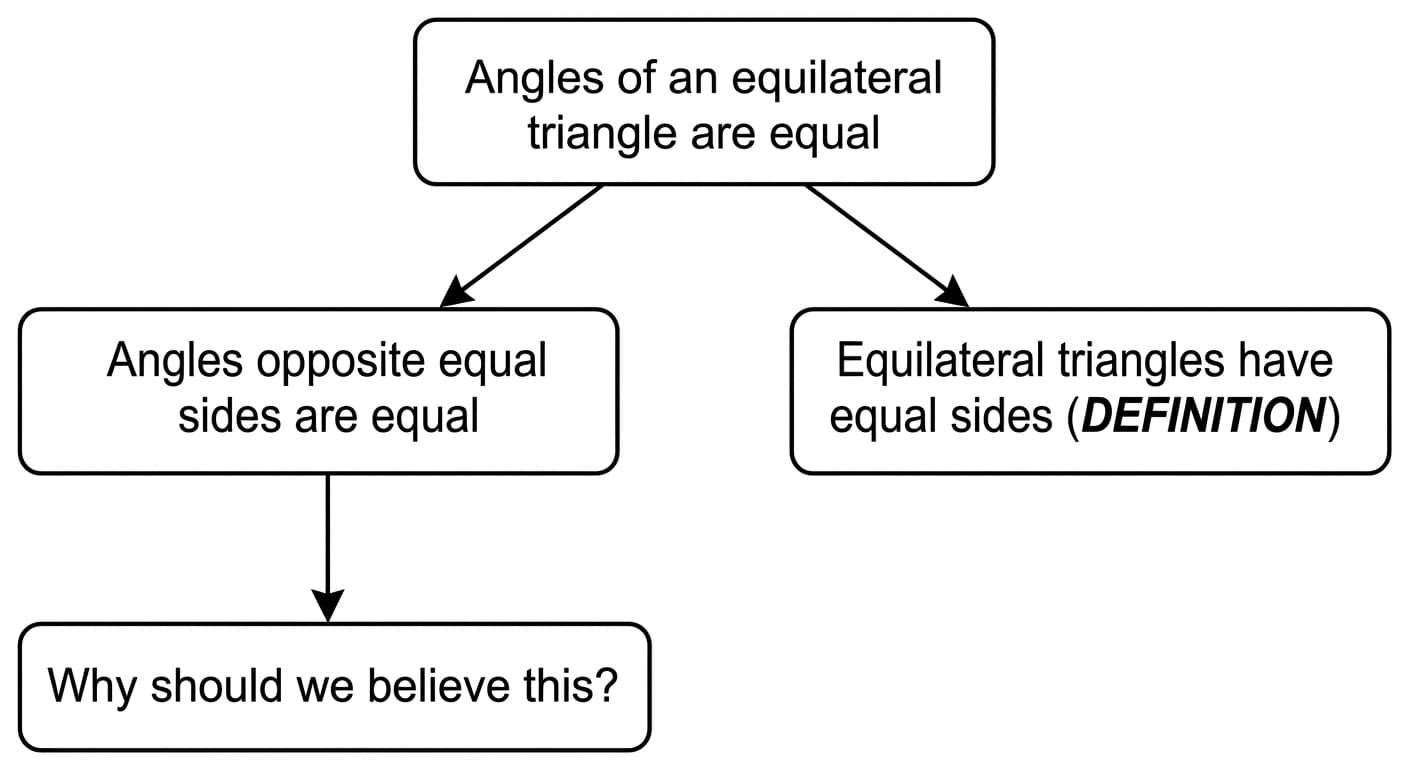
On the whiteboard, start drawing the proof tree. Put "angles of an equilateral triangle are equal" at the top. Below it, draw arrows from the claims it depends on: "angles opposite equal sides are equal" and "equilateral triangles have equal sides (definition)." This tree will grow over the next few sessions.
Session 2: Classification (~90 min)
Side-based classification
Start from claim 2: "there are many types of triangles." Ask students to classify triangles, starting with classification by sides.
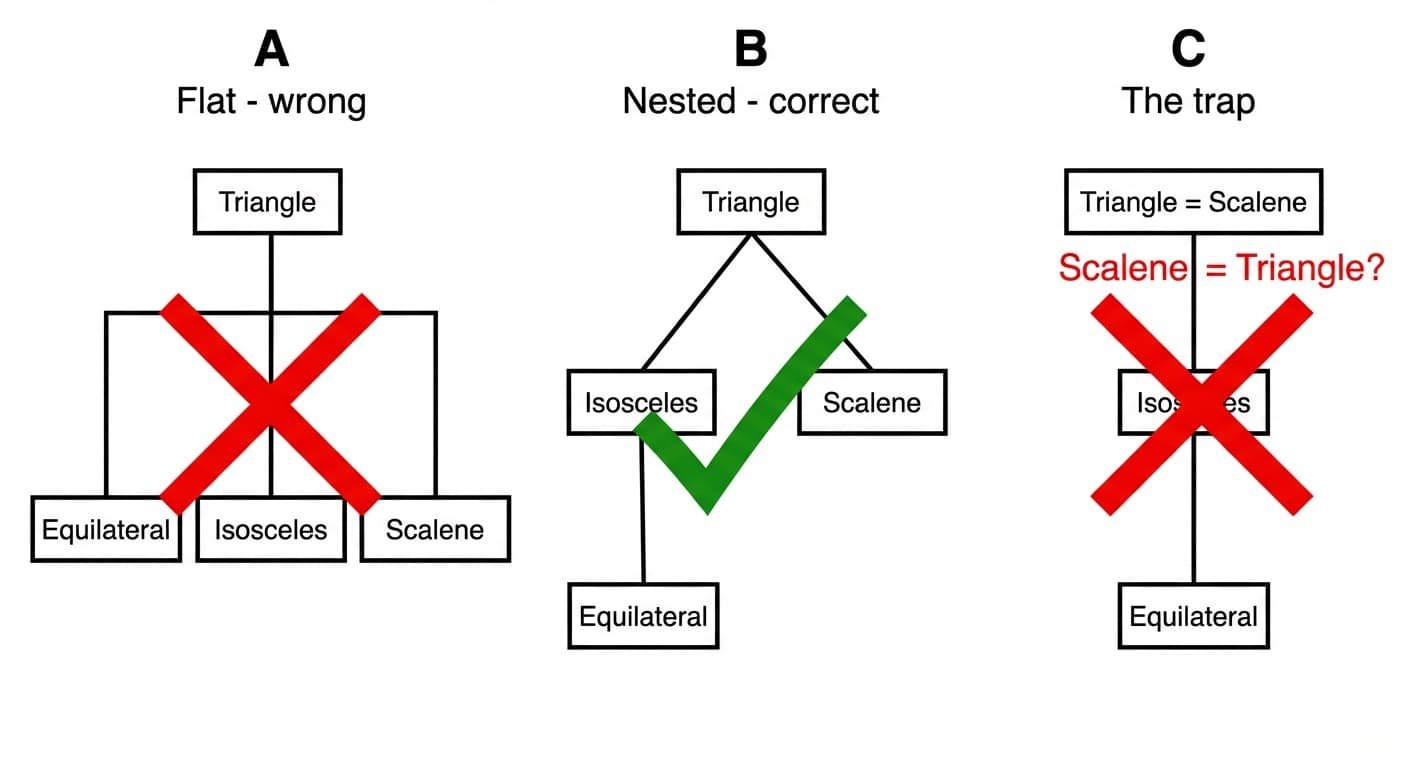
The first issue that will come up: is an equilateral triangle a type of isosceles triangle? This produces genuine disagreement. In my implementation, one student said: "Equilateral triangles have all sides equal while isosceles triangles only have two sides equal." Another responded: "I agree that isosceles triangles have two sides equal. However, equilateral triangles also have two sides equal. They also happen to have a third side equal to the other two."
This is a definitional choice, not a factual dispute. There are two definitions of isosceles:
- Triangles with exactly two equal sides (equilateral is not isosceles)
- Triangles with at least two equal sides (equilateral is isosceles)
Discuss the tradeoffs. The advantage of the "exactly two" definition is descriptive — it matches everyday usage. The advantage of "at least two" is logical inheritance: if you prove something about isosceles triangles, it automatically applies to equilateral triangles too. Since we are building a theory and want to minimise the number of proofs we need, the "at least two" definition is the better choice for our purposes.
The scalene = triangle trap
If students follow the same logic, they may argue that isosceles triangles should be types of scalene triangles (since isosceles triangles do have sides, just some happen to be equal). This happened in my implementation. Tanya and Tarini insisted that scalene should be the parent category containing isosceles. I pushed back:
"So, all triangles are scalene triangles? Then what is the difference between the word 'triangle' and 'scalene triangle'?"
The students eventually accepted: "Nothing."
This is actually a productive confusion. The students were caught between two competing values — logical inheritance (wanting everything to nest) and descriptive usefulness (wanting each term to pick out a distinct class). The resolution is that scalene triangles are simply the triangles that are not isosceles. You do not need them to be a parent category.
Angle-based classification
Move to classification by angles: acute, right, obtuse. Ask: is this classification complete? That is, does every triangle fit into exactly one of these categories?
Students will say yes. Ask: "How do I know there cannot be a triangle with two right angles?"
The answer depends on the angle sum being 180 degrees. If a triangle had two right angles, the third would be 0 degrees, and "triangles cannot have zero degree angles" is a claim that needs to go on the board.
One student, Tanya, pointed out that in spherical geometry you can have a triangle with two right angles. If this comes up, acknowledge it and note that we are working in Euclidean geometry. This is actually a sophisticated observation — the completeness of the classification depends on assumptions specific to Euclidean geometry.
The 47.5-degree challenge
Ask: "Why not classify triangles by whether they have a 47.5-degree angle? I can make a complete classification: one angle equal to 47.5 degrees, two angles equal to 47.5 degrees, two angles greater than 47.5 degrees, two angles less than 47.5 degrees. Everything is covered. Why is this a bad classification while the right-angle-based one is good?"
Students will struggle with this. The answer is that right-angled triangles have interesting theorems about them (Pythagoras' theorem, the area formula being particularly simple). There are no interesting theorems specifically about 47.5-degree triangles that are not also true of 50-degree triangles or 48-degree triangles. A classification is useful when it carves the domain at joints where interesting things happen.
I used an analogy from biology: you could classify humans into red-sock-wearers and non-red-sock-wearers, but that classification is useless for biology. Classifying by age (under 13 / over 13) is useful because there are genuine biological differences. The same principle applies to mathematical classification.
Session 3: Deeper Digging (~90 min)
The isosceles triangle theorem
Go back to the claims used in Session 1. You assumed: "angles opposite equal sides of a triangle are equal." Why should we believe that?
Students will likely give the standard textbook proof: drop a perpendicular from the vertex to the base, creating two right triangles, and use RHS congruence. This happened in my implementation. Arnav's group gave exactly this proof.
The value here is not the proof itself — it is what the proof assumes. Work through the proof step by step and extract every assumption:
- You can always drop a perpendicular from a point to a line (why?)
- Two right triangles are congruent if their hypotenuses are equal and one other side is equal — RHS (why?)
- Corresponding parts of congruent triangles are equal — CPCT (what does this actually mean?)
- The angle between two line segments is the same if they are part of the same line
Each of these goes on the board as a new claim, and each becomes something we could dig into further.
The congruence tangle
If students appeal to congruence, ask: "What do you mean by congruence?"
In my implementation, students gave various answers: "The triangles are equal," "They coincide," "If we rotate or move or reflect the triangle, then they coincide." Vivaan gave the most precise version: "If we rotate or move or reflect the triangle, then they coincide. Using only these three operations."
The key question is the relationship between different congruence tests (RHS, SSS, SAS, ASA). Are these different ways of checking the same thing, or different things? One student, Imran, showed that if you have RHS, you can derive the third side using Pythagoras' theorem, giving you SSS. This is a nice example of showing equivalence between congruence tests.
Sum of angles = 180 degrees
This claim will have been used multiple times by now — in classification, in the equilateral triangle proof, in the isosceles theorem. It is a good one to dig into.
The standard proof uses a parallel line through the opposite vertex and alternate interior angles. Work through it and extract the assumptions:
- Given a point and a line, you can draw a parallel line through the point
- Alternate interior angles formed by parallel lines and a transversal are equal
- The angle of a straight line is 180 degrees
- The three angles along the straight line at the vertex add up to the angle of the straight line
That last claim — about the angle of a straight line being 180 degrees — leads to the circularity problem.
The straight-line circularity
Ask: "What is a straight line?"
In my implementation, Gauri said: "A set of collinear points." I asked: "What does collinear mean?" Vivaan immediately saw the problem: "Collinear lies on a line. So, we will use straight line in the definition."
This is the circularity: straight line is defined as collinear points, and collinear is defined as points on a straight line. Draw this on the proof tree as an arrow going back upward — it forms a loop.
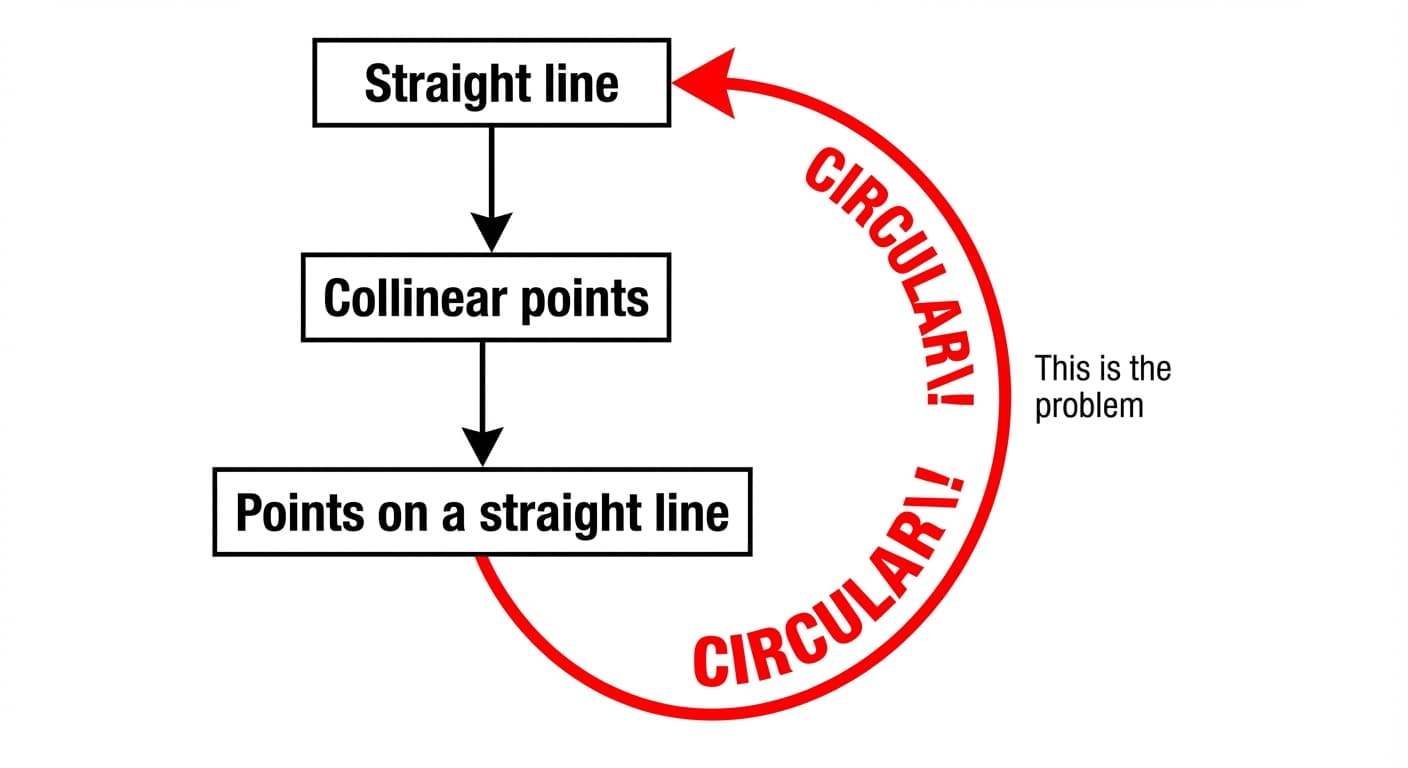
A student, Imran, suggested defining straight line as "shortest path." But what is length? What is distance? Distance between two points is the length of the straight line between them. Circular again.
Another student, Gauri, suggested: "What if we consider collinear points as the axiom? We do not have to further define it." This is essentially the right idea, though the terminology is slightly off — what she was describing is an undefined entity rather than an axiom.
Undefined entities and axioms
This is where you introduce the resolution. Not everything can be defined. If you try to define everything, you end up in circularity. Some things have to be left as undefined entities — we do not define what they are, but we constrain them using axioms.
I used the analogy of defining a t-shirt: whatever words you use, I can keep asking "what do you mean by that?" With real-world objects, you can eventually point at the thing. In mathematics, you cannot — the lines on the board are representations, not actual mathematical lines.
So we treat "straight line" as undefined and put rules on it. For example: "Given two points, there is a unique straight line which they lie on." This does not tell us what a straight line is, but it constrains the possibilities.
This is the bottom of the proof tree. The tree goes: theorems at the top, proved using other theorems and definitions below them, all the way down to axioms and undefined entities at the base.
Things that come up in practice
Four common errors
Based on running this module across two schools, four types of flawed reasoning came up repeatedly:
1. Applying a theorem outside its scope. A student, Anya, applied a theorem about two sides of the same triangle to sides of two different triangles. She was arguing about chords and diameters in a circle, and concluded that since the diameter is longer than a chord, the angle it subtends must be larger. The claim "the side opposite the greater angle is greater" applies within a single triangle, not across different triangles. When this happens, point out the scope explicitly: "That claim is about sides and angles of the same triangle. You are comparing sides of two different triangles."
2. Confusing a statement with its converse. A group claimed their result was the same as another group's, but one group had shown "sides opposite greater angles are greater" while the other was using "angles opposite greater sides are greater." These are converses, not the same statement. When this happens: "Is 'if it rains, the ground is wet' the same as 'if the ground is wet, it rained'?"
3. Circular reasoning. This came up most dramatically with the straight-line/collinear circularity. But it also appeared in smaller ways — a student tried to show a quadrilateral was cyclic by using a property that assumed it was cyclic. When you spot this, draw the loop on the board. Make the circularity visible in the structure of the proof tree.
4. Over-generalising from examples. Less common in this module than in the Podgon Game, but it does happen. A student might draw one triangle, measure its angles, and conclude the angle sum is 180. The response: "You have shown it for this triangle. Why should I believe it for all triangles?"
Students who find this repetitive
Some students found the recursive questioning tedious. One wrote: "we kept going endlessly." Another said it "gave minimal opportunity for finding alternatives and doing something different/new." On the other hand, other students valued it precisely because it challenged things they normally took for granted: "it intrigued us to prove things we normally would not question."
If students are getting frustrated, it helps to step back and show them the tree they have built. The tree is the product. Each session adds branches and depth. Pointing at the growing structure can make the purpose of the digging visible.
Students who find the content too easy
One student said this module "was a repetition and too easy for my grade." She was talking about the conclusions — she already knew the theorems about triangles. The point, which is worth making explicit, is that we are not trying to learn new facts about triangles. We are trying to understand the structure of how those facts are connected. The question is not "is the angle sum 180 degrees?" but "why should I believe it, and what does my justification depend on?"
The board gets crowded
The claim inventory and the proof tree will both grow large. Use colour coding if possible — one colour for claims, another for definitions, another for things you have flagged as needing justification. Take a photo at the end of each session.
Conceptual points worth making explicit
At various points during or after the sessions, it is worth drawing out these ideas:
Definitions are choices. Whether an equilateral triangle counts as isosceles depends on your definition of isosceles. Whether a classification is by sides or by angles is a choice. This connects directly to the Podgon Game.
Proofs connect claims. The proof tree is not just decoration. It shows the logical structure of the theory. When you prove that "angles of an equilateral triangle are equal," you are connecting that claim to "angles opposite equal sides are equal" and "equilateral triangles have equal sides." If someone rejects one of the premises, the conclusion no longer follows.
Axioms are where the digging stops. You cannot prove everything. At some point you hit claims that are accepted without proof. These are axioms. They are not "obviously true" — they are the rules we agree to play by. In Euclidean geometry, the angle sum of a triangle is 180 degrees. In spherical geometry, it is not. The axioms are different.
Circularity means the structure is broken. If a proof chain loops back on itself, it is not a proof at all — it is just asserting the conclusion in disguise. The straight-line/collinear circularity is the cleanest example. The resolution is to break the loop by leaving something undefined.
A good classification carves at the joints. The 47.5-degree classification is complete and exclusive, but useless. The right-angle classification is useful because interesting theorems cluster around the category. Definitions and classifications are tools, and some tools are better than others.
What this prepares students for
If you are running this as part of a longer course, this module does the heavy lifting on proof, axioms, and the structure of mathematical theories. The Podgon Game introduced definitions as choices. This module introduces the idea that choices have consequences — the definitions you pick determine what you can prove and how. It also introduces the idea that theories have foundations, and that investigating those foundations is itself a mathematical activity.