
Part 10 of 39
The Grazing Plan
By Madhav Kaushish · Ages 10+
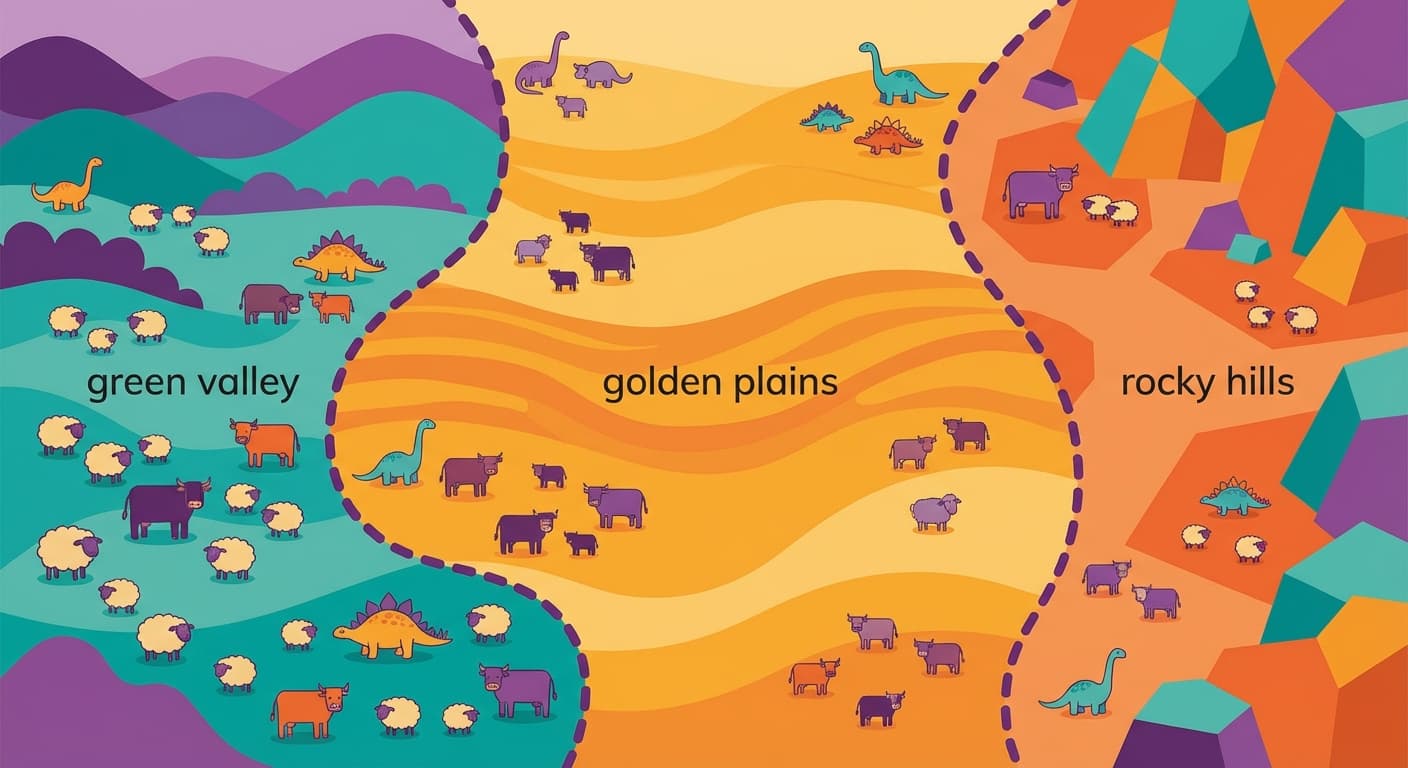
With multiplication and division in hand, Glagalbagal turned to a problem that had been nagging him since the redistribution. He had split his herd equally among the three locations — but the three locations were not equal. Location 1 was a lush river valley with rich grazing. Location 2 was open plains, decent but not exceptional. Location 3 was sparse hill terrain where Qveshna's pterodactyl patrols kept predators away but the grass was thin. Putting the same number of animals at each location made no sense.
The Capacity Question
Glagalbagal needed to figure out how many animals each location could actually support. He consulted his managers.
Frojj reported that each unit of valley grazing land could comfortably sustain five animals. Mvantika said the plains supported about three per unit. Qveshna said the hills managed two per unit at best, and even that required rotating pastures.
Glagalbagal knew the area of each location — he had measured it in land-units some years ago during a surveying project (conducted by a team of particularly meticulous ankylosaurs). Location 1 had about eighty land-units. Location 2 had sixty. Location 3 had forty.
The calculation required multiplication: animals per land-unit, multiplied by land-units, gives total capacity. He computed each one:
- Location 1: eighty land-units, five animals per unit. Adding eighty to itself five times — four additions — gave four hundred.
- Location 2: sixty land-units, three animals per unit. Adding sixty to itself three times gave a hundred and eighty.
- Location 3: forty land-units, two animals per unit. Adding forty to itself twice gave eighty.
Total capacity across all locations: four hundred plus a hundred and eighty plus eighty. Six hundred and sixty animals. Glagalbagal's current herd was only about a hundred and seventy. He had enormous room to grow.
The Allocation
But in the short term, the question was how to distribute the hundred and seventy animals he had. Equal distribution (roughly fifty-six per location, from Part 9) would overload the hills and underuse the valley.
Glagalbagal decided to allocate animals in proportion to each location's capacity. Location 1 could hold four hundred out of six hundred and sixty total — roughly six-tenths of the capacity. Location 2 held a hundred and eighty out of six hundred and sixty — roughly three-tenths. Location 3 held eighty out of six hundred and sixty — roughly one-tenth.
He used his ratio method from Part 6 to split the herd accordingly. Location 1 received about a hundred animals, Location 2 about fifty, and Location 3 about twenty. Each location was loaded at roughly the same fraction of its capacity — none was overstressed, none was wasted.
The Feed Order
Satisfied with the allocation, Glagalbagal turned to feed. Winter was still months away, but after two consecutive purchasing disasters (Parts 8 and 9), he was not taking chances. He would order early.
The calculation was a chain of operations. Monthly feed per location required multiplication: number of animals times three sacks per animal. Total monthly feed required addition across the three locations. Total winter feed required multiplying the monthly total by four months.
Glagalbagal worked through it methodically: a hundred animals at three sacks each, plus fifty at three each, plus twenty at three each. Three hundred plus a hundred and fifty plus sixty. Five hundred and ten sacks per month. Times four months. Two thousand and forty sacks.
He placed the order with Plyvek, feeling confident for the first time in a feed-related transaction.
The Surplus
At the end of winter, Glagalbagal counted his remaining feed. There were over three hundred sacks left — far more than expected. He had over-ordered by roughly fifteen percent. At Plyvek's prices, this was a substantial waste of money.
Qveshna, who had been reviewing the accounts (she had taken an interest in bookkeeping after the unfair-reward incident), identified the problem almost immediately.
Qveshna: You computed three sacks per animal per month. For every animal.
Glagalbagal: That is the consumption rate. Three sacks per animal.
Qveshna: Per adult animal. I have about twenty animals at my location. Five of them are lambs born in autumn. A lamb eats about half what an adult eats.
Glagalbagal checked the other locations. Frojj reported that roughly a quarter of his hundred animals were calves or lambs. Mvantika had a similar proportion.
In total, about forty of the hundred and seventy animals were young. These consumed roughly one and a half sacks per month, not three. The correct calculation was: a hundred and thirty adults at three sacks, plus forty young at one and a half sacks. Three hundred and ninety plus sixty. Four hundred and fifty sacks per month — not five hundred and ten. Over four months, the difference was two hundred and forty sacks. That was the surplus, and it was wasted money.
The Deeper Problem
The error was not in the arithmetic. Every multiplication and addition had been performed correctly. The error was in the model — Glagalbagal had treated every animal as identical. One pebble equaled one animal, regardless of whether that animal was a full-grown bull or a newborn lamb.
Qveshna: Your pebble system counts animals. It does not say what kind of animal each pebble represents.
Glagalbagal: I could keep two separate counts — one for adults and one for young animals.
Qveshna: And when you need to distinguish sheep from cattle? Healthy from sick? Breeding stock from meat animals? You will need a separate count for every category. Your baskets will fill the entire cave.
She was right. Glagalbagal's system was powerful for manipulating quantities — adding, subtracting, multiplying, dividing. But it could only represent one type of information: how many. It could not represent what kind.
For now, Glagalbagal worked around the limitation by maintaining two parallel sets of arrangements — one for adults, one for young — and running every calculation twice. It was clunky, and adding a third category (say, distinguishing sheep from cattle) would triple the work. The system needed something more, but what that something was, Glagalbagal could not yet see.