
Part 20 of 39
The Rule Tablets
By Madhav Kaushish · Ages 10+
The normalized records, the indexes, the structured formats — everything was running well. Glagalbagal had, for the first time in years, a morning where nothing was on fire, no pterodactyl carried a panic message, and Blortz had nothing to complain about. This, naturally, was when the summons arrived.
The Pilgrimage
Every citizen of the region was required, once per decade, to make the pilgrimage to the Temple of Brvjanka — a four-week journey each way across the Grothian Desert and the Swamp of Unreasonable Humidity. The chieftain had granted no exemptions, not even for shepherds whose businesses depended on their daily presence. Glagalbagal's decade was up.
Blortz: You could pretend to be dead.
Glagalbagal: They check.
Blortz: You could send a convincing substitute. I know a diplodocus who owes me a favour.
Glagalbagal: The penalty for skipping the pilgrimage is forfeiture of all livestock. The penalty for sending a substitute is forfeiture of all livestock and the substitute.
Blortz conceded the point. Glagalbagal would be gone for two months. The business would need to run itself — or, more precisely, the velociraptors would need to run it.
The Problem
The velociraptors were excellent at following instruction tablets. They could count, carry, update indexes, and maintain records with mechanical precision. But instruction tablets described procedures — sequences of steps. What the velociraptors lacked were decision-making rules. The instruction tablets said how to do things. They did not say when to do them, or whether to do them at all.
Currently, Glagalbagal made every significant decision himself. When should the herd be moved to fresh pasture? When should a predator alert be escalated to a full relocation? When should feed reserves be restocked? When should a carrier pterodactyl be dispatched to a location manager? The velociraptors had never needed to make these decisions because Glagalbagal was always there to make them.
He would not be there for two months.
The First Attempt
Glagalbagal sat down with Blortz and began listing every decision that might arise during his absence. For each decision, he wrote what he called a rule tablet — a stone slab stating a condition and an action.
The first rule tablet read:
If the monthly count at any location drops by more than ten animals, send a carrier pterodactyl to Glagalbagal.
This seemed straightforward. A velociraptor would check the monthly count against the previous month's count. If the difference exceeded ten, it would dispatch a pterodactyl. Simple.
The second rule tablet:
If the feed reserve at any location falls below twenty units, order additional feed from the Thjervak supplier.
The third:
If a predator is sighted at any location, move the herd to the backup grazing area.
He continued in this fashion for three days, producing forty-seven rule tablets covering every scenario he could imagine.
The Test
Before leaving, Glagalbagal ran a test. He gave the rule tablets to Krothva, his most reliable velociraptor, and presented her with a scenario: "The monthly count at Location 2 has dropped by fourteen. What do you do?"
Krothva examined the rule tablets. She found Tablet 1: if the count drops by more than ten, send a pterodactyl. She dispatched a pterodactyl (a hypothetical one, for the test).
Glagalbagal: Good. Now: the feed reserve at Location 3 is at eighteen units. What do you do?
Krothva found Tablet 2: if the feed reserve falls below twenty, order feed. She placed an order.
Glagalbagal: Excellent. Now: a predator is sighted at Location 1, but the count has not dropped and the feed is fine. What do you do?
Krothva found Tablet 3: if a predator is sighted, move the herd. She moved the herd.
All correct. Glagalbagal was satisfied.
The Ambiguity
Blortz was not satisfied.
Blortz: What does "drops by more than ten" mean, exactly?
Glagalbagal: It means the count decreased by more than ten animals.
Blortz: Compared to what? The previous month? The same month last year? The expected count based on the breeding schedule?
Glagalbagal paused. He had meant "compared to the previous month." But the rule tablet did not say that. A velociraptor reading it could reasonably compare the count to any of those baselines.
He re-carved Tablet 1:
If the monthly count at any location is more than ten animals fewer than the count at the same location in the immediately preceding month, send a carrier pterodactyl to Glagalbagal.
Blortz: Better. Now what does "send a carrier pterodactyl" mean? Which pterodactyl? With what message? To which location along the pilgrimage route?
Glagalbagal: The nearest available pterodactyl, carrying a message stating which location had the drop and by how many, sent to the Temple of Brvjanka.
Blortz: The rule tablet says none of that.
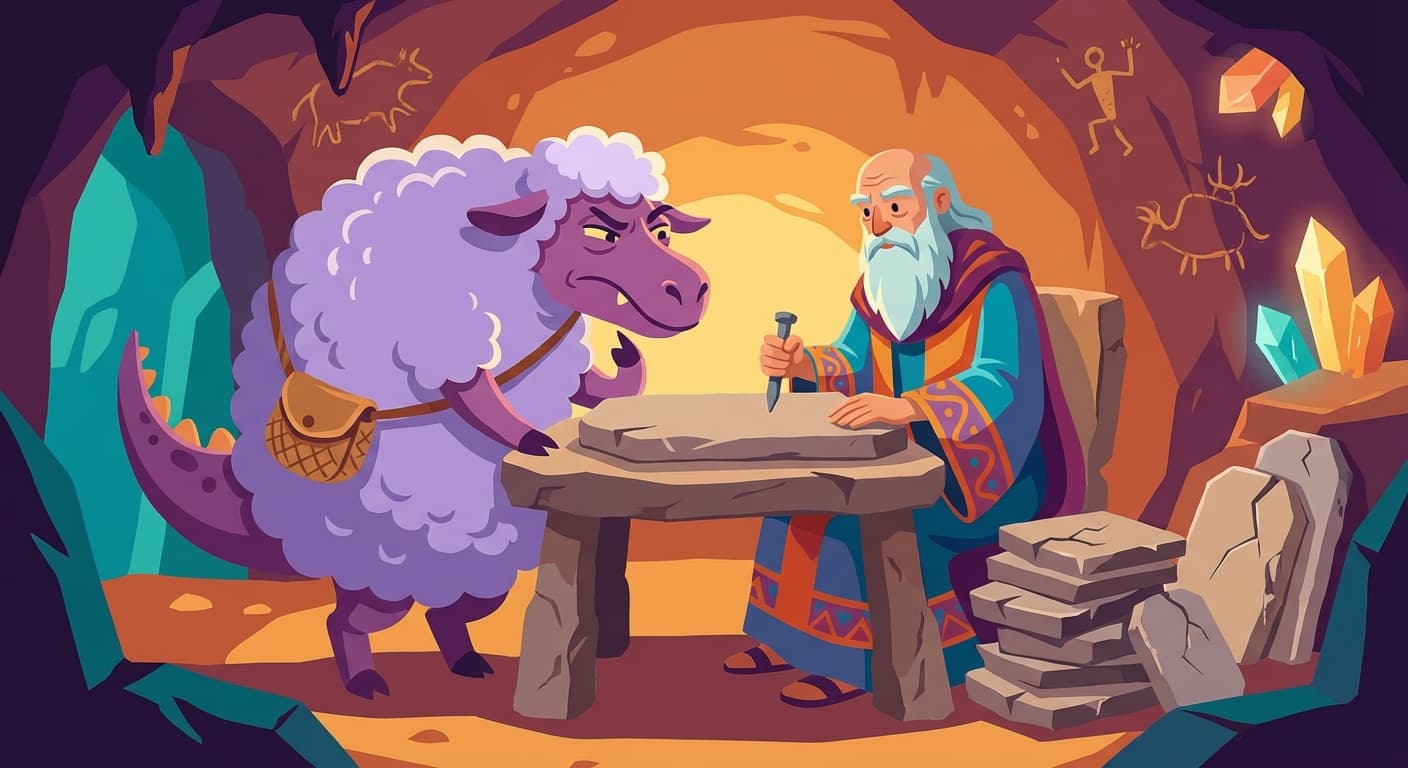
Glagalbagal re-carved it again. Then again. Each time Blortz found a word that could be interpreted in more than one way. "More than ten" — did that include exactly ten? "Any location" — did that include the Thjervak Plains, which used a different counting cycle? "Immediately preceding" — what if the preceding month's record was missing due to a clerical error?
By the end of the fourth day, the forty-seven rule tablets had become sixty-three, each one carved with painful specificity. Every condition was defined in terms of exact comparisons between specific fields in the structured records. Every action was a reference to an existing instruction tablet that the velociraptors already knew how to execute.
The Gap
On the fifth day, Blortz raised a different problem.
Blortz: You have sixty-three rules. What happens when a situation arises that none of the rules cover?
Glagalbagal: I have covered everything.
Blortz: What if the count drops by exactly ten? Your rule says "more than ten." Ten is not more than ten. The velociraptor will do nothing. Is that what you want?
Glagalbagal considered. A drop of ten was nearly as alarming as a drop of eleven. He changed the threshold to "ten or more."
Blortz: What if the count drops by five, but this is the third consecutive month of dropping by five? That is a loss of fifteen over three months, which should certainly trigger the rule. But no single month exceeds ten.
Glagalbagal stared at the rule tablet. He had written rules about individual months. He had not written rules about trends. A slow, steady decline would slip through every rule he had carved.
He added Tablet 64: If the count at any location has decreased in each of the three most recent months, and the total decrease over those three months exceeds ten, send a carrier pterodactyl to Glagalbagal.
Blortz nodded. Then asked what should happen if the count decreased in months one and two but increased in month three — but the net change was still negative. Glagalbagal carved another tablet. And another.
The pile of rule tablets now numbered seventy-one, and Blortz had not yet asked about weather events, animal diseases, disputes between location managers, or the possibility that a pterodactyl might fail to deliver a message.
Glagalbagal: I am beginning to think that no finite number of rules can cover every situation.
Blortz: Now you understand why the chieftain employs advisors.