
Part 31 of 39
Tax Season
By Madhav Kaushish · Ages 10+
GlagalCloud's customer partitions were solid. Data was isolated. Working baskets were cleared between tasks. The system was trustworthy. Then Hrijpa arrived, and with it, the pre-festival tax deadline.
The Rush
Every livestock owner, trader, and property holder in the region was required to file tax records by the fifth day of Hrijpa. Thvajjik had set this deadline decades ago and saw no reason to change it, despite the fact that the regional economy had grown considerably since the days when tax filing meant a single shepherd handing over a basket of pebbles.
Eight of GlagalCloud's eleven customers needed their annual tax calculations completed before the deadline. Each calculation required a velociraptor to process a full year's records — twelve monthly reports, combined with the animal type valuations, the location-specific tax rates, and the regional adjustments that Thvajjik updated annually with the enthusiasm of someone who genuinely enjoyed making tax law more complicated.
A single tax calculation took approximately four hours of velociraptor time. Eight calculations meant thirty-two hours. GlagalCloud had five velociraptors. The deadline was in three days.
Blortz: Five velociraptors, thirty-two hours of work, seventy-two hours available. The arithmetic works — barely.
Glagalbagal: That assumes no other work. We also have routine monthly reports coming in, Grothvik's patient queries, the boat-builder's structural calculations, and Hjelvran's end-of-quarter inventory.
Blortz: Then the arithmetic does not work.
The Queue
The simplest approach was first-come, first-served. Jobs would be processed in the order they were submitted. But this was demonstrably unfair: Gnelvik had submitted his tax request three weeks ago (he was anxious by nature), while Bretchka had submitted hers yesterday. Under first-come, first-served, Gnelvik's four-hour calculation would be processed long before Bretchka's, even though both had the same deadline.
Worse, Grothvik's patient query — a five-minute lookup — was stuck behind Thvajjik's regional tax aggregate, which would take twelve hours. Grothvik needed to know whether a patient was allergic to fever-bark before administering it that afternoon. The query was urgent and small. The tax aggregate was important but not time-sensitive for another two days.
Glagalbagal: Not all jobs are equal. Some are urgent and small. Some are large but can wait. Some have hard deadlines. Some are routine.
The Priority Queue
Glagalbagal assigned each job a priority based on two factors: deadline urgency and estimated processing time.
Priority 1 (highest): Urgent, small. Grothvik's patient lookups. Process immediately, even if it means pausing a larger job. Priority 2: Deadline-critical, any size. Tax calculations due within two days. Priority 3: Important but flexible. End-of-quarter reports, inventory analyses. Priority 4 (lowest): Routine. Monthly report processing, index updates.
A velociraptor would always pick the highest-priority job available. If a Priority 1 job arrived while a Priority 3 job was in progress, the velociraptor would pause the Priority 3 job (saving its intermediate state in the customer's working baskets), process the Priority 1 job, then resume the Priority 3 job.
This solved the urgency problem but not the capacity problem. Even with perfect prioritisation, thirty-two hours of tax calculations and five velociraptors and three days still left almost no time for anything else.
The Temporary Workers
Glagalbagal had, until now, employed five full-time velociraptors. They were trained, reliable, and expensive. Hiring five more permanently would double his labour costs year-round — costs that were only justified during the three-week pre-Hrijpa rush.
Blortz proposed hiring temporary workers.
Blortz: There are velociraptors in the village who do seasonal work — harvest counting, festival setup, postal delivery. They are available for hire on short contracts.
Glagalbagal: They are not trained on our instruction tablets.
Blortz: Your instruction tablets are explicit enough that a velociraptor of average competence can follow them. That was the entire point of Parts 11 through 14.
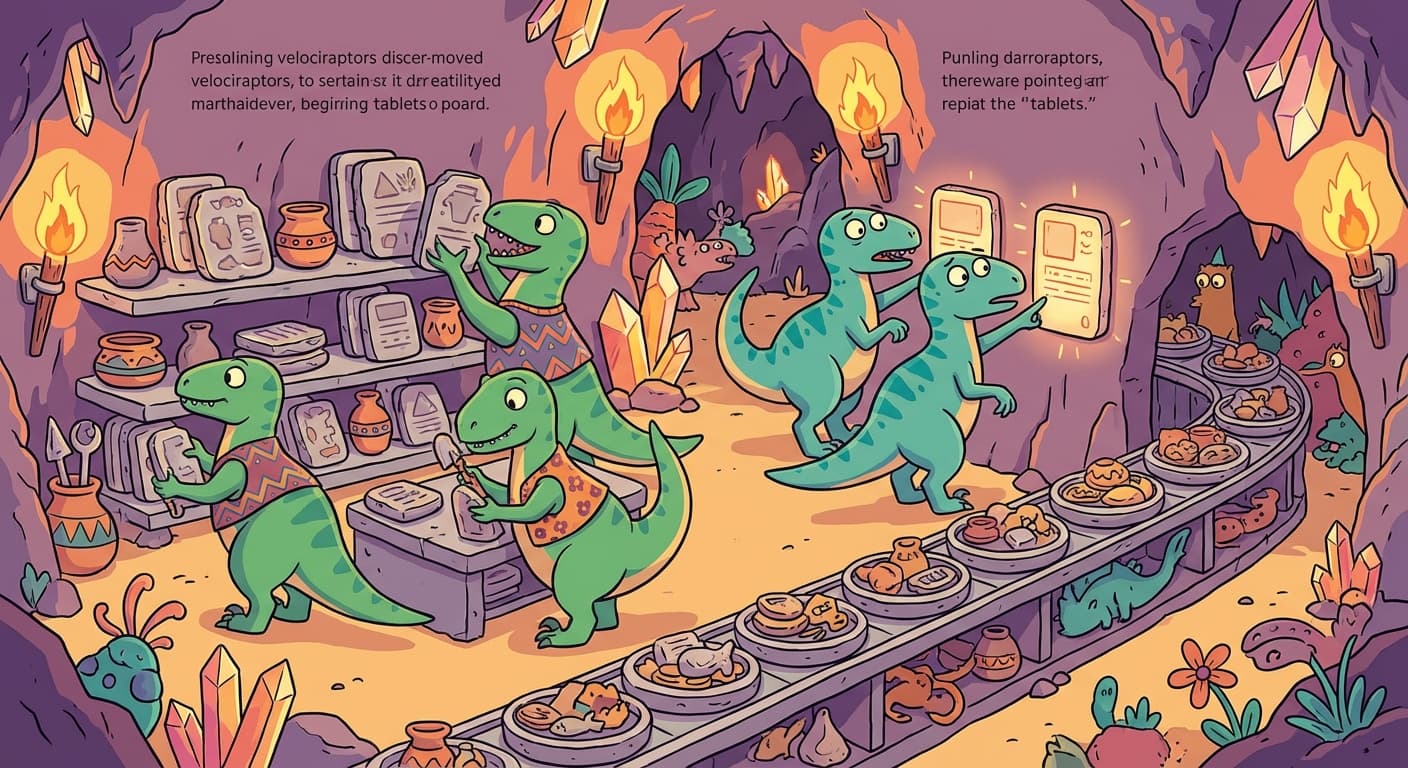
Glagalbagal hired three temporary velociraptors for the pre-Hrijpa period. Training took one day — the instruction tablets, the customer partitions, the access rules, the check sum verification. The temporary workers were slower than the regulars (they consulted the tablets more frequently) but they were adequate for the well-defined tax calculations. Complex queries — Grothvik's medical analyses, the boat-builder's structural calculations — remained with the experienced staff.
The Economic Calculation
After Hrijpa, the temporary velociraptors were released. The cave returned to its normal five. Blortz reviewed the economics.
Blortz: During the three-week rush, revenue was four times the monthly average. Labour cost was 1.6 times — five permanent velociraptors plus three temporaries at a slightly higher daily rate. Net margin was substantially better than a quiet month, even with the extra workers.
Glagalbagal: So we should hire temporaries every Hrijpa.
Blortz: You should hire temporaries whenever demand exceeds capacity, and release them when it drops. The permanent staff handles the baseline. The temporaries handle the peaks.
Glagalbagal: What if we hired no permanent staff and used only temporaries?
Blortz: Then every day would begin with a training period. No institutional memory. No velociraptor who knows where the indexing anomaly in Shelf 4 lives. Institutional knowledge has value that does not appear on the ledger.
The optimal configuration, they concluded, was a core of permanent velociraptors large enough to handle average demand, supplemented by temporaries during predictable peaks. The core provided expertise and continuity. The temporaries provided elasticity.
Glagalbagal: We have built a system that breathes — it expands when demand rises and contracts when it falls.
Blortz: You have built a staffing agency. But yes, that is a more poetic way of saying it.