
Part 2 of 4
Two Systems
By Madhav Kaushish · Ages 10+
Fliba showed Lagard diagrams representing two different classification systems for quadrilaterals. In one system (the "skyscraper system"), squares are types of rectangles, which are types of parallelograms, which are types of trapeziums. In the other (the "globe system"), each shape is its own separate category with no overlaps.
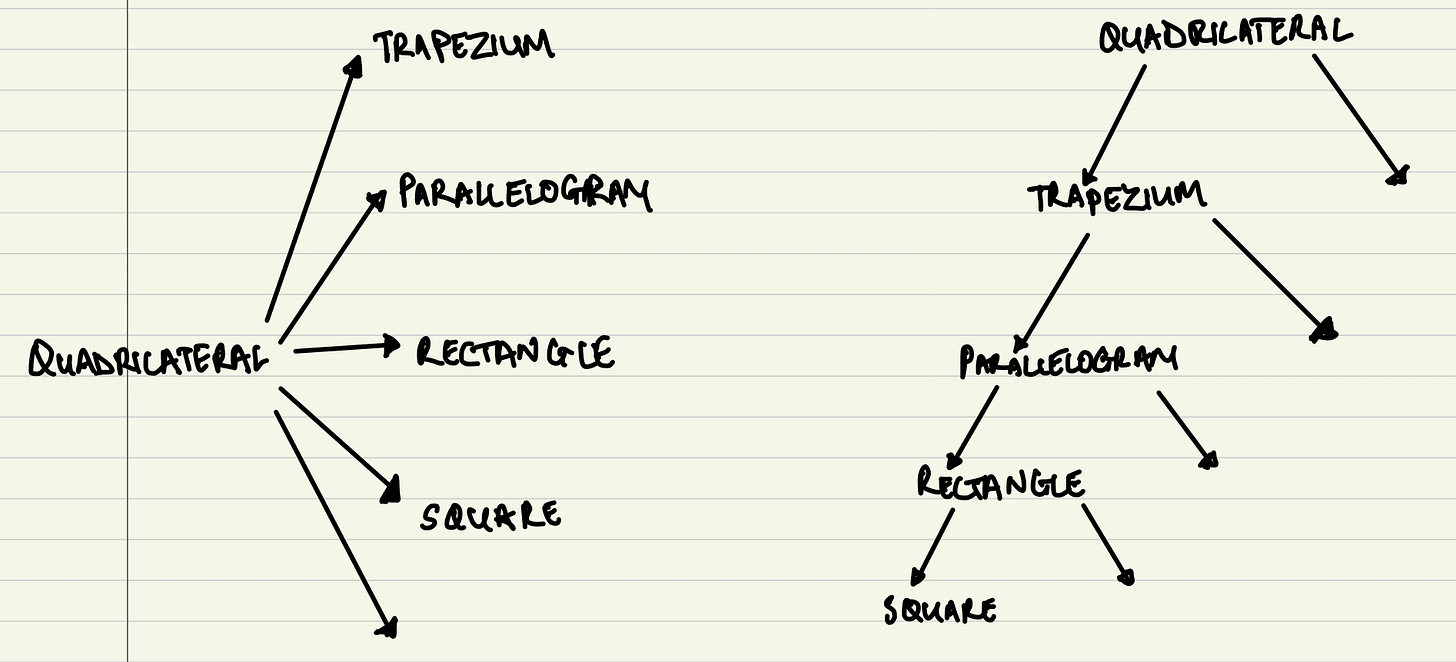
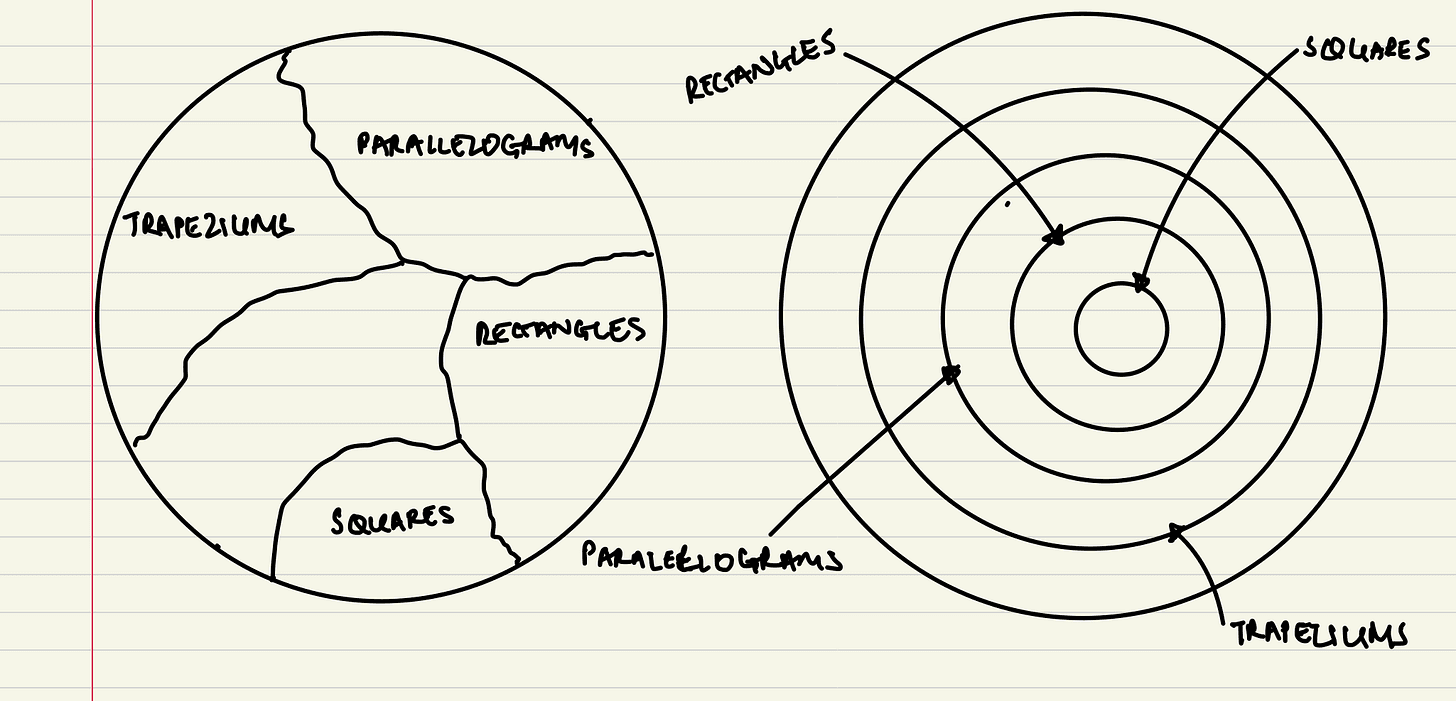
Lagard: Wait — you drew these! Your handwriting is the same as your sister Glagalbagal's.
Fliba: We had the same preschool teacher. Anyway, let's focus. Notice that rhombuses are missing — we'll add them later.
Definitions in the Skyscraper System
Both systems use the same square definition: A square is a quadrilateral with all sides equal and all angles 90 degrees.
For rectangles in the skyscraper system: A rectangle is a quadrilateral with opposite sides equal and all angles 90 degrees.
Fliba pointed out a nice shortcut — since squares are a type of rectangle in this system, you can abbreviate: A square is a rectangle with adjacent sides equal.
Lagard developed the full hierarchy of definitions:
- A rectangle is a parallelogram with all angles 90 degrees
- A parallelogram is a trapezium with opposite sides parallel
- A trapezium is a quadrilateral with one pair of parallel sides
Each definition builds on the previous one — short and clean.
Definitions in the Globe System
For the globe system, where no shape is a type of another, the definitions need extra conditions to exclude overlaps.
Lagard: For a parallelogram... a quadrilateral with opposite sides parallel.
Fliba: But that would make rectangles types of parallelograms!
So the revised definition became: A parallelogram is a quadrilateral with opposite sides parallel and all angles not equal to 90 degrees.
For trapeziums: A trapezium is a quadrilateral with one pair of opposite sides parallel and the other pair not parallel.
Fliba: See how much more complicated the globe definitions are? They need all these extra exclusion clauses. That suggests the skyscraper system is better.
Lagard: The definitions are more complicated, I'll give you that. But I'm not fully convinced that's enough reason to prefer one over the other.
Fliba: Fair enough. Let's try adding rhombuses to both systems. That might make the case clearer.