
Part 17 of 58
The Sick Field
By Madhav Kaushish · Ages 12+
Grothvik's medical models were running smoothly. Jvelthra's grain contamination system was deployed across twelve villages. GlagalCloud's prediction service was gaining a reputation.
Then Kvrothja the farmer arrived with a different kind of data entirely.
The Grid
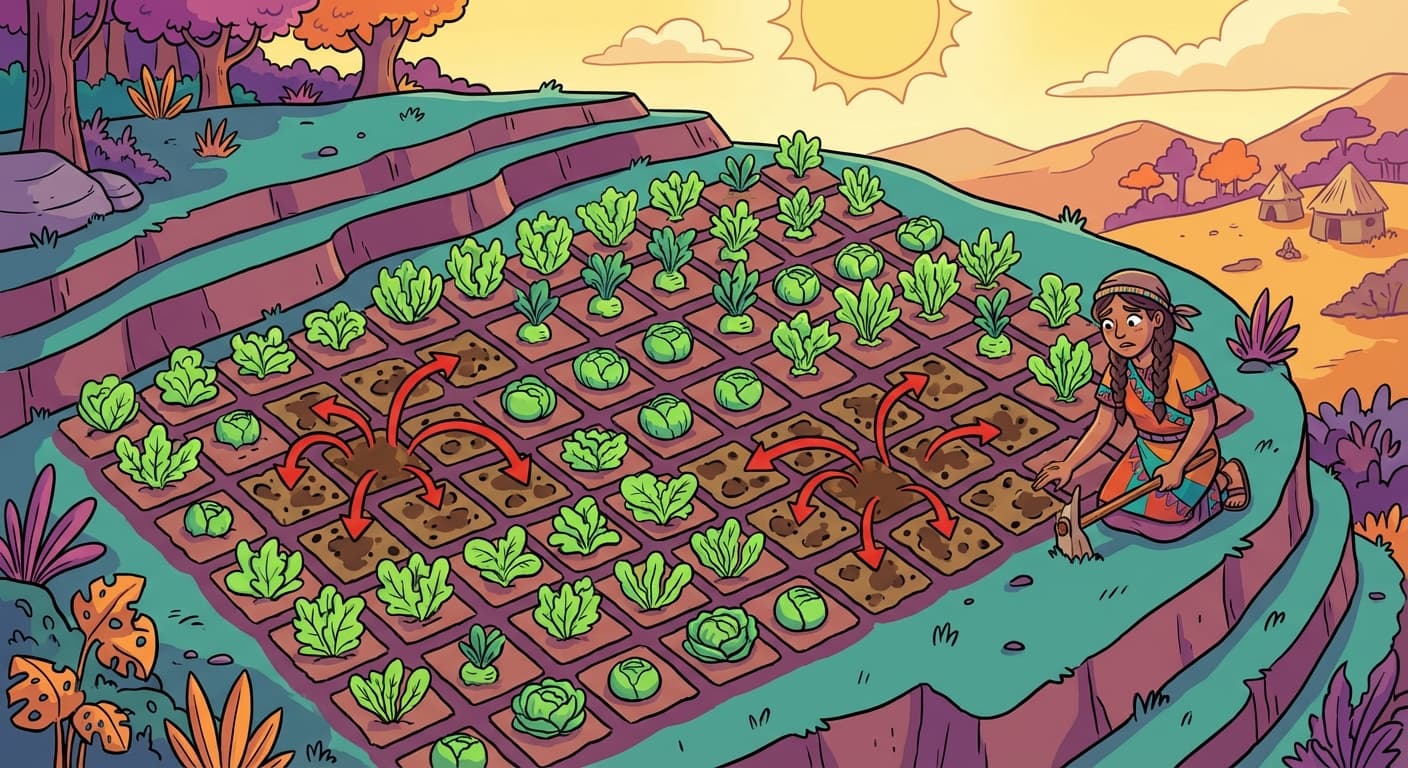
Kvrothja managed terraced fields on the hillside east of GlagalCloud. Each field was divided into a grid of plots — twenty rows by twenty columns, four hundred plots per field. She monitored each plot for blight, a plant disease that destroyed crops.
She brought survey records for forty fields. Each record was a grid: four hundred entries, one per plot, marking the plot as healthy or blighted. Some fields had no blight. Some had patches. Some were devastated.
Kvrothja: The blight spreads in clusters. It starts at one plot and radiates outward. If I can predict where the next cluster will form, I can treat the soil before the blight takes hold.
Trviksha: You want a model that looks at a field and predicts which plots are at risk.
Kvrothja: I want a model that looks at a field and tells me where to apply the treatment. Treatment is expensive. I cannot treat every plot. I need to know which ones.
The Flat Approach
Trviksha's instinct was to apply the same technique she had used for patients and grain stores. She flattened each field grid into a list: plot 1, plot 2, plot 3, ... plot 400. Each plot's status (and the statuses of all other plots) became inputs. She built a network with four hundred inputs, a hidden layer, and one output per plot.
The network trained. After many passes, it achieved 76% accuracy on held-out fields — decent, but not good enough for Kvrothja's purposes. More troubling were the errors.
Kvrothja: Your model flagged a cluster of plots in the upper-right corner of Field 23. But the blight in Field 23 is in the lower-left corner. The upper-right is perfectly healthy.
Trviksha examined the network's behavior. On a different field — Field 7 — the blight was in the upper-right corner, and the network had learned to associate "upper-right" with blight. When it saw Field 23, it applied the same association, even though Field 23's blight was elsewhere.
Trviksha: The network thinks location on the grid matters. It has learned that plot 17 (upper-right area) tends to be blighted, because in many training fields, the blight happened to be in that area. But the blight is not caused by being in the upper-right. It is caused by soil conditions, drainage, and proximity to already-blighted plots.
The Shuffle Test
To confirm her suspicion, Trviksha ran a test. She took a field, shuffled the order of the plots randomly — swapping rows and columns — and fed it to the network. The network's predictions changed completely, even though the pattern of blight was the same. The same cluster of disease, in the same relative arrangement, produced different predictions depending on where in the grid it happened to sit.
Blortz: The network does not know that plot 17 and plot 18 are next to each other. It treats each plot as an independent input, like patient age or grain humidity. But plots are not independent. A plot's risk depends on its neighbours.
Trviksha: The network sees four hundred disconnected numbers. It does not see a grid. It does not know that plot 17 is adjacent to plot 18 and below plot 37. It has no concept of "next to."
Kvrothja: But "next to" is everything. Blight spreads to neighbours. A healthy plot surrounded by blighted plots is at extreme risk. A blighted plot surrounded by healthy plots is an isolated case. The neighbourhood is the signal.
The Problem
The fully connected network — the kind Trviksha had been building — treated every input as potentially connected to every output. Plot 1 in the upper-left could influence the prediction for plot 400 in the lower-right, just as easily as for its immediate neighbour. The network had no built-in understanding that space existed, that some inputs were close and others were far, that local patterns mattered more than distant ones.
For patient data, this did not matter. A patient's age was not "next to" their diet in any spatial sense. Every factor was equally connected to the outcome.
For field data, it mattered enormously. The grid had structure. Neighbours mattered. Distance mattered. A cluster of blight in one corner of the field was the same pattern as a cluster in another corner — but the fully connected network treated them as entirely different situations, because the input positions were different.
Trviksha: I need a network that understands space. One that knows about neighbourhoods. One that recognizes the same pattern regardless of where it appears in the grid.
Drysska: My current architecture does not support this. I process each input independently.
Trviksha: Then I need a different architecture.