
Part 58 of 58
The Guided Dream
By Madhav Kaushish · Ages 12+
The diffusion model generated new layouts, but they were uncontrolled — each random starting point produced whatever the network happened to sculpt. Kvrothja needed specific designs.
The Specification
Kvrothja: I need a layout for marsh terrain, high animal density, with water access on the eastern boundary. Your generator produces hill-terrain layouts because that is what it was trained on. Can it produce marsh layouts?
Trviksha: I have trained it on your thirty hill-terrain examples. It can only generate things that resemble those examples. For marsh terrain, I need either marsh-terrain training data or a way to steer the generation toward desired properties.
She collected twelve marsh-terrain layouts from other farms, added them to the training set, and retrained. The model could now generate both hill-terrain and marsh-terrain layouts. But it chose between them randomly — sometimes producing one type, sometimes the other.
Conditioning
Trviksha added a label to each training example: terrain type, animal density, water access direction. During training, the denoiser received not just the noisy layout but also the label describing the target layout's properties.
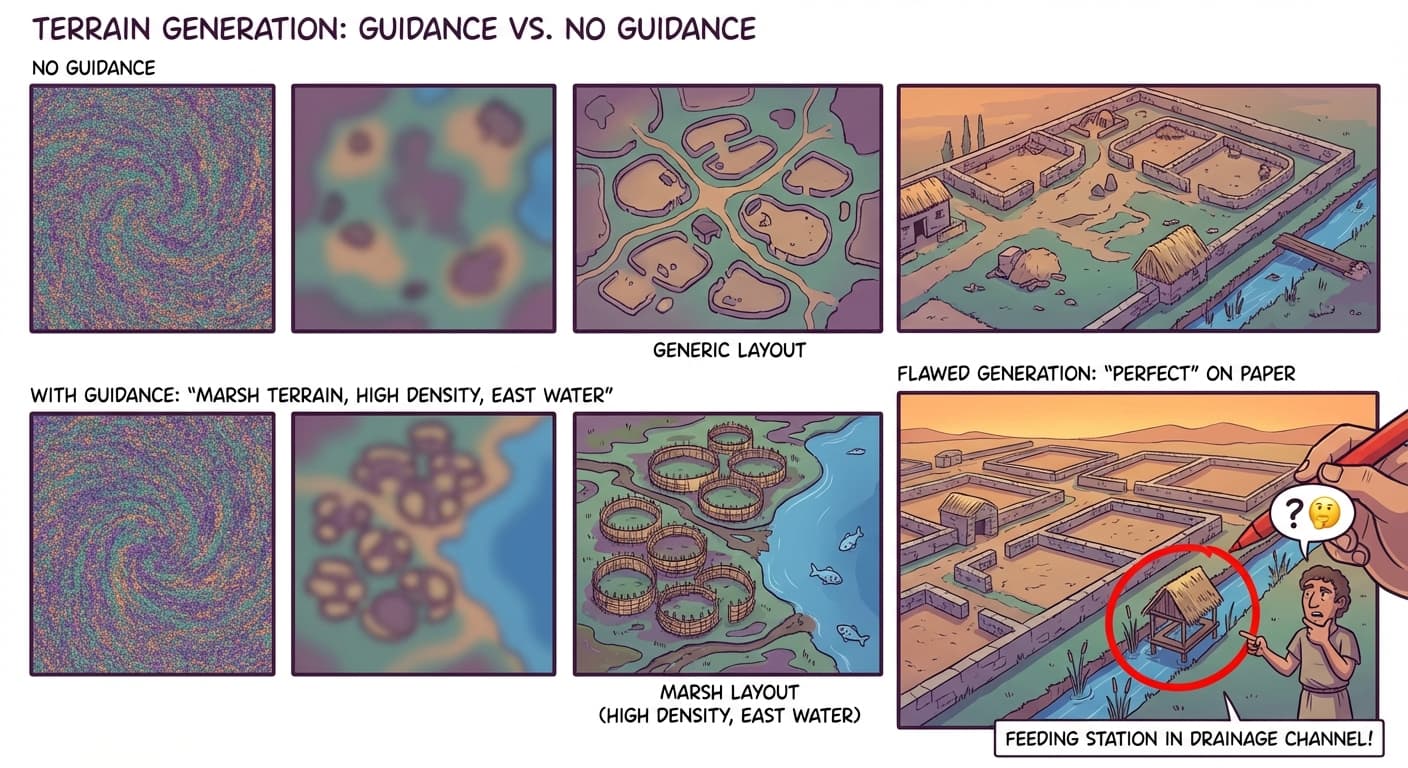
At generation time, she provided the desired label — "marsh terrain, high density, eastern water access" — and the denoiser used it to guide the denoising process. At each step, the network removed noise in a way that steered toward the specified properties.
Trviksha: The label is a steering signal. Without it, the denoiser removes noise arbitrarily — whatever direction reduces the noise, it takes. With the label, the denoiser removes noise preferentially in directions that match the specification. The result is a layout that satisfies the requested properties.
She generated ten layouts with the specification "marsh terrain, high density, eastern water access." All ten had marsh-appropriate infrastructure, high-density pen arrangements, and water access along the eastern boundary. Each was unique — different specific placements — but all matched the description.
Kvrothja: Seven of these are usable. Two need minor adjustments. One has a problem — it placed a feeding station in the middle of a drainage channel.
The Impossible Layout
The drainage channel error was instructive. The model had learned, from the training data, that feeding stations were placed near water access. In marsh terrain, water access and drainage channels were often in the same area. The model, following the statistical pattern "feeding stations go near water," placed a feeding station where a drainage channel ran — a location that was statistically consistent with the training data but physically impossible.
Kvrothja: You cannot put a feeding station in a drainage channel. The animals cannot reach it, and it would flood every time it rains. Anyone who has worked on a marsh farm would know this.
Trviksha: The model does not know what a drainage channel is. It knows that certain grid positions, in the training layouts, had a particular combination of features. It does not know the physical reason behind the placement. When the statistical pattern and the physical reality diverge — which they occasionally do — the model follows the statistics.
Blortz: The shadow problem again. In the blight detection system, the model confused shadows with disease because both had the same statistical signature. Here, the model confuses "near water" with "in the drainage channel" because both co-occur in the data.
Trviksha: Every model we have built has this limitation. It learns patterns from data. It does not understand the physical, causal, or logical reasons behind those patterns. When the patterns hold, the model works beautifully. When they break — when statistical correlation diverges from physical reality — the model produces something that looks right but is wrong.
The End of the Beginning
Glagalbagal: So after all of this — from counting pebbles to generating farm layouts from pure noise — the fundamental limitation has not changed. The pebbles do not know what they are counting.
Trviksha: They never did. They count faster now. They count in more dimensions. They count patterns that I could never have found by hand. But they are still counting — correlations in data, not truths about the world.
Kvrothja: And yet seven of your ten layouts are usable. That is seven layouts I did not have to design from scratch. I will fix the drainage channel myself. The model saved me weeks of work.
Trviksha: That is the honest summary. The model is powerful and limited. It generates remarkable things that are mostly right and occasionally wrong in ways that require human expertise to catch. It extends what humans can do. It does not replace the need for humans to understand what they are doing.
Glagalbagal: The pebbles are tools. The best tools we have ever built. But tools. The understanding — the real understanding of what the pebbles are doing and why it matters — that still lives in us.
Trviksha looked at the row of systems she had built: the patient predictor, the grain classifier, the blight detector, the weather forecaster, the contract reader, the language model, the pterodactyl navigator, the aligned advisor, the efficient processor, the step-by-step reasoner, the layout generator. Each one had started with a problem, discovered a limitation, and invented a solution — which revealed a new problem. The chain had run from simple pattern recognition to diffusion models, from counting by hand to generating from noise.
And the chain, she suspected, was not finished.