
Part 13 of 43
The Amnesty
By Madhav Kaushish · Ages 12+
The amnesty came on a Tuesday. A clerk read the decree in the prison courtyard: all persons convicted of "minor bodily offenses" were to be released immediately, by order of the governor, in a gesture of enlightened mercy toward those who had merely used their bodies in unapproved ways.
Crivsola's crime — performing a headstand while female — qualified.
Lomytguya's did not.
The Goodbye
They stood in the cell that had been their shared home for months. Lomytguya's face was composed, as it always was. She had survived worse disappointments than this.
"I will visit," Crivsola said.
"You will be busy."
"I will visit."
Lomytguya nodded. Then she said, "Figure out the rivers. I want to hear about them when you come back."
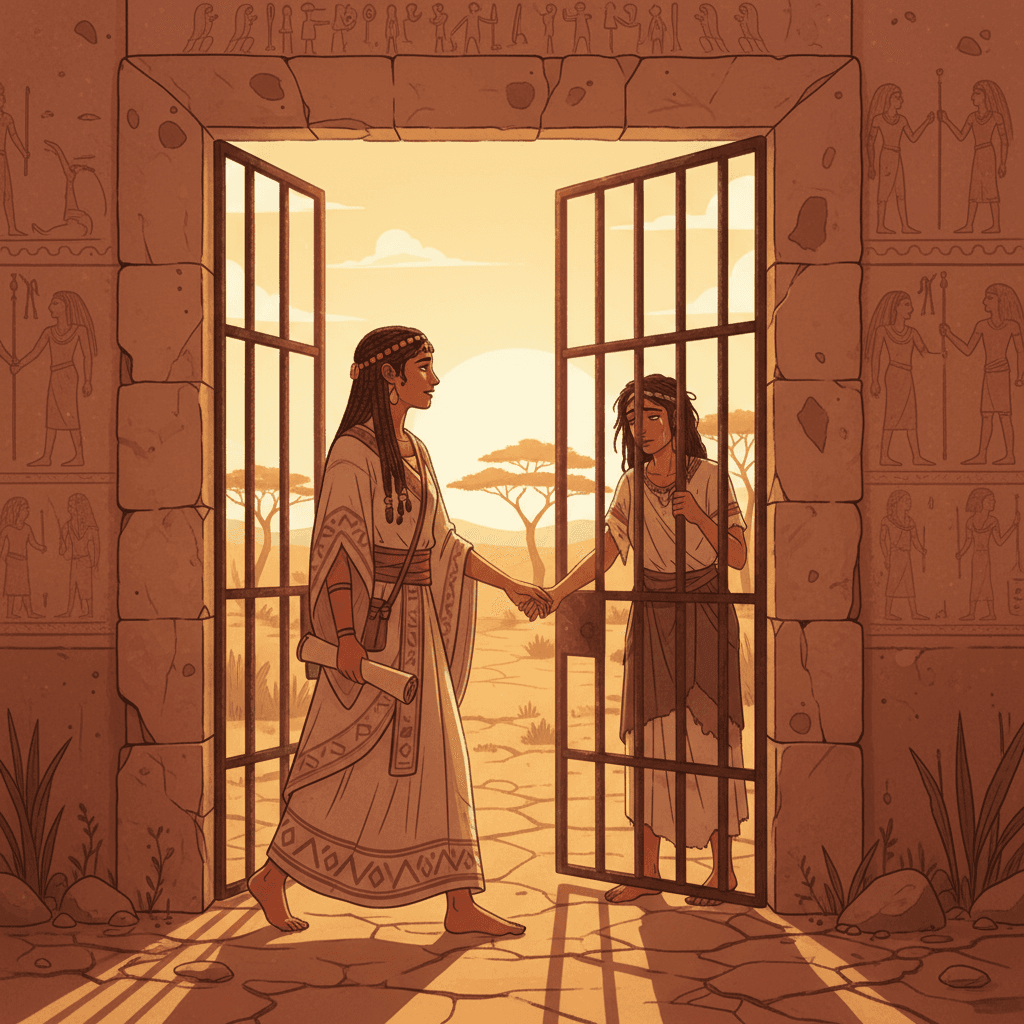
Crivsola gathered her few belongings — a shawl, her scratched notes on a flat stone, and the wooden spoon she had used to demonstrate the one-way valve concept. She walked toward the gate.
The Guard
A prison guard named Tszuvok was stationed at the exit. He was a tall, quiet man with the calloused hands of someone who had worked with wood before he had worked with keys. A carpenter by trade, he had taken the guard position after his workshop burned down — one of many small casualties of Sonhlagot's policy of taxing independent craftsmen into ruin.
"Doctor," he said as she approached. He had heard the other prisoners call her that, though it was not quite the right title. "I have been listening to your conversations with the factory woman. Through the walls. The guards' station is adjacent to your cell."
Crivsola waited.
"I would like to learn more. About the body. About how you reason through these things." He paused. "I have never heard anyone think the way you do."
Crivsola studied him. His expression was earnest in the way of someone who had spent years working with objects that rewarded careful observation — joints and grains and the particular behaviour of different woods under stress.
"Walk with me," she said.
The Explanation
As they walked through the streets of the capital, Crivsola explained her model from the beginning. She found that saying it aloud — to someone who had not been present for the months of reasoning — was a different experience from thinking it.
"Food enters the mouth and is crushed by the teeth. It passes through a one-way valve — like a trap door that only opens downward — so it cannot come back up. It arrives in a dissolving chamber, where the body produces a powerful liquid that breaks the food down into a kind of mush. The chamber is lined with a protective coating so the liquid does not attack the body itself. The dissolved food then passes through the walls of the tube — which work like a straining cloth — and the useful material leaks into the body while the waste continues down and exits."
She paused.
"And then what?" Tszuvok asked.
"And then — I believe the useful material enters a network of channels. Rivers inside the body. They carry the dissolved food to every part — the arms, the legs, the head."
"You believe?"
"I have not confirmed it. It is a prediction. The model requires it."
The Gaps
Tszuvok listened with the careful attention of a man accustomed to measuring twice. When she finished, he asked three questions.
"What drives the liquid through the rivers? Water in an irrigation channel flows downhill. What makes the body's rivers flow?"
"How does the body know what to let through the sieve and what to keep out?"
"And what happens to the dissolved food once it reaches its destination? Does it become flesh? Bone? How?"
Crivsola did not have answers to any of these questions. She had not even thought of the first one. Each question pointed to an entire territory of ignorance she had not mapped.
Explaining her model to Tszuvok had done something she had not expected. It had not merely communicated her theory — it had revealed its hidden assumptions, its unfinished edges, the places where confidence shaded into hope.
She had a student now. And more questions than ever.