
Part 19 of 43
The Broken Arm
By Madhav Kaushish · Ages 12+
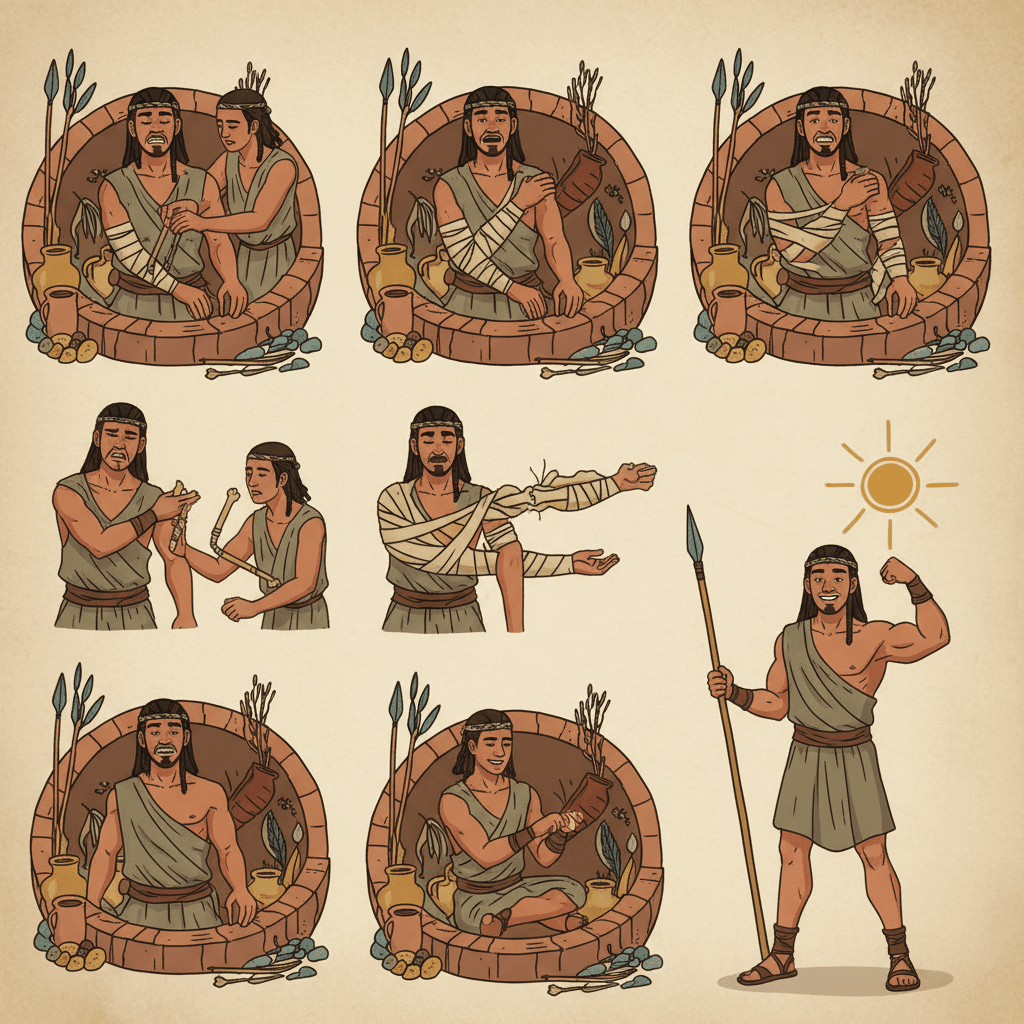
Tszuvok fell off a ladder. He had been repairing a roof beam — his carpentry work continued alongside his studies with Crivsola — when a rotten rung gave way beneath him. He landed badly on his left arm. The crack was audible from across the street.
The Break
Crivsola examined him carefully. His forearm was swollen, discoloured, and bent at a point where it should not bend. The hard frame-piece inside — the rod that ran from the elbow to the wrist — had broken. She could feel the discontinuity through the skin: the rod was in two pieces where there should have been one.
"The frame can break," Tszuvok said through gritted teeth, stating the obvious with the determined calm of a man trying not to scream.
Crivsola set the arm as best she could — aligning the pieces by feel and binding the forearm between two straight sticks to hold everything in place. It was crude, but the principle was sound: keep the broken pieces aligned and still.
The Surprise
Weeks passed. Tszuvok could not use the arm, and he was a poor left-handed carpenter. But Crivsola checked the injury regularly, pressing gently along the break.
Something was happening under the skin. At first, the area around the break was swollen and tender — the body reacting to the damage. Then, gradually, the swelling subsided. The tenderness faded. And at the point where the break had been, Crivsola felt something unexpected.
New hard material. Rough, lumpy, but unmistakably hard — bridging the gap where the frame had snapped.
After six weeks, Tszuvok could move the arm again. After ten, he was back on ladders, albeit more cautiously. The frame-piece had mended.
Dead Things Do Not Heal
"Think about what just happened," Crivsola said. "The frame broke and then repaired itself. What kind of material does that?"
Tszuvok considered this. "Not wood. If a beam cracks, it stays cracked. You replace it or reinforce it — it does not grow back together."
"Not stone. Not clay. Not metal. No dead material heals itself."
The hard frame of the body is not dead scaffolding. It is alive.
This was a significant revision. Crivsola had been thinking of the frame as something like the timber beams in a house — rigid, structural, and inert. But inert things could not repair themselves. The frame had to be made of living material, capable of growth and repair, just like the skin that healed over a cut or the pulling-strings that rebuilt themselves after strain.
Revising the Model
Crivsola updated her picture of the body. The frame was not dead architecture. It was a living structure that could grow, mend, and presumably change over time — which explained why children's frames were small and adults' were large. The frame grew as the person grew.
This also meant the frame needed to be maintained. Living things required sustenance. The hard frame, like the pulling-strings and every other part of the body, needed food-power to stay alive, to repair damage, to grow.
Everything in the body is alive. And everything that is alive needs fuel.
She sat back and considered the full picture. The pulling-strings needed power to contract. The frame needed power to mend and grow. The dissolving chamber needed power to produce its dissolving liquid. The sieve-walls needed power to sort useful material from waste. The internal rivers needed power to flow.
Every part of the body required fuel. And all of that fuel had to come from one source.
She knew what it was. The question was how it got where it needed to go.