
Part 29 of 43
Where Air Meets Blood
By Madhav Kaushish · Ages 12+
Crivsola visited Lomytguya on a grey afternoon. The prison was cold, and Lomytguya was sitting with a blanket pulled tight around her shoulders, but her mind was as sharp as ever.
"Tell me about the burning," Lomytguya said. She had heard about the fire analogy from Tszuvok, who had taken to relaying Crivsola's discoveries with the enthusiasm of a town crier.
Three Systems
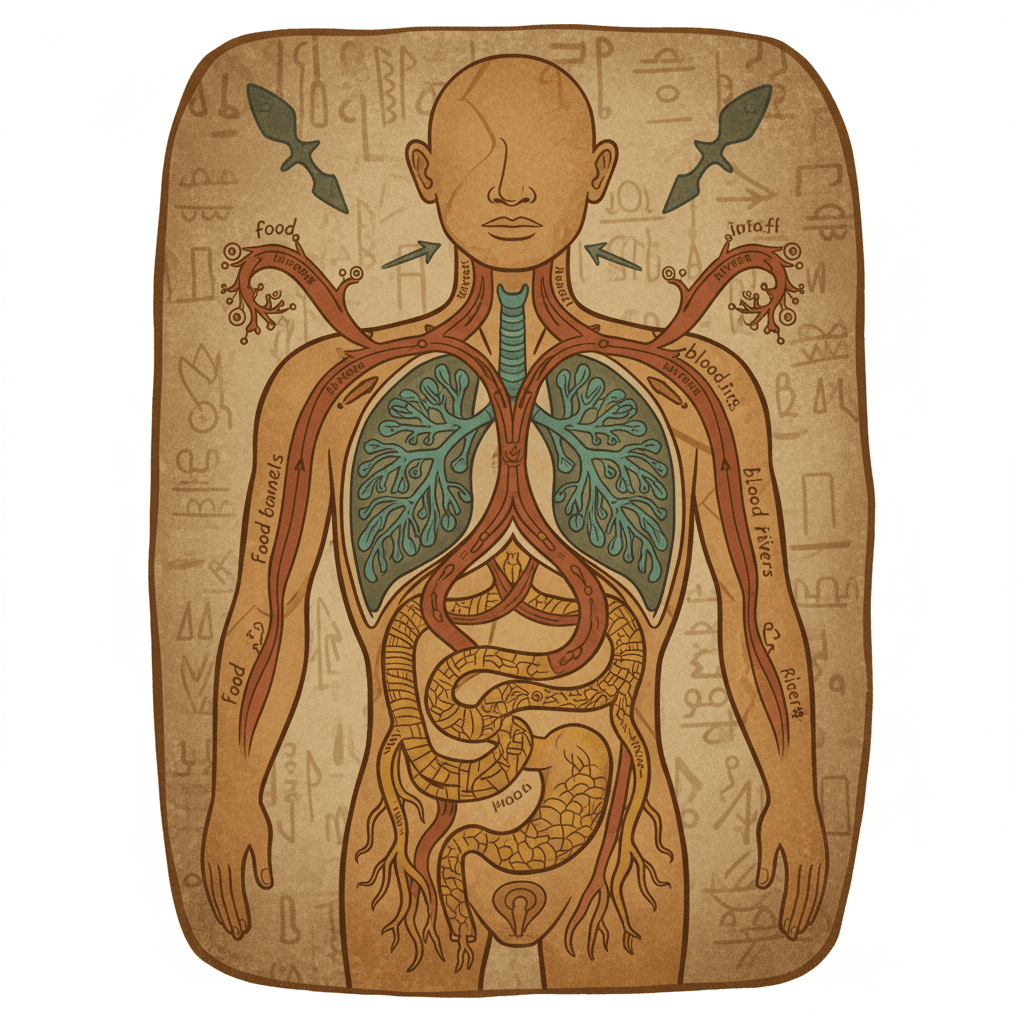
Crivsola laid it out. The body had three systems she now understood in rough outline. The food system — a tube that dissolved food, extracted the useful material through sieve-walls, and sent it into the red rivers. The river system — a pump in the chest driving red fluid through a loop, carrying fuel to every part of the body. And now the air system — bellows in the chest pulling air in and pushing it out.
Each system made sense on its own. But Lomytguya's observation from weeks ago still hung in the air: breathing and the chest-pump sped up together during exertion. Why would two separate systems accelerate in unison — unless they were connected?
The Meeting Place
Crivsola thought about what the fire analogy required. Burning needed fuel and air in the same place at the same time. The red fluid carried fuel — dissolved food, picked up from the sieve-walls of the tube. Air entered through the mouth and nose, pulled into the chest by the bellows.
The fuel is in the red fluid. The air is in the chest. They must meet somewhere.
And where was the most obvious meeting place? The chest contained both the pump that drove the red fluid and the bellows that moved the air. The red fluid already passed through the chest-pump on every circuit of the body. The air was already being drawn into the chest with every breath.
The Exchange
If the red fluid passed through an area where air was present, two things could happen. The fluid could pick up whatever ingredient fire needed from the air. And the fluid could drop off waste — the used-up remnants of burning, the way a furnace produced ash and smoke.
This would explain why exhaled air was different from inhaled air. The breath left warm and moist because the red fluid had dumped heat and waste moisture into the air before it was pushed back out. The air was, in effect, the body's chimney.
The red fluid picks up something from the air and drops off waste. The breath carries that waste out of the body.
Direct Dissolving
Crivsola proposed a simple mechanism: direct dissolving. The air dissolved straight into the red fluid when they met in the chest, the way salt dissolved into water. The fluid absorbed what it needed from the air and released what it did not.
This was wrong in the details — she had no way to know that the meeting place involved millions of tiny air sacs with walls thin enough for exchange to occur across them. The actual mechanism was far more intricate than simple dissolving. But the core insight was sound. Air and blood met in the chest. Something was exchanged. And the red fluid then carried that something to every part of the body, where the burning of fuel actually took place.
The Integrated Machine
Lomytguya was quiet for a moment after Crivsola finished. Then she said, "So the food system feeds the river system, and the air system also feeds the river system, and the river system delivers both to everywhere that needs them."
"Yes."
"It is like a factory," Lomytguya said. "Raw materials come in through two different doors. They meet at the central conveyor. And the conveyor carries them to every workstation in the building."
Crivsola nodded. Three systems, each with its own entry point and its own mechanism — but all connected, all dependent on one another. Remove any one and the others became useless. No food meant no fuel for the rivers to carry. No air meant no ingredient for the burning. No rivers meant no way to deliver either.
The body was not a collection of separate machines. It was one machine with many parts.