
Part 35 of 43
The Dark Room
By Madhav Kaushish · Ages 12+
Crivsola was visiting Lomytguya in prison — the weekly visit the guards permitted, thirty minutes, no physical contact, a wooden table between them. Lomytguya looked thinner than last month but her eyes were the same: sharp, impatient, interested.
Crivsola had been describing the signal-paths, the commander in the head, the two-way network of commands and feelings. Lomytguya listened without interrupting, which was unusual for her.
"So the thing in the head," Lomytguya said when Crivsola finished. "It sits inside the skull. In the dark."
"Yes."
"It has never seen anything."
Crivsola paused. She had not thought about it in quite those terms.
The Sealed Commander
But Lomytguya was right. The thing inside the skull — whatever it was — was encased in bone. No light reached it. No sound touched it directly. It had never felt the texture of cloth or the warmth of sunlight on skin. Everything it knew about the outside world arrived through signal-paths: reports from the body's surface, translated into whatever form the signals carried.
The commander has never experienced the world directly. It knows only what its messengers tell it.
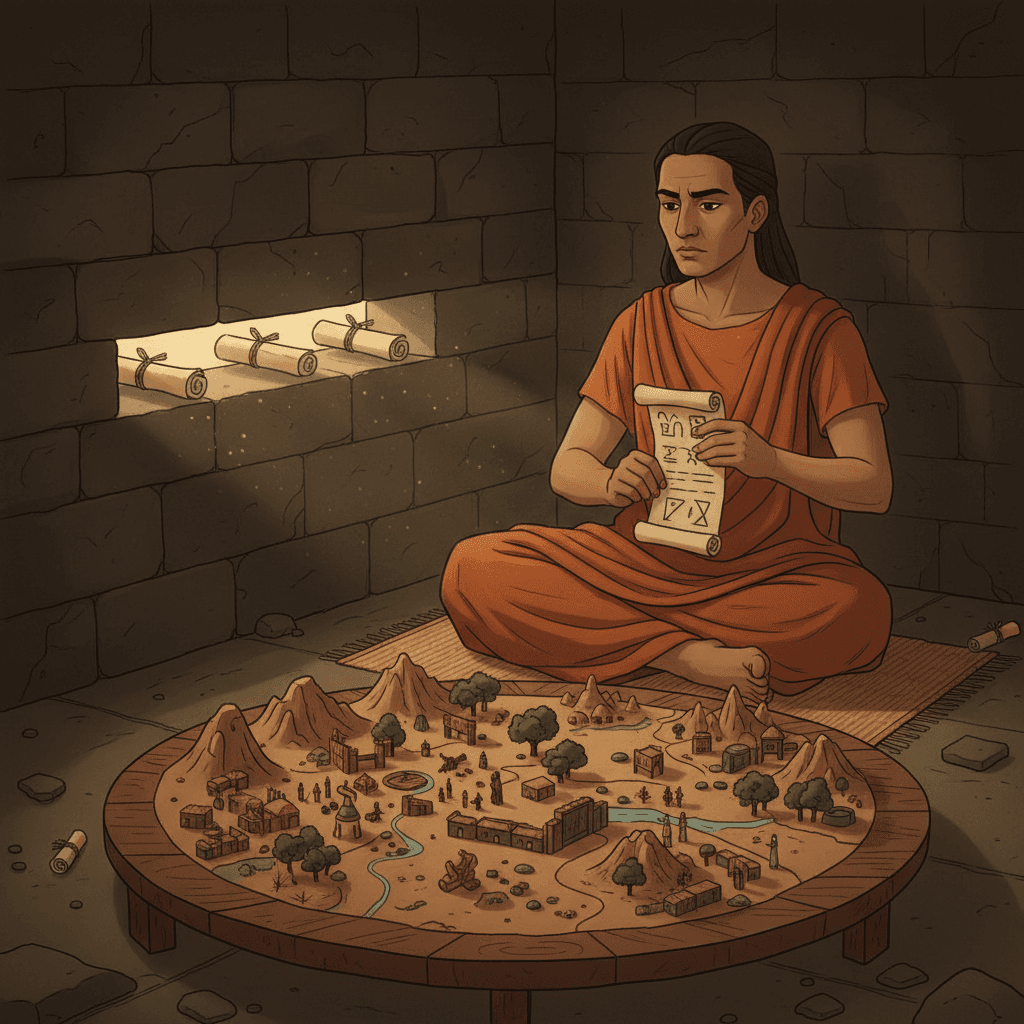
When Crivsola saw a red flower, she did not see it with the thing in her head. Her eyes — whatever they were, however they worked — detected something and sent a signal along a path to the skull. The commander received that signal and somehow constructed the experience of "red flower." But the commander itself was in darkness. It had always been in darkness.
The Dark Room
"It is like a person in a sealed room," Lomytguya said. She gestured at the prison walls around them. "I know something about sealed rooms. You sit inside. You cannot go out. You cannot look through the walls. But scouts come to the door and deliver reports. 'It is raining.' 'The market is busy.' 'There are soldiers in the square.' You build a picture of the world from their messages. But you never see it yourself."
Crivsola stared at her.
"What?" Lomytguya said.
"You just described my entire method."
The Sealed Clock
It hit her with a force she had not expected. Four years ago, sitting in her study, she had compared the human body to a sealed clock — something whose outside you could observe but whose inside you could never open. She had spent every day since then trying to deduce the body's hidden structures from external clues: pressures, bulges, temperatures, pulses, the behaviour of food, the colour of blood.
And now she had discovered that the body itself contained something doing exactly the same work — but in reverse. The commander in the head was sealed inside the skull, trying to understand the outside world from internal signals. Crivsola was sealed outside the body, trying to understand the inside world from external signs.
The commander is Crivsola. Crivsola is the commander. Both are locked on one side of a wall, building models of what lies on the other side from indirect evidence.
The symmetry was almost unsettling.
What the Commander Does Not Know
Tszuvok, when she told him that evening, took it further. "If the commander only knows what the messengers report, then the commander can be fooled. If a messenger sends the wrong signal, the commander would believe something false about the world."
Crivsola thought of Grujla's fingers — feeling nothing where there should have been sensation. The messengers were damaged. The commander received silence and interpreted it as absence. Nothing is touching my fingers. But things were touching her fingers. The commander simply was not being told.
"The commander's picture of the world is only as good as its scouts," Crivsola said.
The Scouts
She walked home through the evening market, aware — in a way she had never been before — that every sensation arriving in her consciousness was a report. The smell of roasting grain: a signal from her nose. The roughness of the cobblestones under her sandals: a signal from her feet. The low light of dusk: a signal from her eyes.
She was not experiencing the world. She was experiencing messages about the world, assembled into a picture by the thing in her skull, which had never once stepped outside its room of bone.
The sealed clock. The dark room. The same problem, seen from both sides.
But if the commander depended entirely on its scouts — on the eyes, ears, nose, skin, tongue — then understanding the body meant understanding how those scouts worked. How did the eyes detect light? How did the ears detect sound? How did the skin detect pressure and heat? Each scout was a mechanism, and each mechanism converted something from the outside world into a signal the commander could read.
If the commander received messages from scouts, how did the scouts gather their information? What were the body's scouts, and how did they work?