
Part 37 of 43
The Vibrating String
By Madhav Kaushish · Ages 12+
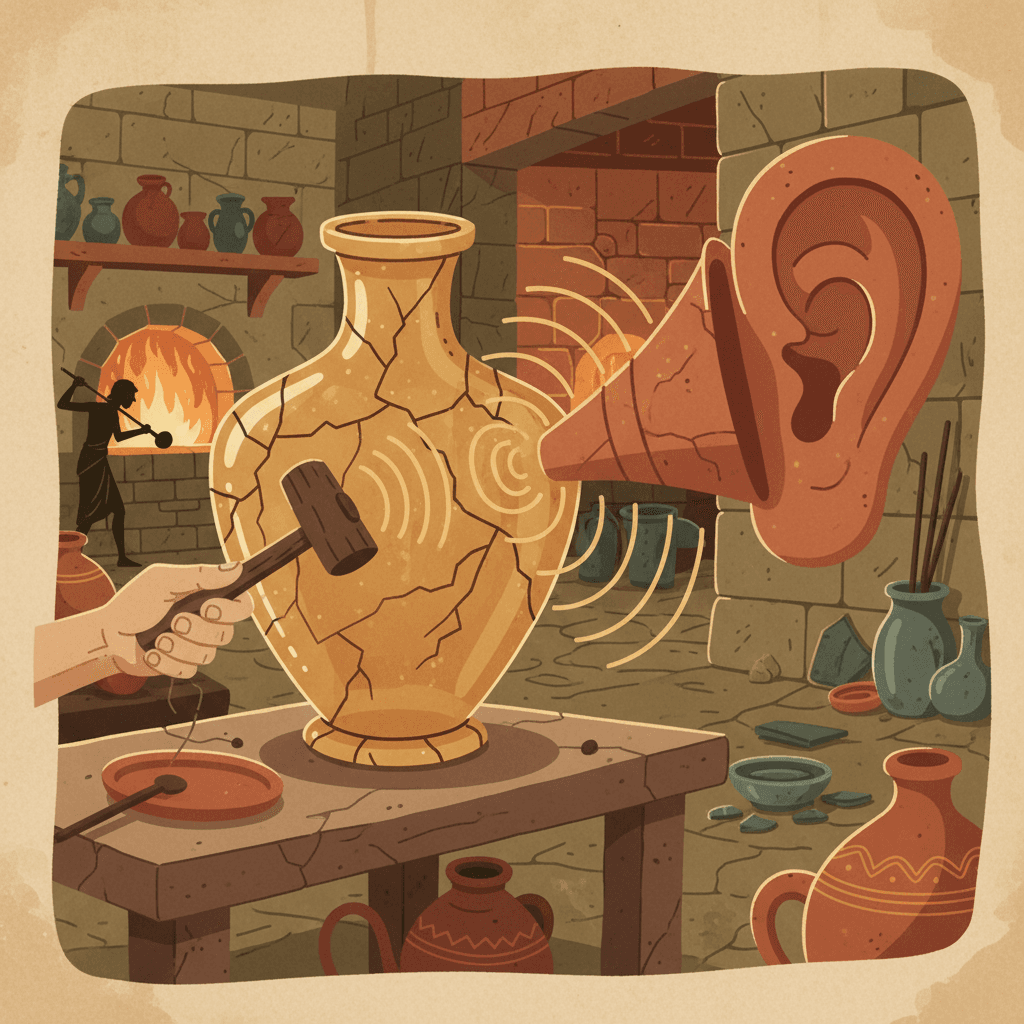
Brekvi brought two glass vessels to Crivsola's workshop. They were identical in shape — small cups he had blown from the same batch of molten glass — except that one had a hairline crack running down its side.
He tapped the uncracked vessel with a wooden rod. It rang — a clear, bright tone that hung in the air for a moment before fading. Then he tapped the cracked one. The sound was flat, dull, and died almost immediately.
"Same glass, same shape, same size," he said. "The only difference is the crack. Why does it sound different?"
Shaking
Crivsola picked up the uncracked vessel and tapped it again. This time she watched carefully. The rim was shaking — a faint blur of motion, barely visible, that lasted exactly as long as the sound did. When the shaking stopped, the sound stopped.
She touched the rim with her finger. The shaking ceased. The sound ceased with it.
The cracked vessel, when tapped, did not sustain this shaking. The crack interrupted whatever motion the glass needed to maintain. No sustained shaking, no sustained sound.
Sound is shaking.
The Throat
This was a claim about glass. Was it true of other sounds? Crivsola hummed — a low, steady note — and pressed her fingers to her throat. She could feel it vibrating beneath the skin. Something inside her throat was shaking rapidly, and the shaking produced the hum.
She stopped humming. The vibration stopped.
She hummed a higher note. The vibration felt faster. A lower note — slower. The pitch of the sound was connected to the speed of the shaking.
Tszuvok, who had been watching, plucked a loose thread from his sleeve and held it taut between his fingers. He flicked it. It vibrated and produced a faint, thin sound. He tightened the thread — the sound rose in pitch. He loosened it — the pitch dropped.
"Like a lute string," he said.
Through the Air
But shaking glass was here, on the table, and the sound reached Crivsola's ears across the room. How did the shaking travel?
She thought about what sat between the vessel and her ear. Air. The same air she breathed, the same air that fed the body's invisible fire. When the glass shook, it must push the air around it, and that pushing must ripple outward — the way a stone dropped in still water sent ripples spreading across the surface.
Sound is shaking that travels through the air.
This explained something she had never questioned. Sound was quieter at a distance. A shout from across a field was fainter than a shout from across a table. If sound was a ripple in the air, it would spread and weaken as it travelled — just like water ripples growing smaller as they moved away from the stone.
The Funnel
She turned her attention to the ear. It was a strange shape — a curved, folded piece of flesh on the side of the head, open at the centre. Not flat. Not round. Funnel-shaped.
A funnel collected and directed. Brekvi used funnels to pour molten glass into moulds — the wide end caught the material and the narrow end channelled it precisely where it needed to go.
The ear is a funnel that catches shaking from the air and channels it inward.
But inward to what? The funnel led to a passage that disappeared into the head. Somewhere deeper — past where Crivsola could see — the shaking in the air had to be turned into the kind of signal the commander could understand. The same kind of signal that the eyes sent for light. The same kind that the skin sent for pressure and heat.
The Conversion Problem
The eye took light and converted it into a signal. The ear took shaking and converted it into a signal. Two completely different things from the outside world — and yet both had to end up as something the head could read.
This was the same problem a translator faced, Crivsola thought. Two foreign merchants speaking different languages could both communicate with the same official — but only if someone translated each language into the one the official understood.
The body had translators. Each sense organ took something the head could not directly use — light, shaking, pressure, heat — and translated it into the head's own language.
The question was whether that language was always the same.