
Part 4 of 43
The Wolf Trap
By Madhav Kaushish · Ages 12+
Crivsola woke in her jail cell to find her cellmate Lomytguya doing a headstand. This was unexpected — and immediately interesting.
The Cellmate's Clue
Crivsola asked Lomytguya whether she had eaten before doing the headstand. She had. And did food ever come out of her mouth during a headstand? Lomytguya thought about it.
"Only once," she said. "I had been drinking Nsujala all night — you know, the strong stuff from the northern breweries. When I did a headstand after breakfast the next day, everything came out."
This was the clue Crivsola needed.
The Sampling Error
Now Crivsola understood what had gone wrong with her experiment. In Sonhlagot, only men who drank alcohol were permitted to do headstands. When Crivsola recruited subjects for her experiment, she could only find people who already knew how to do headstands — which meant her entire sample consisted of men who drank alcohol.
Her sample was not representative of all humans. It was representative of alcohol-drinking men. And alcohol, it seemed, affected the body's ability to keep food down during a headstand.
The Wolf Trap
Though this discovery was fascinating, Crivsola disciplined herself to continue with her original investigation rather than getting sidetracked. The question remained: how does food stay in the body when a person is upside down?
The answer came from an unexpected place. While exercising in the prison garden, Crivsola came across a fellow prisoner working on a strange contraption — a door in the ground. He explained that it was a wolf trap. The door was hinged so that it could only open downward. A wolf stepping on it would fall through, but once inside, it could not push the door open from below. The door only worked in one direction.
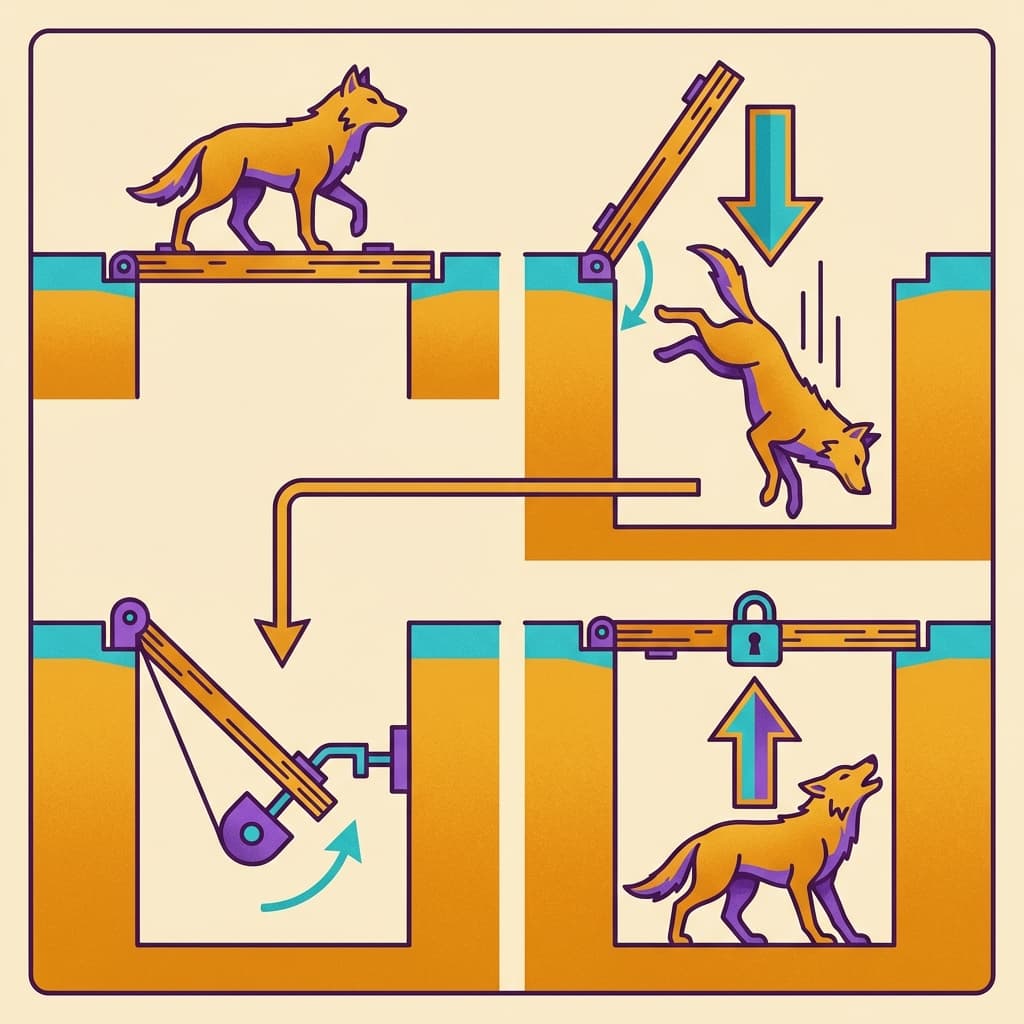
Crivsola stared at the trap for a long time. Then she understood.
The One-Way Door
Perhaps the human body contained a similar mechanism — a one-way door near the base of the neck. Food could pass through it going down, but the door would close behind it, preventing food from coming back up even if the person turned upside down. This would explain why food normally stays down during a headstand.
And what about the alcohol? Perhaps excessive Nsujala weakened or damaged this one-way mechanism, causing it to malfunction. That would explain why her alcohol-drinking subjects all expelled food, while she and Lomytguya (who had not been drinking) did not.
Crivsola amended her model of the human body. Somewhere between the mouth and wherever the food ended up, there was a one-way valve. She did not yet know where exactly the food went after passing through this valve, but she now had a better model than before.
She sat back in her cell, satisfied with the progress. There was still much to figure out — the question of where food actually goes, what happens to it, and why we need to eat in the first place. But those were questions for another day.