
Part 40 of 43
The Plague
By Madhav Kaushish · Ages 12+
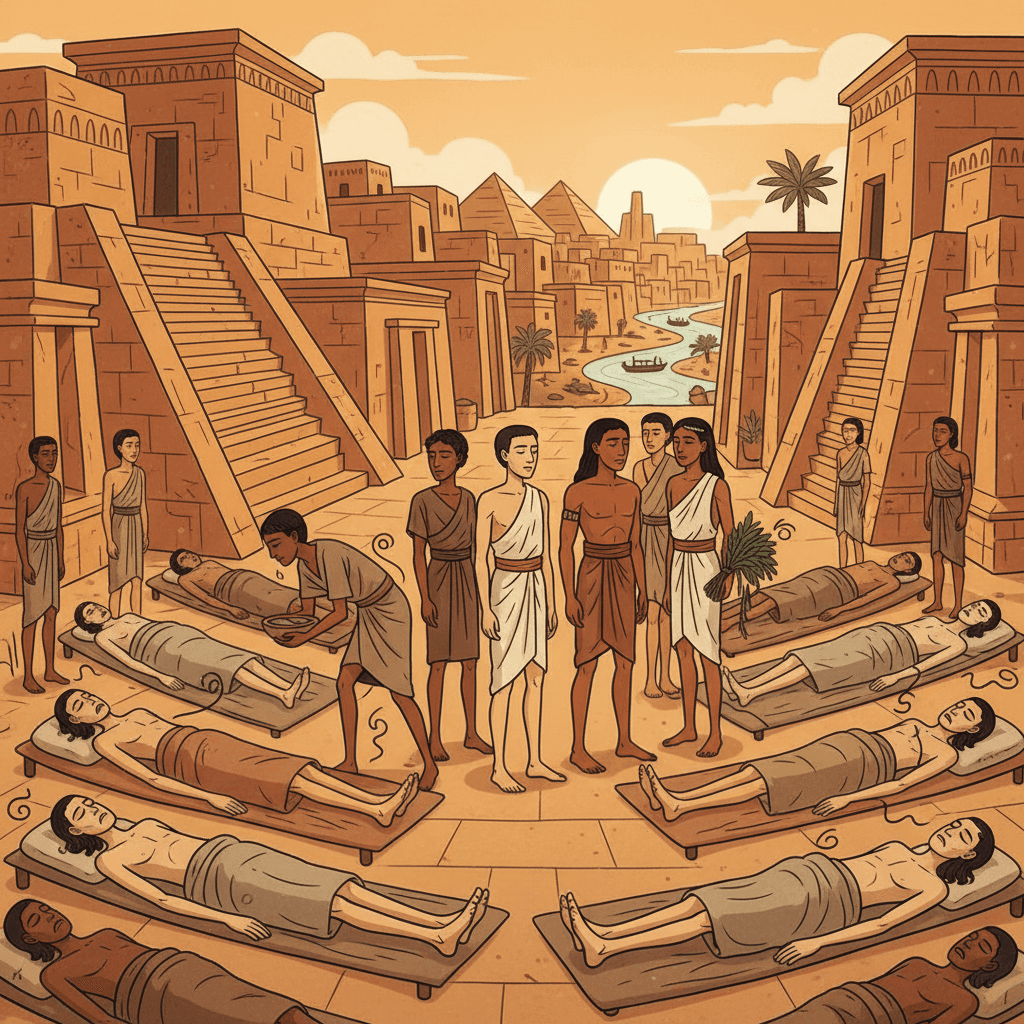
The first cases appeared near the docks. A trader from the eastern provinces collapsed in the fish market, shaking with fever. By the next morning, three dockworkers had the same symptoms — aching joints, drenching sweat, a rash that spread from the chest outward. By the end of the week, the sickness had reached every district of the city.
Sonhlagot had seen plagues before, though not in Crivsola's lifetime. The governor responded with his usual precision: he banned the consumption of soup on odd-numbered days and ordered all citizens to walk backward through doorways, on the theory that diseases could not follow a person who reversed direction.
The Pattern
Crivsola did not walk backward through doorways. She did what she had been doing for years now. She observed.
The sickness struck hard. Fever, weakness, aching in the pulling-strings, a deep exhaustion that kept people flat on their backs for days. Some recovered. Some did not. There was no obvious logic to who lived and who died — young and old, strong and frail, it seemed to take people at random.
But then Tszuvok brought her a piece of information that changed everything.
"The harbour district had the same sickness three years ago," he said. "A smaller outbreak. And the people who caught it then — the ones who survived — are not getting sick now. Not a single one of them."
The Anomaly
Crivsola confirmed this over the following days. She spoke to families, neighbours, anyone who would talk. The pattern was unmistakable. People who had recovered from this same sickness in the previous outbreak walked among the dying without falling ill. Meanwhile, new arrivals to Sonhlagot — traders, migrants, visitors — caught it at alarming rates.
The body remembers. Something about having survived this sickness once protects a person from getting it again.
The obvious explanation was what she called "Sickness is Weakness" — the idea that falling ill meant the body was fragile, and recovery simply meant it had been strong enough to endure. Under this model, survivors should be weaker afterward, not stronger. A body that had been battered by disease should be more vulnerable the next time, the way a cracked beam is more likely to snap under a second load.
But the opposite was happening. Survivors were not merely recovering. They were becoming protected.
Selection Bias — Again
Crivsola briefly wondered if this was a sampling problem — perhaps the people who survived were simply the strongest to begin with, and their immunity was just their natural strength showing itself again. She remembered the headstand experiment from years ago, the way an unrepresentative sample had fooled her.
But she ruled this out. Some of the previous survivors had been elderly. Some had been children. Some had nearly died the first time. The protection was not about being strong. It was about having been sick before — specifically with this sickness.
What the Body Keeps
Something changed inside a person when they fought off a disease. Something persisted after recovery — a trace, a record, some alteration that remained long after the fever broke and the aches faded. The body was not simply enduring the sickness and moving on. It was learning from it.
The body does not merely survive an attack. It remembers the attacker.
This was unlike anything in Crivsola's existing model. The food tube did not remember yesterday's meal. The chest-pump did not beat differently because of last month's exertion. But whatever system fought off sickness — whatever defended the body from this kind of attack — it kept a record. And it used that record to respond faster, or harder, or more precisely, the next time.
The body had defenders. And the defenders had memory.
But what were they defending against? What, exactly, was a sickness? And how did these invisible defenders fight it?