
Part 14 of 18
The Other Error
By Madhav Kaushish · Ages 12+
Wrinje did write the letter to the newspaper. It was not published, which Vilila said was for the best because "nobody wants to read a twelve-year-old lecturing about probability." But the case continued to develop, and a few days later, Jansu's lawyer made a public statement that caught Wrinje's attention.
The lawyer's name was Drimglak, and he appeared on a local television program to defend his client. Wrinje watched the clip on Vilila's phone, which she grudgingly allowed.
Drimglak said: "This city has over a million residents. The DNA evidence, at best, narrows the field to one person in a million. Even with a match, my client is just one person among a million — the probability that she specifically committed this crime is vanishingly small."
Wrinje: That sounds reasonable.
Vilila: Of course it does. She is innocent and the lawyer is doing his job.
Wrinje: Wait. Let me think about this.
He called Glagalbagal, who answered on the first ring. Wrinje suspected she had been waiting for this call.
Glagalbagal: The Defense Attorney's Fallacy.
Wrinje: There is another one?
Glagalbagal: There is. And it is the mirror image of the Prosecutor's Fallacy. They are opposite errors, but they come from the same root cause.
Wrinje: What is the lawyer's mistake?
Glagalbagal: Drimglak says: there are a million people in the city, the DNA evidence points to one person, therefore the probability my client is guilty is approximately 1 in a million. What is he ignoring?
Wrinje: He is... treating Jansu as a random person drawn from the city?
Glagalbagal: Exactly. He is ignoring all the other evidence. Jansu is not a random person in the city. She is the victim's niece, she was the last known visitor, an eyewitness places her near the house at 7pm. All of that evidence has already narrowed the field long before the DNA evidence arrives. The lawyer is pretending that none of that prior evidence exists.
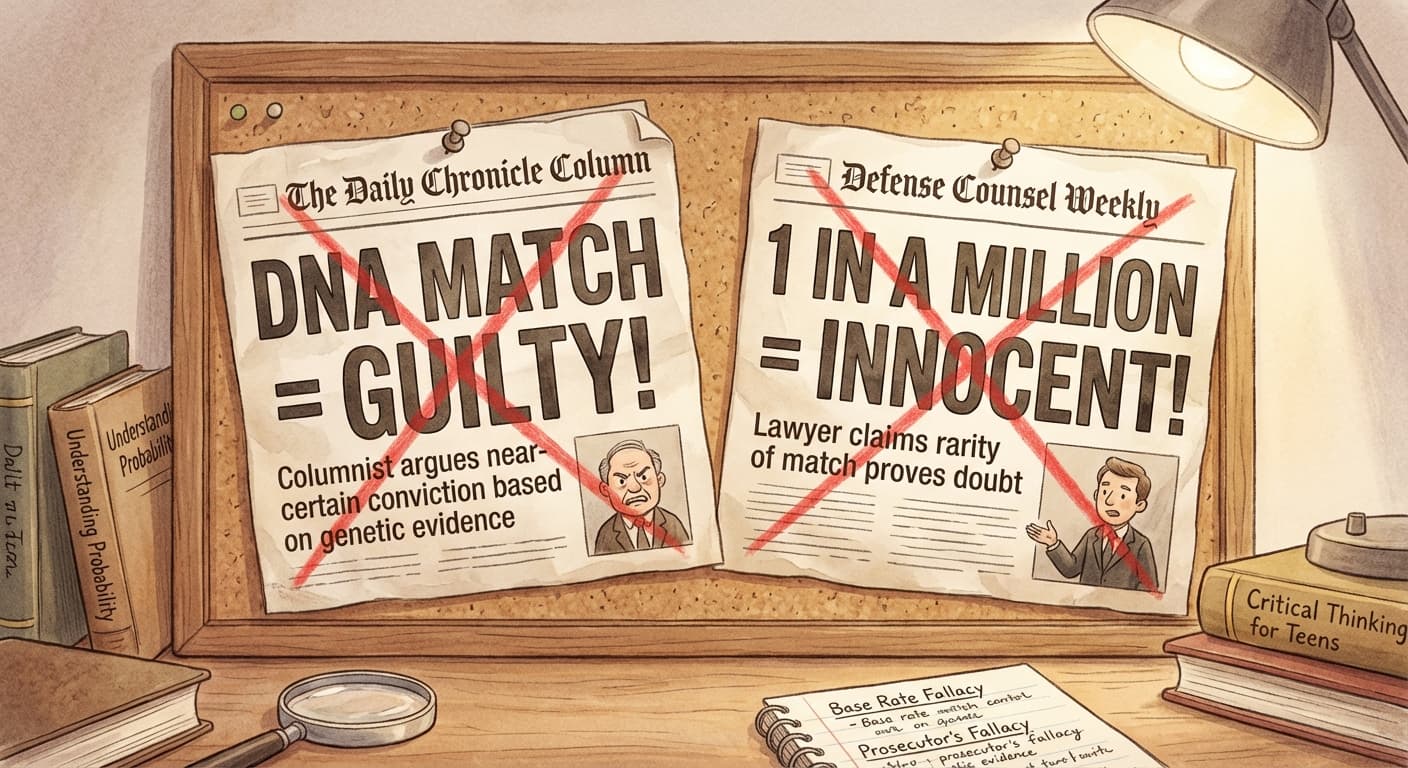
Wrinje: The columnist ignored the prior when arguing for guilt. The lawyer ignores the prior when arguing for innocence.
Glagalbagal: Yes. Both fallacies involve ignoring the prior probability. The columnist starts with the evidence and jumps to guilt without considering how likely guilt was beforehand. The lawyer starts with the population size and claims innocence without considering how much the prior evidence has already shifted the probability.
Wrinje: So what is the correct way to think about it?
Glagalbagal: You take all the evidence together. The prior probability accounts for Jansu's relationship to the victim. The eyewitness testimony updated that. The fingerprint evidence (or lack of it) updated it again. The DNA evidence updates it further. Each piece builds on the last. You cannot grab one piece of evidence and use it in isolation, ignoring everything that came before.
Wrinje: The prosecutor grabs the DNA match and says "guilty." The defense grabs the population size and says "innocent." Both are cherry-picking.
Glagalbagal: Correct. And here is the deeper lesson: both errors feel persuasive. The Prosecutor's Fallacy sounds scientific — "1 in a million." The Defense Attorney's Fallacy sounds logical — "there are a million people." Each one exploits a different intuition. The only way to avoid both is to do the full calculation: start with a prior, update with each piece of evidence in sequence, and see where you end up.
Wrinje: Which is exactly what we have been doing.
Glagalbagal: Which is exactly what we have been doing.
Wrinje: I think the real question is what evidence I still do not have. We know about the eyewitness testimony, the fingerprints, the hair. But I have not looked into motives. I have not tried to figure out who actually had a reason to want Glerna dead.
Glagalbagal: That is a very good next step. Evidence about motive is different from physical evidence — it is harder to quantify. But it is still evidence, and it still updates the probabilities.
Wrinje: I am going back to the neighbourhood.
Vilila: You are not going back to interrogate strangers.
Wrinje: I am going to buy more figs.
Vilila: You still have not eaten the last ones.