
Part 9 of 18
The Rule
By Madhav Kaushish · Ages 12+
Glagalbagal did not leave after dinner. She said she wanted to show Wrinje something important, and Vilila said she wanted them both to leave, and then she brought out tea for three and sat down to listen.
Glagalbagal: We have been doing something informally that has a formal name. I think it is time you learned the rule.
Wrinje: What rule?
Glagalbagal: The rule for updating your beliefs when you get new evidence. It is called Bayes' theorem, after Thomas Bayes, a minister who figured it out in the 1700s.
Wrinje: A minister?
Glagalbagal: Probability theory has strange origins. Anyway, let me show you with pebbles.
She gathered a handful of small stones from the pot of the plant Vilila kept by the window. Vilila objected. Glagalbagal promised to put them back.
Glagalbagal: Let us use a simple version of our problem. Suppose there are only two possibilities: either Jansu did it, or someone else did it. We said the prior probability for Jansu is about 1%. So I put 1 pebble over here for "Jansu guilty" and 99 pebbles over here for "someone else guilty."
She arranged them on the table in two groups.
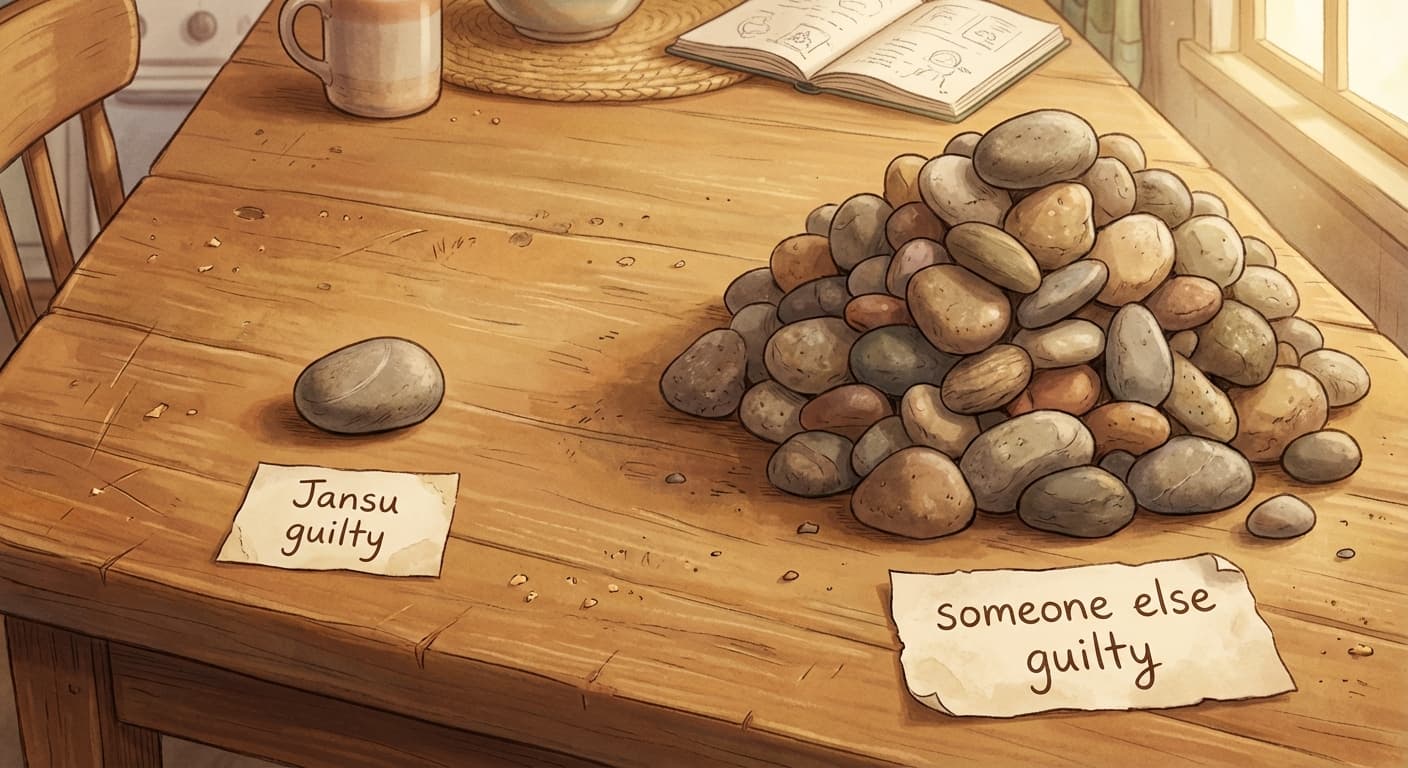
Wrinje: That is a lot of pebbles for "someone else."
Glagalbagal: That is the prior. Now, let us bring in a piece of evidence — the eyewitness testimony. Hyjop says he saw Jansu at 7pm. We need to ask two questions. First: if Jansu is guilty, how likely is it that a witness would see her near the house at 7pm?
Wrinje: Very likely, I think. If she went there to commit the murder, she would have been there. Let us say 80%.
Glagalbagal: Fine. Second question: if someone else is guilty and Jansu is innocent, how likely is it that a witness would report seeing her there at 7pm?
Wrinje: Less likely. She says she was at home. Hyjop could be mistaken. We said the false identification rate is about 30%. So, maybe 10% — she could have been in the area for another reason, or it could be a misidentification.
Glagalbagal: Good. Now watch what happens. Take the 1 pebble for "Jansu guilty." Multiply by 80% — the chance of seeing this evidence if she is guilty. That gives us 0.8.
Wrinje: 0.8 pebbles?
Glagalbagal: Think of it as the weight of that pebble after the evidence. Now take the 99 pebbles for "someone else guilty." Multiply by 10% — the chance of this evidence if she is innocent. That gives us 9.9.
Wrinje: So after the evidence, the "Jansu guilty" group has weight 0.8 and the "someone else" group has weight 9.9?
Glagalbagal: Exactly. Now, to get the updated probability that Jansu is guilty, you take her weight and divide by the total weight. That is 0.8 divided by 0.8 plus 9.9.
Wrinje: 0.8 divided by 10.7. That is about... 7.5%.
Glagalbagal: Right. The eyewitness testimony moved Jansu from 1% to about 7.5%. Significant, but far from certain.
Wrinje: That is the same kind of answer we got before, when you explained the witness reliability.
Glagalbagal: It is. Because we are doing the same calculation, just more explicitly. What I showed you just now is Bayes' theorem. The rule says:
Glagalbagal: Start with how likely you think something is — the prior. Then look at the evidence, and ask how much more likely that evidence would be if the thing is true versus if it is false. Multiply the prior by that ratio. Then adjust so everything adds up to 100%.
Wrinje: That is it? That is the whole rule?
Glagalbagal: That is it. Prior times likelihood, then normalize. Everything we have been doing in this investigation follows that pattern. When we thought about the arrest, we said it barely changes the probability — because an arrest is almost equally likely whether Jansu is guilty or innocent, given that she was the last known visitor. When we thought about the eyewitness testimony, we said it changes the probability more — because seeing her at 7pm is much more likely if she is guilty than if she is innocent.
Wrinje: So every new piece of evidence just repeats the same process? Start with where you are, ask how the evidence shifts things, update?
Glagalbagal: Exactly. And you can do it again and again. Your new probability after one piece of evidence becomes the prior for the next piece. It is like the pebbles are being redistributed each time — some possibilities get heavier, some get lighter, but they always add up to the same total.
Wrinje: Can you use this on all four suspects at once?
Glagalbagal: You can. You would have a pile of pebbles for each suspect plus one for "unknown person." Each time evidence comes in, you would multiply each pile by the likelihood of that evidence under that hypothesis. Some piles grow. Some shrink. The relative sizes tell you who is the most likely suspect.
Wrinje: I want to do that. But I need more evidence.
Glagalbagal: Then keep investigating. But now you have a framework. Every time you learn something new, ask yourself: how likely is this if suspect A did it? How likely if suspect B did it? And so on. The answers will guide you.
Vilila: I understood about half of that, but the pebble thing made sense. Can I have my plant back now?
Glagalbagal: Of course.
She returned the pebbles to the pot, though Vilila spent the next ten minutes rearranging them and complaining that the plant looked different.