
Part 3 of 39
Comparing Herds
By Madhav Kaushish · Ages 10+
We left Glagalbagal pondering how he could reward successful managers at his two different locations. Right now, looking at the two herds, they appeared to be about the same size. He decided that on the same day as Hrijpa, the harvest festival, he would reward the manager with the larger herd. He decided to give the winning manager a bottle of Grtizki, an alcoholic drink made from the bile of a Megalodon. It was so hard to acquire that a single bottle was being exchanged for eight cows.
But how would he know whether one herd was larger than the other? If the difference was large, it would be obvious just by looking. However, given that the two herds were about the same size currently, that was unlikely to be the case even by the time Hrijpa came around.
The Brainwave
Glagalbagal pondered over this as he watched one of the managers count in the herd. (I would have mentioned the manager's name, but no source I found seems to have it — I guess nobody remembers middle management.)
The manager looked a little panicked. Glagalbagal asked what the problem was. He said that there were pebbles left over once the herd had returned. On hearing that, Glagalbagal had a brainwave.
He realised that the solution was staring him in the face. When there were more pebbles than animals, there would be pebbles left over. If, say, a cow had a baby, then there would be animals left even after counting out all the pebbles. He could use this idea to compare the sizes of the two herds. He could count in one animal from each of the two herds at a time. If one of the herds had an animal left over, that herd would be larger, and that manager would be the winner!
The Flaw
Glagalbagal was very excited, but soon he realised the flaw. There was no way that he could bring the two herds to the same location. A morose Glagalbagal returned home and went in for a shower.
It was in the shower — where all ideas tend to emerge — that he realised he could save the plan. Rather than comparing the animals, he could compare the pebble arrangements.
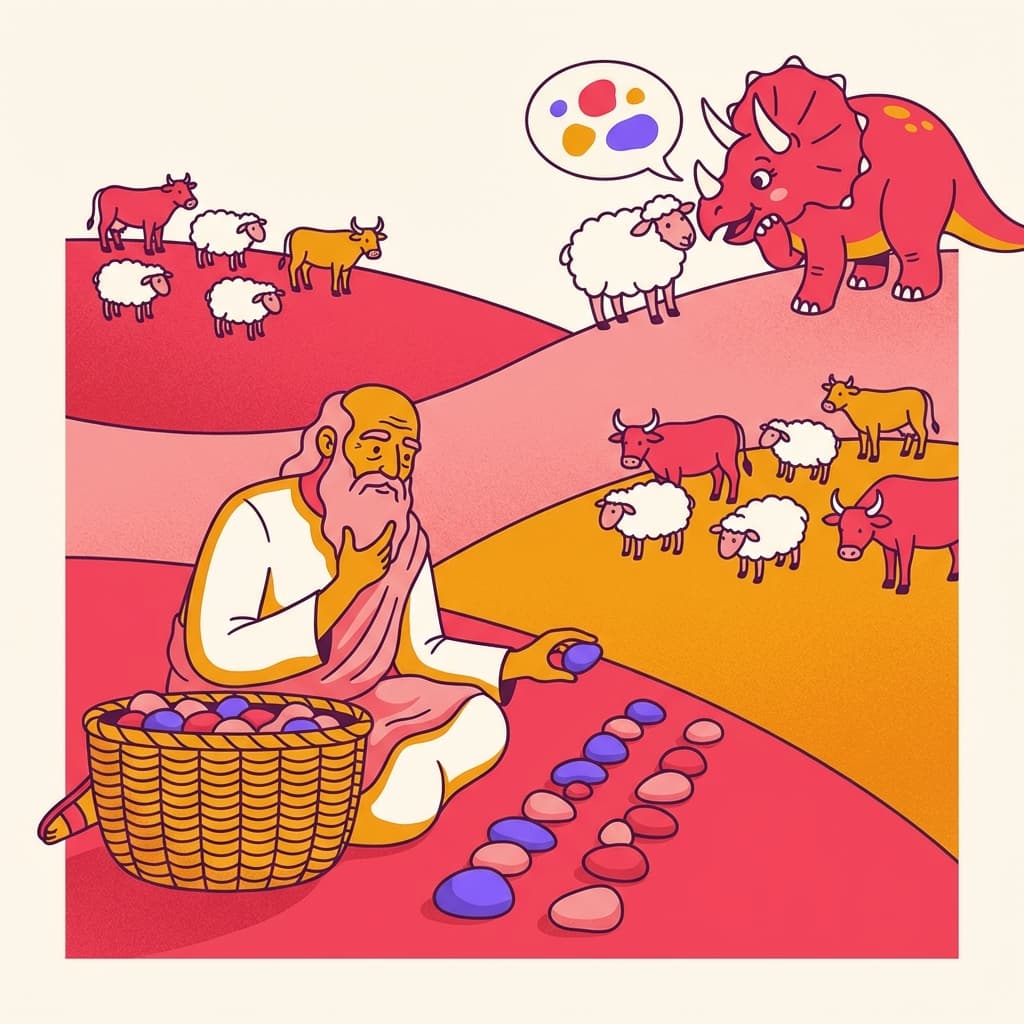 It would be much easier to carry one of the pebble arrangements to the other location. Since the animals and pebbles matched up, comparing the pebbles served the same purpose as comparing the animals.
Since we don't know the names of the managers, there is no point discussing who won the first year. Regardless, there was a winner who received the bottle of Grtizki.
The Gossip
On the way back from presenting the bottle, Glagalbagal ran into the local town gossip — a triceratops named Hyjop. Hyjop told him something alarming. According to Hyjop, the two managers had conspired amongst themselves to do no work — they put no effort into growing the herd and were planning to split the bottle regardless of who won.
Glagalbagal went home in a state of shock. He realised that there was nothing in his system which was stopping them from doing this. Even if this was a baseless rumour, it was still worrying that it was even possible.
Once again Glagalbagal was faced with a dilemma. How would he make sure that the managers were actually doing their jobs — that they were growing the herd rather than slacking?