
Part 2 of 39
Baskets and Velociraptors
By Madhav Kaushish · Ages 10+
Glagalbagal's system of pebbles, rocks, boulders, and obelisks worked — but it was impractical. He needed ten triceratopses just to move the objects around, and their clumsiness was causing livestock losses. He needed a better approach.
The Basket System
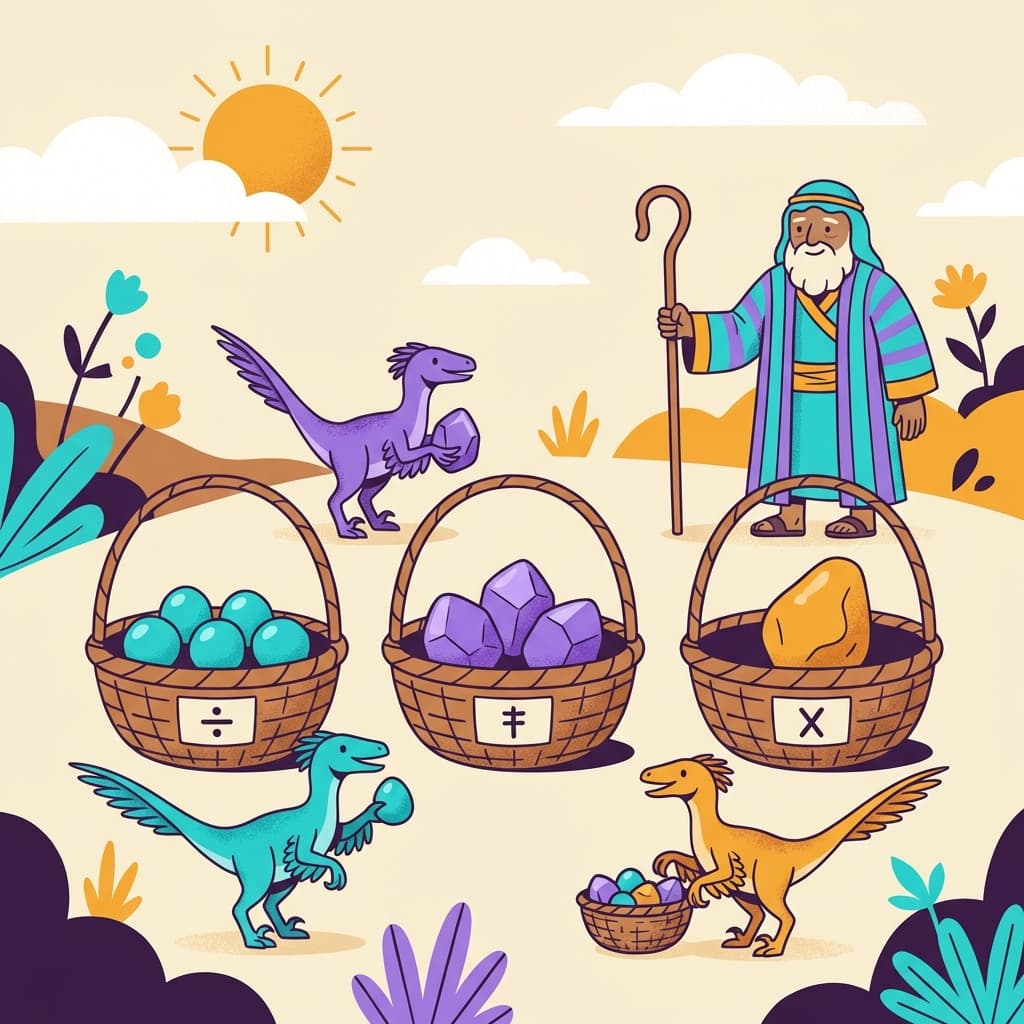
Glagalbagal had a breakthrough. Instead of using different objects for different values, he could use identical pebbles in different baskets. Each basket represented a different value: the first basket held pebbles representing single animals, the second held pebbles worth what small rocks had previously represented, the third equaled boulders, and the fourth had unlimited capacity like the old obelisk system.
Outside each basket, he placed the maximum number of pebbles it could contain: eight for the first, five for the second, four for the third, and none for the fourth. As each animal exited, he took a pebble from in front of the first basket and put it in the basket. When the basket was full (eight pebbles), he emptied it, put those pebbles back in front, and moved one pebble into the second basket instead.
Technological Innovation
This was a remarkable improvement. The basket system replaced all the heavy objects with lightweight pebbles. Glagalbagal could now replace his team of triceratopses with velociraptors — smaller, faster, and cheaper. This was the second recorded example of technological innovation resulting in a loss of jobs.
A New Problem: Identification
But Glagalbagal encountered a problem. After counting his herd, he had pebbles distributed across his baskets — but if he walked away and came back, he could not remember which basket was which. They all looked the same.
He solved this by creating copies of every possible basket arrangement in advance. He lined up all the possible combinations. Then, when he counted his herd, he found the pre-made arrangement that matched and labelled it with that day's date. This way, every arrangement had a unique identity.
Expansion
With his system perfected, Glagalbagal expanded his business to a second location. He hired managers to run each site. To motivate them, he planned a reward for whichever manager grew their herd more.
But this raised a fundamental question: how would he know whether the managers were doing a good job? How could he compare the sizes of two herds at different locations?