
Part 7 of 39
The Tax Collector
By Madhav Kaushish · Ages 10+
Glagalbagal's business now spanned three locations. This attracted the attention of the regional tax authority — specifically, a brontosaurus named Thvajjik who served as the chieftain's tax collector. Thvajjik informed Glagalbagal that he owed a tax based on his total herd size across all locations.
Glagalbagal had a pebble arrangement for each location. But Thvajjik wanted a single arrangement representing the total. Glagalbagal could, in principle, drive all the animals to one place and count them from scratch. But moving herds across the countryside was expensive, slow, and dangerous — the last time someone attempted it, a pack of wild velociraptors had eaten a third of the cattle. He needed to figure out the combined arrangement from the three individual ones.
The Naive Attempt
Glagalbagal's first idea seemed obvious: take the pebbles from the first basket of all three arrangements and put them together into a single first basket. Do the same for the second, third, and fourth baskets. The result should be the combined arrangement.
He tried it. Location 1 had six pebbles in its first basket. Location 2 had five. Location 3 had three. Together: fourteen pebbles in the first basket.
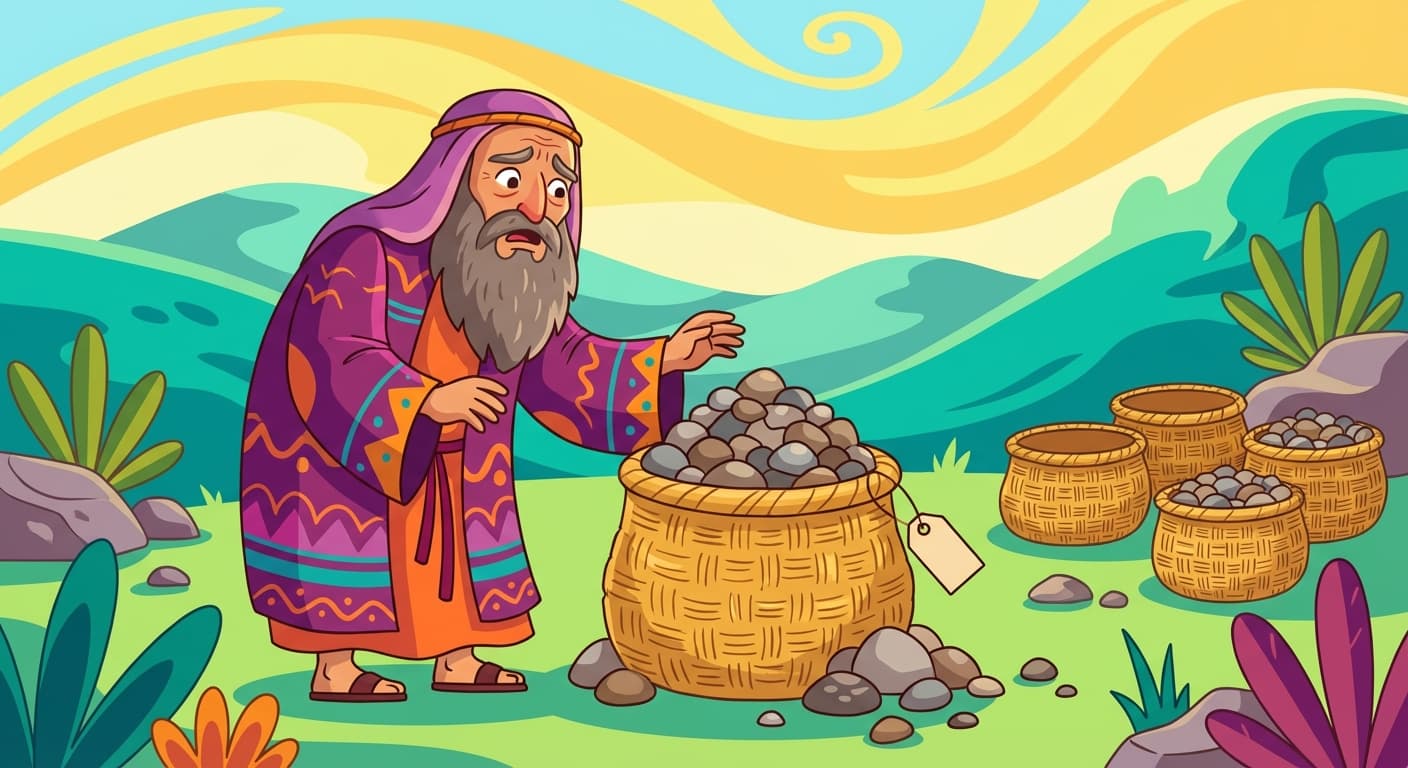
But the first basket could only hold eight pebbles. Fourteen was an impossible arrangement — it did not correspond to any valid count. Glagalbagal stared at the overflowing basket, irritated. He had assumed that combining baskets would be straightforward. It was not.
The Carry
Blortz, who had been watching from behind a pile of accounting tablets, nudged a pebble thoughtfully.
Blortz: You have the same problem you had when counting animals. When the first basket fills up to eight, what do you do?
Glagalbagal saw it immediately. When counting animals one by one, every time the first basket reached eight pebbles, he emptied it and moved one pebble into the second basket. The same rule had to apply here. Fourteen pebbles in the first basket meant: remove eight (one full cycle), carry one pebble to the second basket, and leave six in the first.
He applied the rule. The first basket now held six pebbles, and the second basket received one extra pebble.
The Cascade
But the second basket had its own problem. The three locations contributed three, two, and one pebbles respectively to the second basket — six in total — plus the one carried over from the first basket. That made seven. The second basket's capacity was five.
Glagalbagal applied the same rule: seven pebbles in the second basket meant one full cycle (five out, one carry to the third basket), leaving two in the second basket.
And the third basket, after receiving contributions from all three locations plus the carry from the second basket, also overflowed. Its capacity was four. He applied the rule once more, carrying into the fourth basket.
The overflows cascaded upward through the baskets, one level at a time, until every basket held a valid number of pebbles. When Glagalbagal was done, he had a single arrangement that represented the total herd across all three locations.
He checked the result by sending velociraptors to each location to count the animals independently and create a fresh total arrangement. The two arrangements matched.
The Tax Bill
Thvajjik examined the total arrangement and declared the tax: a certain number of animals, expressed as a pebble arrangement, to be surrendered to the chieftain. Glagalbagal needed to figure out how many animals he would have left — the total arrangement minus the tax arrangement.
He set up the two arrangements side by side and started with the first basket. The total had six pebbles. The tax required removing one. That left five. Simple enough.
The second basket was a problem. The total had two pebbles in the second basket. The tax required removing three. He could not remove three from two.
Borrowing
Glagalbagal was stuck. He stared at the second basket for a long time. Then Blortz, demonstrating the quiet competence of a reformed criminal, moved a pebble from the third basket.
Blortz: One pebble in the third basket is worth how many in the second?
Glagalbagal thought. Each pebble in the third basket represented a full second basket — which was five pebbles. So removing one pebble from the third basket and placing five pebbles in the second basket changed nothing about the total. It was the same quantity, expressed differently.
He made the exchange. The third basket lost one pebble. The second basket gained five, bringing its total to seven. Now he could remove the three required by the tax, leaving four.
But the third basket had a similar problem — after giving up a pebble, it did not have enough to cover the tax's demand on that basket. So Glagalbagal borrowed from the fourth basket: one pebble from the fourth basket became four pebbles in the third (since the third basket's capacity was four). The borrowing cascaded downward through the baskets, just as the carrying had cascaded upward.
The Discovery
Glagalbagal sat back and considered what he had built. He could now combine arrangements and reduce them without ever touching the actual animals. The pebble arrangements had become a system for reasoning about quantities in the abstract — separate from the physical objects they represented.
He had started, many years ago, with a simple trick: one pebble per animal, to check whether any were missing. From that single idea, he had built a place-value system, a method for comparing quantities, a way to measure change over time, and now a way to combine and separate quantities through carrying and borrowing. The pebbles in the baskets, which had begun as a bookkeeping device, had become something closer to what we would recognise as arithmetic.
Thvajjik the tax collector, for his part, was simply pleased to receive his cattle. He had no interest in the baskets.