
Part 8 of 39
The Feed Problem
By Madhav Kaushish · Ages 10+
With addition and subtraction working reliably, Glagalbagal's business entered a period of calm. The managers were performing well (even Frojj, who had stopped panicking after the Grtizki Rule was established), the tax collector had been satisfied, and Blortz had not eaten any animals in years. Then winter approached.
The Problem
In this region, winter meant the grazing lands froze for four months. The animals could not feed themselves. Glagalbagal needed to buy dried marsh-grass from Plyvek, the regional feed merchant — a stegosaurus who sold goods at fair prices but demanded payment in full before the first frost.
The question was how much to order. Each animal consumed roughly three sacks of dried marsh-grass per month. Glagalbagal knew his total herd size from combining the arrangements of all three locations. But he needed to go from "this many animals" and "three sacks each" to "this many sacks total."
The method seemed obvious. For each animal in the herd, add three to a running total. If he had a hundred and eighty animals, that meant starting with three and adding three again, and again, and again — a hundred and eighty times.
Dryzk's Long Day
Glagalbagal assigned this task to a velociraptor named Dryzk, who was diligent if not particularly sharp. Dryzk began. Three plus three. Six. Plus three. Nine. Plus three. Twelve. The sun climbed. Dryzk kept adding. By midday, he had lost count of how many additions he had performed and had to start over. By evening, he produced a final arrangement, looking exhausted.
Glagalbagal had no efficient way to verify the result — doing so would require repeating the entire process, which was precisely what he wanted to avoid. He took Dryzk's total on faith and placed his order with Plyvek.
The Shortage
Two months into winter, the feed ran out. The animals were starving. Glagalbagal had to buy emergency sacks from Plyvek at triple the price — Plyvek understood leverage as well as any stegosaurus could.
After winter, Glagalbagal and Blortz investigated. They re-did the calculation slowly and found that Dryzk had miscounted somewhere around the hundredth addition — he had performed roughly a hundred and fifty additions instead of a hundred and eighty. The error at each step was invisible. The accumulated shortfall was catastrophic.
The problem was not Dryzk. The problem was that any procedure requiring a hundred and eighty identical operations was practically guaranteed to go wrong at some point. Glagalbagal needed a method with fewer steps.
The Grid
Blortz had been laying out pebbles on the floor of the cave while thinking about this. He placed them in rows — five rows of three pebbles each, representing five animals that each need three sacks.
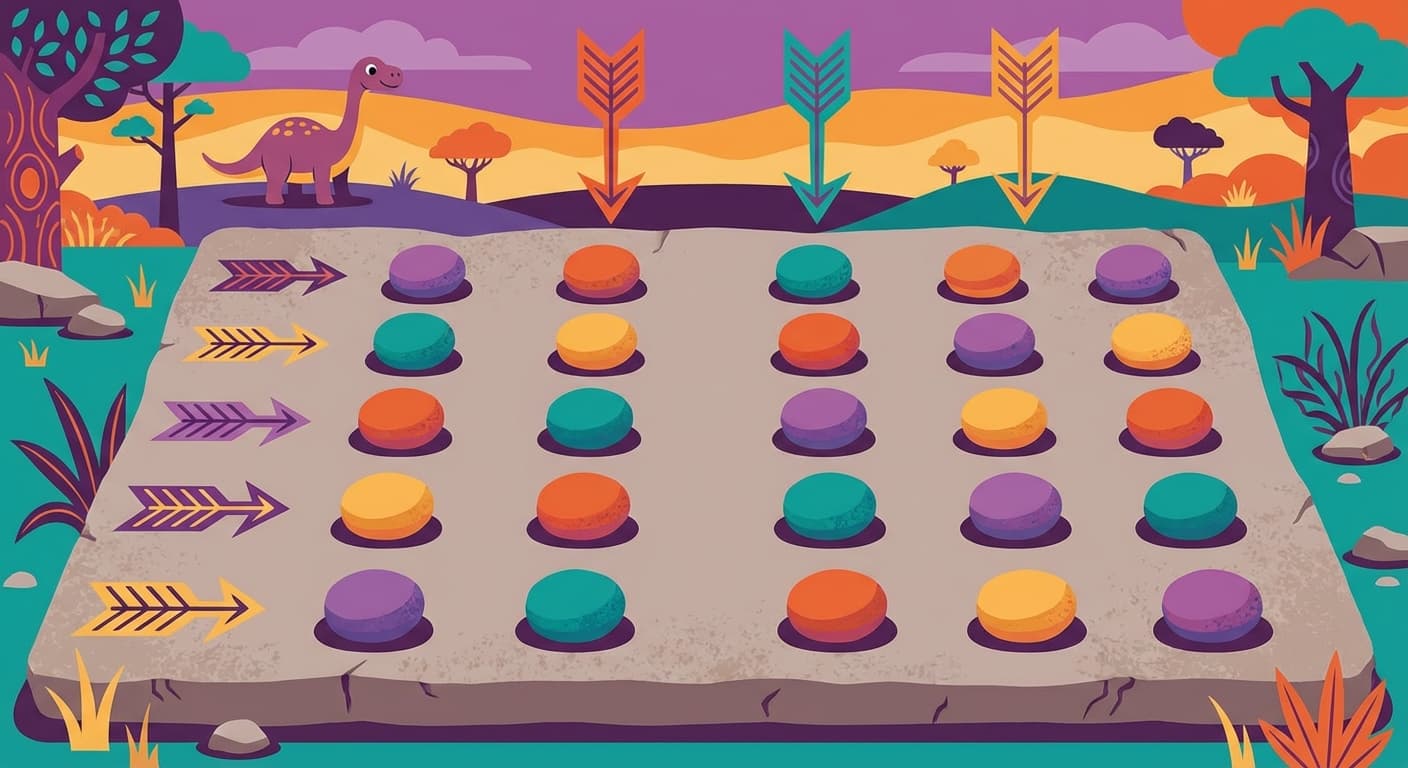
Blortz: Count by rows. Three, three, three, three, three. That is five additions.
Glagalbagal counted. Fifteen.
Blortz: Now count by columns instead. Five, five, five. That is only two additions.
Glagalbagal counted. Also fifteen.
He stared at the grid. The total number of pebbles was obviously the same regardless of how you counted them — they were the same pebbles, sitting in the same spots. But counting by columns required only two additions instead of four. And the difference grew with scale: for a hundred and eighty animals needing three sacks each, counting "by rows" meant a hundred and seventy-nine additions. Counting "by columns" meant two.
The Shortcut
Glagalbagal tested this on several more examples, because one case was not proof (Crivsola's mistake with the headstand had become something of a cautionary tale in the region). Seven animals, four sacks each: adding four seven times gave twenty-eight. Adding seven four times also gave twenty-eight. Ten animals, two sacks each: adding two ten times gave twenty. Adding ten twice also gave twenty.
Every case came out the same. And the grid made it clear why — you were always counting the same pebbles, just in a different order. The total could not change.
For his actual problem — roughly a hundred and eighty animals, three sacks each — Glagalbagal took his total herd arrangement and added it to itself, then added it once more. Three additions. The result: total feed for one month. He then added that monthly total to itself four times to get the full winter requirement. Seven operations total, where Dryzk had needed nearly two hundred.
He placed his order with Plyvek. This time, the feed lasted exactly as long as it should have.
The New Operation
Glagalbagal recognised that this process — adding an arrangement to itself a certain number of times — was distinct enough to deserve its own instruction tablet. He carved one and placed it alongside the addition and subtraction tablets on the wall of his office.
The operation had a useful property: it did not matter which arrangement you repeated and which told you how many times. Three groups of a hundred and eighty gave the same result as a hundred and eighty groups of three. The grid guaranteed it.