
Part 1 of 43
The Sealed Clock
By Madhav Kaushish · Ages 12+
In 5427 BC, in a country called Sonhlagot, there lived a doctor named Crivsola. She had been trained in the traditional medical arts — administering snake venom for fevers, applying leeches for headaches, and performing ritual chants for broken bones. These methods had been passed down for generations, originating from the dreams of an old man named Sudgara, who claimed the gods spoke to him in his sleep.
Crivsola had followed these practices diligently for years. But she had been keeping records, and the records told a troubling story: roughly 75% of her patients died. The ones who survived seemed to do so despite the treatment, not because of it.
One evening, sitting alone in her study, Crivsola made a decision that would change her life. She would abandon the old methods and try to actually understand how the human body works. Only then could she hope to fix it when something went wrong.
The Problem
There was one major obstacle. In Sonhlagot, dissection of human bodies was strictly forbidden — punishable by death. Crivsola could not cut a body open to see what was inside. She would have to figure out the internal structure of the human body using only what she could observe from the outside.
Einstein's Clock
Crivsola's approach was remarkably similar to one described thousands of years later by Albert Einstein in The Evolution of Physics. Einstein asked his readers to imagine a sealed clock — you can see the hands moving on the face, but you cannot open it to see the mechanism inside. How would you figure out how it works?
You would watch the hands move. You would notice patterns — the minute hand goes around once for every small movement of the hour hand. You would propose possible mechanisms that could produce these patterns. You would look for new observations that could distinguish between your proposed mechanisms.
This is exactly what Crivsola decided to do with the human body.
The First Observation
Crivsola began with the most basic observation she could think of:
Humans put objects into their mouth, mash those objects using their teeth, and then the objects disappear, seemingly into the body.
This was eating. Everyone did it, every day. But where did the food actually go?
Two Models
Crivsola proposed two competing models:
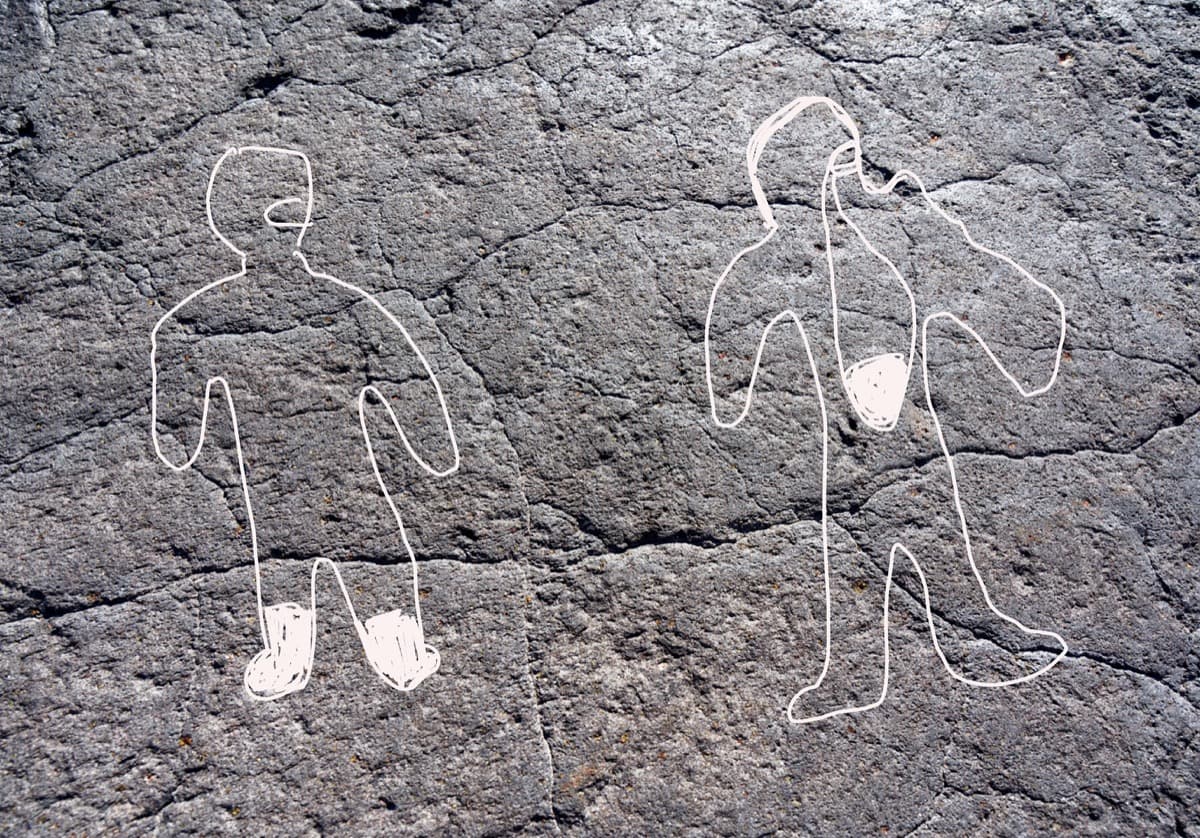
Model 1: The Hollow Body. The entire body is hollow, like an empty vessel. Food falls from the mouth all the way down to the feet, piling up at the bottom.
Model 2: The Sac. There is a sac or pouch somewhere below the mouth. Food falls into this sac and stays there.
She sketched both models on the wall of her cave:
She committed herself to finding observations that could distinguish between them. This was the fundamental strategy: start simple, propose alternatives, and use evidence to refine understanding.