
Part 24 of 43
The Red Fluid
By Madhav Kaushish · Ages 12+
Tszuvok cut his hand on a chisel. It was a shallow wound, and he cursed and pressed a rag against it in the practiced manner of someone who injured himself regularly. But Crivsola was already leaning in.
"Wait," she said. "Let me see it before you cover it."
The Red Liquid
Red liquid welled from the cut. It was warm — she could feel the warmth when it ran across her fingers as she examined the wound. The flow was steady but not forceful. A shallow cut, a gentle bleed.
She had seen this a hundred times before. Everyone had. Cuts produced red liquid. This was perhaps the least surprising observation in the history of medicine. But Crivsola was looking at it differently now.
The red liquid comes from inside the channels.
If the body contained a network of fluid-filled channels, and you cut through the skin into one of those channels, the fluid would leak out. That was what bleeding was — a breach in the channel wall.
The Two Kinds of Bleeding
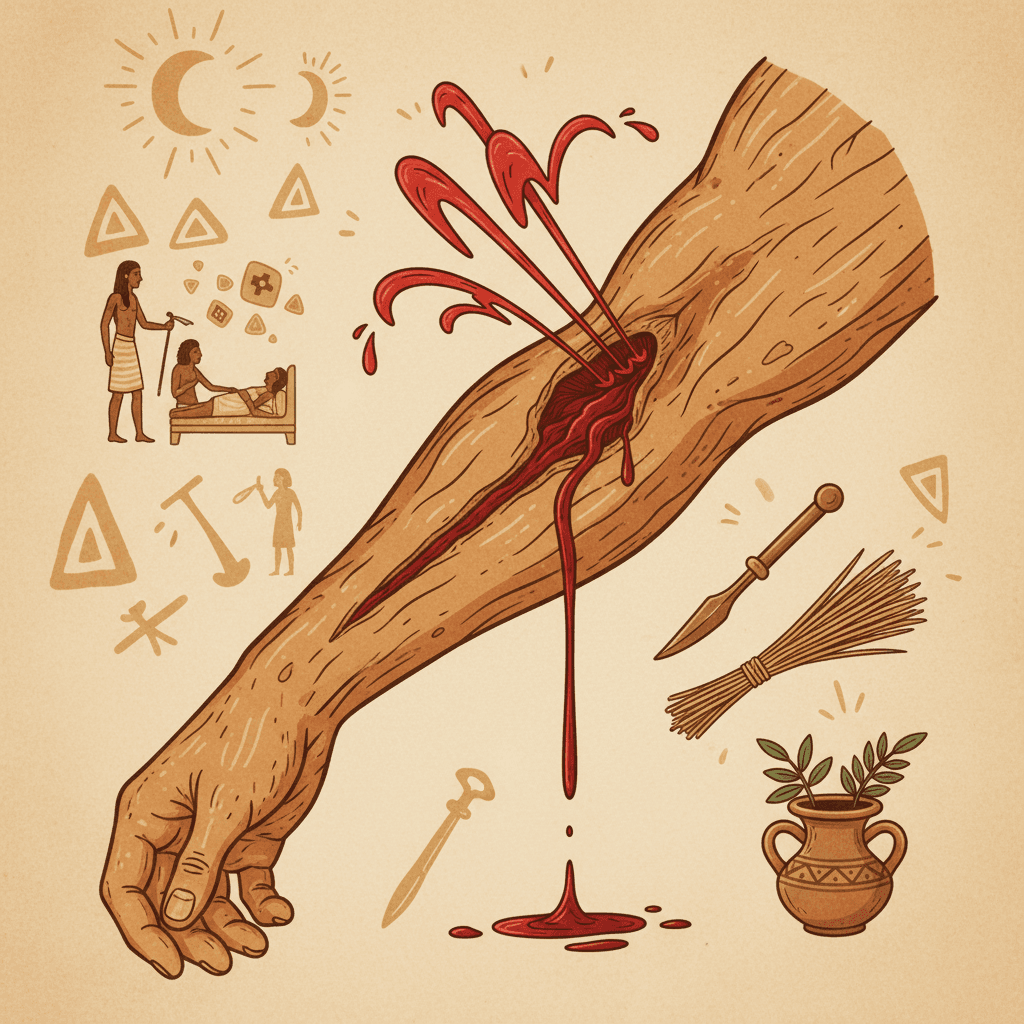
A few days later, a more useful injury occurred. A man in the market — a butcher — sliced his forearm badly while working. The wound was deep. Crivsola happened to be nearby and offered to help bind it. What she saw made her stop.
The blood was not simply flowing. Part of it was spurting — pulsing outward in rhythmic jets that matched the beat she could feel in her own wrist. Between the jets, a steadier, darker flow seeped from the edges of the wound.
Two kinds of bleeding from the same wound. One rhythmic, one steady.
The spurting comes from a pushing-channel. The steady flow comes from a return-channel.
The pushing-channels, carrying fluid under pressure from the chest-pump, would naturally spurt with each beat. The return-channels, carrying fluid back at lower pressure, would bleed in a calm, continuous stream. The butcher's cut had been deep enough to open both types.
The Price of Losing It
The butcher went pale. His skin turned a greyish white, and he became unsteady on his feet. The people around him pressed cloth against the wound and held his arm above his head — folk knowledge passed down for generations, the reasons for which nobody had explained.
Crivsola had seen worse cases. People who lost large amounts of the red fluid grew weak, confused, and cold. If they lost too much, they died.
The red fluid is not incidental. It is essential to life.
This made sense within her model. If the fluid carried fuel to every part of the body, then losing that fluid meant losing the supply line. Muscles, frame-pieces, the pulling-strings — everything depended on the fuel delivered by the red rivers. Drain those rivers, and the body shut down.
Convergence
She counted the evidence. The pulse at the wrist — rhythmic pushing. The thumping in the chest — the pump. The blue lines on the hand — return channels. The rhythmic spurting from deep cuts — pressurized outgoing channels. The steady bleeding from shallow cuts — low-pressure return channels. The danger of blood loss — the fluid was the body's fuel-delivery system.
Each observation had been gathered separately. None depended on the others. And yet they all pointed to the same picture: a pump in the chest pushing red fluid through a network of channels, delivering fuel, and receiving the fluid back in a continuous loop.
The model was growing stronger. But Crivsola still had questions about the pump itself. What was it made of? How did it work? And why, when she placed her ear against Tszuvok's chest, did she hear not one beat but two?