
Part 25 of 43
The Pump's Design
By Madhav Kaushish · Ages 12+
Crivsola pressed her ear against Tszuvok's chest for the third time that afternoon. He sat patiently on a stool in the workshop, arms at his sides, breathing steadily. He had learned not to talk during these sessions.
She listened. The sound was not a single beat. It was a double beat — two sounds in quick succession, then a pause, then two more. Something like lub-dub, lub-dub, lub-dub.
Two Sounds
A simple pump — a bladder you squeezed and released — would make one sound. Squeeze, release, squeeze, release. One action, one noise per cycle. But the chest-pump made two distinct sounds every cycle.
Something happens twice per beat. The pump is more complex than a single squeeze.
She thought about the bellows in a blacksmith's forge. Tszuvok, whose carpentry brought him into contact with metalworkers, described how bellows worked. You pulled the handles apart, and air rushed in through a flap. You pushed the handles together, and air was forced out through the nozzle. The intake flap closed automatically when you squeezed — a one-way valve, like the wolf trap from prison.
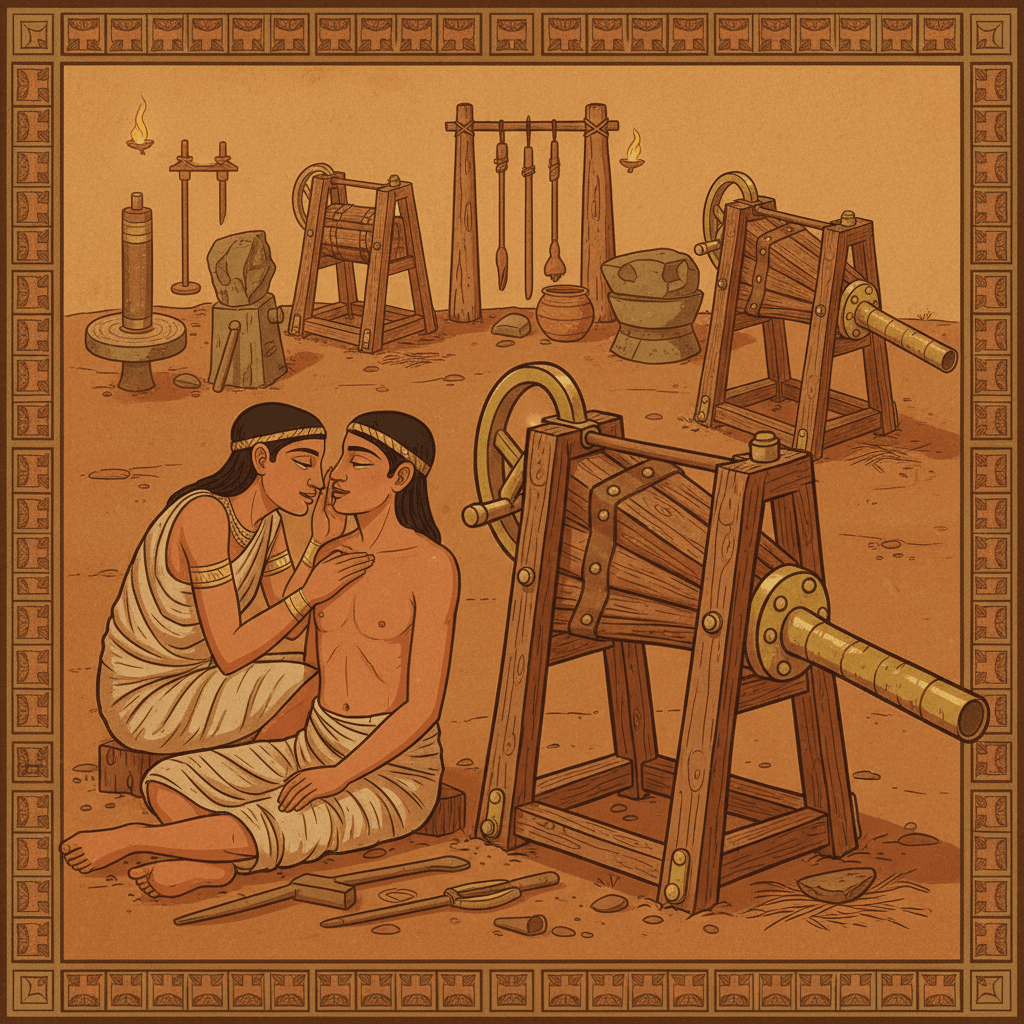
The Bellows Model
Perhaps the chest-pump worked like bellows. It expanded, pulling fluid in from the return-channels. Then it contracted, pushing fluid out through the pushing-channels. One-way valves at each end would prevent backflow — fluid could only enter from one direction and leave from the other.
The two sounds might correspond to these two phases. One sound for the contraction — the push. Another for the expansion — the pull. Or perhaps the sounds were made by the valves themselves, snapping shut.
Crivsola drew a picture. A bellows-like chamber in the chest. Return-channels feeding into it from one side. Pushing-channels leaving from the other. Valves at each junction.
The Honest Limit
She stared at the drawing. It was plausible. It was consistent with what she could hear and feel. It explained the double beat, the pulse, the one-way flow.
And she did not trust it.
The problem was that she was drawing the inside of something she had never seen and could never open. In Sonhlagot, cutting open a body carried the death penalty. She was reasoning about the pump's internal structure based entirely on sounds heard through a wall of ribs, muscle, and skin.
This is the best model I can build without opening a body. It may be wrong in ways I cannot yet detect.
The bellows picture might be close. It might also be completely wrong in its details — the pump might have chambers she could not guess at, or valves arranged in ways no sound could reveal. She was like a person trying to draw the mechanism of a clock by pressing her ear against the case. She could hear ticking. She could not see gears.
The Breathing Connection
She asked Tszuvok to run around the workshop — three laps between the door and the far wall. He did, looking faintly ridiculous. When he stopped, she pressed her ear to his chest again.
The thumping was faster. Much faster. The double beat came in rapid succession — lub-dub-lub-dub-lub-dub — as if the pump was working harder to push more fluid to muscles that were demanding more fuel.
That made sense. Running required more fuel. The pump sped up to deliver it.
But something else had changed. Tszuvok was also breathing harder. His chest heaved, pulling in air and pushing it out in deep, fast cycles. The pump and the breathing had both accelerated together.
When the body works harder, both the pump and the breathing speed up.
This was an odd coincidence. The pump moved red fluid. Breathing moved air. Why would the two be linked? What did air have to do with the red rivers?
She had no answer. But the connection was too consistent to be accidental. Every time the pump raced, the breathing raced with it. They were tied together by some logic she could not yet see.