
Part 26 of 43
The Complete Circuit
By Madhav Kaushish · Ages 12+
Crivsola visited Lomytguya every third day. The prison guards knew her by now — one of them was Tszuvok's replacement, a quiet woman who waved her through without checking her papers. Sonhlagot's bureaucracy was famously thorough, except when it was famously lazy.
Lomytguya was sitting cross-legged on her cot, mending a sock. She looked up when Crivsola entered. "Tell me what you have found."
The Full Picture
Crivsola laid a sheet of paper on the cot between them and drew as she spoke.
"There is a pump in the chest. It beats rhythmically — you can feel it here." She tapped her own chest. "The pump pushes red fluid outward through deep channels. These are the pushing-channels. You can feel them throbbing at the wrist, neck, and temple."
She drew lines radiating outward from the pump.
"The fluid reaches every part of the body. It carries fuel — the fuel that comes from food, which is dissolved in the tube and absorbed through the sieve-walls into the rivers. The fuel feeds the pulling-strings, the frame, the flesh, everything."
She drew the return lines. "Then the fluid comes back through a second set of channels — the return-channels. These are the blue-green lines you can see on the back of your hand. They carry no pulse. The fluid flows through them gently, back to the pump, and around again."
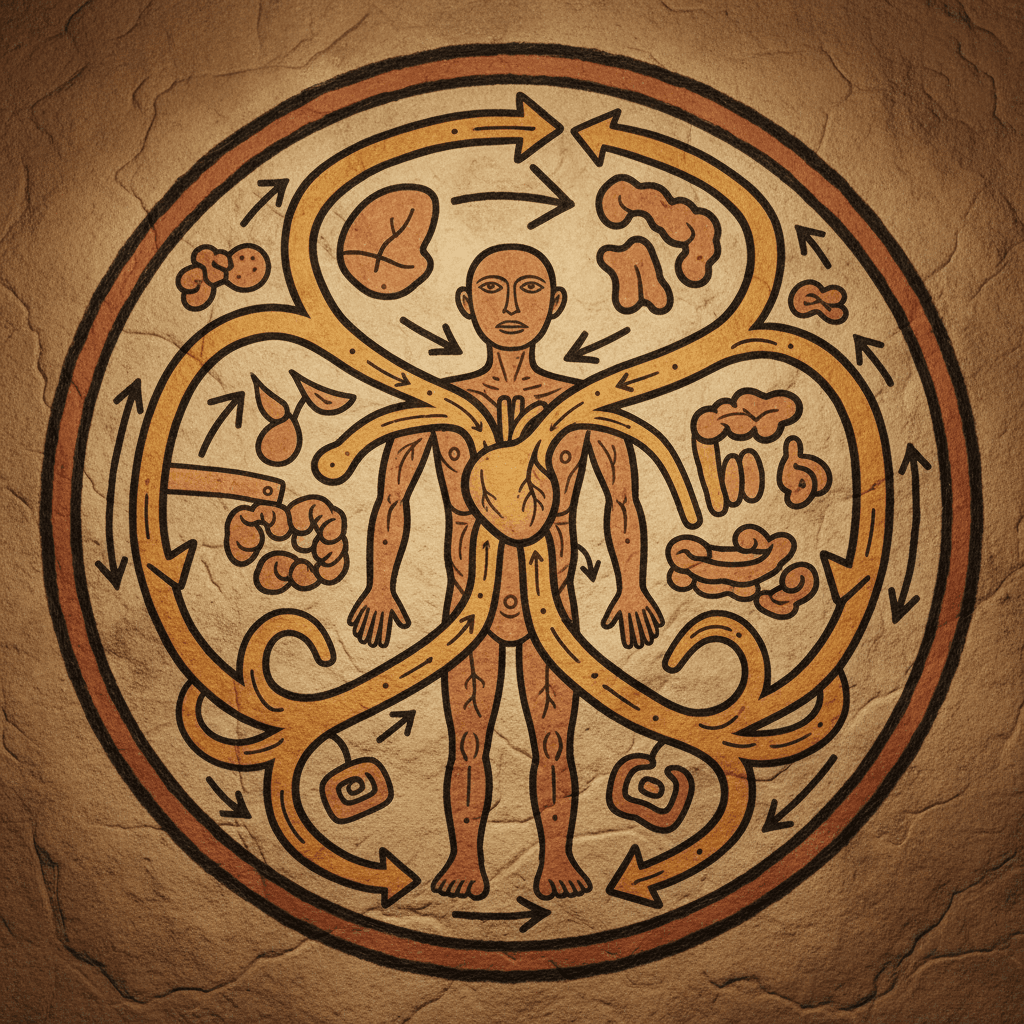
A complete circuit. Out, around, and back.
Lomytguya's First Question
Lomytguya studied the drawing. She traced the loop with her finger — pump, outward, body, return, pump.
"If the fluid picks up fuel from the food-tube and delivers it to the body," she said, "then it arrives at the body carrying fuel. Good. But what does it pick up on the way back?"
Crivsola paused. "What do you mean?"
"In the factory," Lomytguya said, "we have carts that bring raw materials to the machines and carry waste away. The carts do not come back empty. They carry slag, shavings, dirty oil. If your red fluid delivers fuel to the body, the body must produce waste when it burns that fuel. Does the waste just sit there? Or does the fluid carry it away?"
The Ever-Dirtying Problem
Crivsola had not considered this. Lomytguya was right. If every part of the body consumed fuel and produced waste, that waste had to go somewhere. The simplest possibility was that the red fluid carried it — picking up waste as it delivered fuel, like Lomytguya's factory carts.
But then what? The fluid returned to the pump and was sent around again. If it picked up waste on every pass and never got rid of it, the fluid would grow dirtier and dirtier with each circuit. After a thousand loops, a million loops, the fluid would be more poison than fuel.
The red fluid cannot keep getting dirtier forever. Something must clean it.
This was the Ever-Dirtying Model — and it was obviously wrong. The body functioned for decades. The fluid could not be accumulating waste indefinitely.
The Cleaning Station
Somewhere in the loop, there had to be a place where waste was removed from the red fluid. A cleaning station — a filter of some kind — that took the dirty fluid from the return-channels and stripped out the waste before sending the clean fluid back to the pump.
Crivsola did not know where this filter was. She did not know what it looked like. But the logic demanded it. A loop that carried waste but never cleaned it was a loop that would poison itself. Therefore, a cleaner existed.
She had done this before — back in prison, she had predicted that internal rivers must exist before she ever saw a blue vein on the back of a hand. That prediction had eventually been confirmed. Perhaps this one would be too.
She added a box to her diagram, along the return path, labeled simply: filter — location unknown.
The Second Question
Lomytguya was not finished. She looked at the drawing again, then looked at Crivsola.
"You told me last week that the thumping speeds up when you run. And so does breathing."
"Yes."
"Why would the rivers and the air be connected?"
Crivsola opened her mouth to answer and found she had nothing to say. The pump moved fluid. Whatever handled air — the breathing-parts — moved air. They were different systems doing different things. And yet they sped up together, every time, without exception.
Why would the red fluid need air?
She did not know. But Lomytguya had, once again, found the question that mattered most. Somewhere in the circuit, the red fluid and the air were meeting. Somewhere, for some reason, the rivers needed the breath.
She folded the diagram carefully and put it in her pocket. She had a new problem to solve.