
Part 31 of 43
The Signal
By Madhav Kaushish · Ages 12+
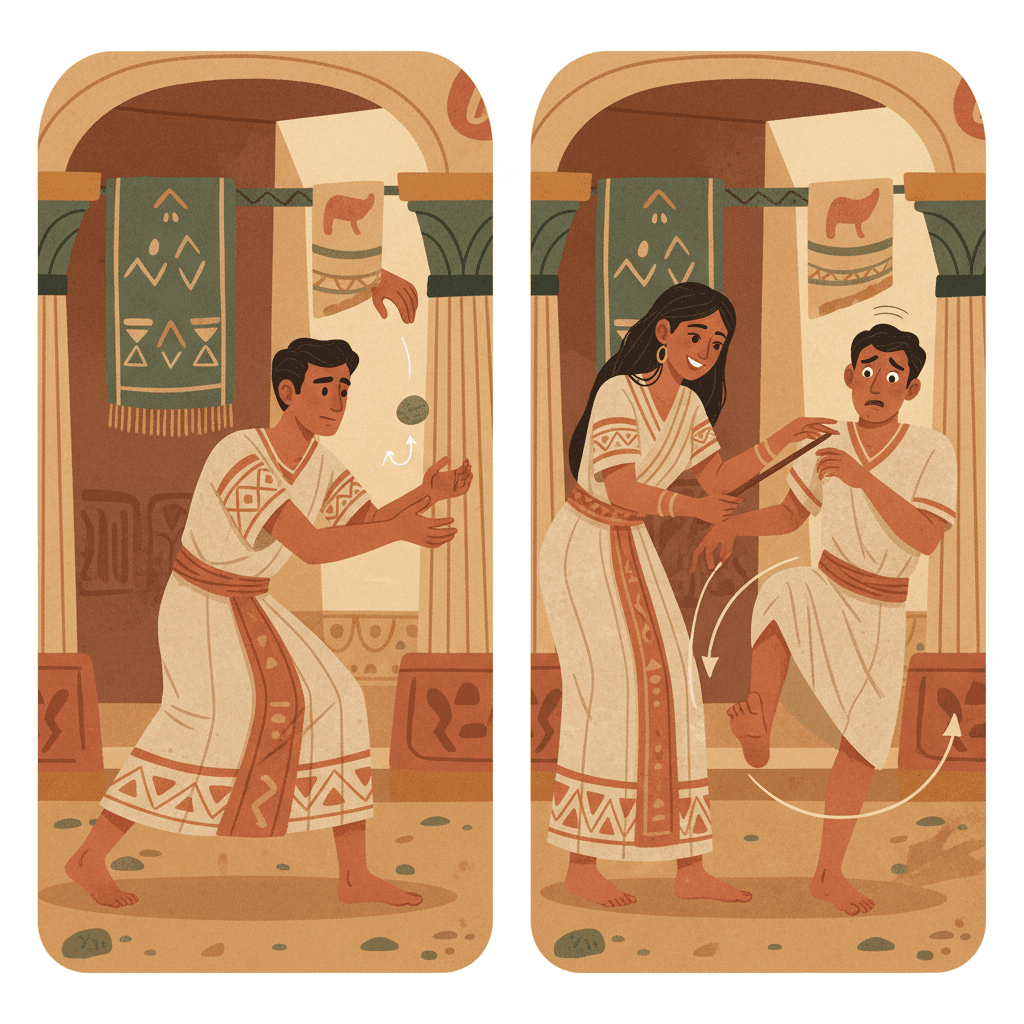
Crivsola held a smooth stone at shoulder height and told Tszuvok to catch it. She released it without warning. His hand snapped forward and closed around the stone before it had fallen more than a foot.
"Fast," she said.
"I am a carpenter. I catch dropped things."
She asked him to close his eyes. Then she poked the tip of his left toe with a stick.
The Delay
He flinched. Not immediately — but after a brief, measurable pause. She could see the moment the stick touched his toe and the moment his body responded, and these were not the same moment. There was a gap.
She poked his shoulder. He flinched again, but faster. The gap between touch and response was shorter.
She went back to the toe. Longer gap. Shoulder again. Shorter.
The Old Assumption
Crivsola had been working under an assumption she had never examined — that when the body decided to do something, it happened instantly. The commander in the head said "move" and the hand moved. The toe was touched and the head knew immediately. She had assumed this the way most people assume the ground is flat: it seemed obvious and nobody questioned it.
She called this Instant Communication — the idea that orders and reports travelled through the body with no delay at all.
But the pokes told a different story.
Time Means Travel
The signal from the toe takes longer to reach the commander than the signal from the shoulder. The toe is farther from the head than the shoulder is.
The pattern was consistent. Farther points meant longer delays. This was not random. It was proportional.
And if a signal took time — if it did not arrive instantly — then it was not magic. It was not thought simply appearing where it was needed. It was something travelling through the body, the way a message-runner travels along a road. A longer road meant a longer journey.
If something takes time, it must travel through space. If it travels through space, there must be a physical path.
The Path
This changed everything about how she thought about the two controllers — the voluntary one in the head and the automatic ones elsewhere. They did not govern the body by sheer will. They sent signals along physical paths, and those signals had a finite speed.
The body was not a single thing that moved all at once. It was a network — a system of paths carrying messages back and forth, the way Sonhlagot's postal riders carried letters between cities. And like the postal system, distance mattered. A letter to the next town arrived sooner than a letter to the capital.
Tszuvok rubbed his toe. "So when I stub my foot, the pain takes time to reach my head?"
"Yes. A tiny amount of time, but real."
"Then there is a moment," he said slowly, "when my toe knows something that I do not."
Crivsola had not thought of it that way. But he was right. The toe had been poked, and for a fraction of a heartbeat, the information existed only in the toe and along the path, not yet in the head. The commander did not know everything the body knew — not until the message arrived.
This raised an obvious next question. If the commander received messages and sent orders along paths — where, exactly, was the commander?