
Part 32 of 43
The Commander's Seat
By Madhav Kaushish · Ages 12+
There were two plausible candidates for the seat of the voluntary commander: the chest and the head. Both were protected by heavy frame-pieces — the ribcage and the skull. Both were clearly important. The question was which one housed the thinking thing.
Crivsola's first instinct pointed to the chest. The pumping-thing lived there — the most vital organ she had identified. When people spoke of feeling deeply, they placed their hands over their hearts. The chest seemed like the centre of the body's life.
She called this the Chest-Pump is Where Thinking Happens — the idea that the same organ that pushed blood also governed thought and decision.
What Breaks
But instinct was not evidence. She needed the same kind of reasoning she had used throughout her investigations: observe what happens when something changes, and deduce what must be true.
She began collecting cases. Not experiments — she could not damage people on purpose — but observations of things that had already happened.
A man struck hard on the head loses consciousness. He falls, he does not respond, his eyes do not track. But his chest-pump continues beating. His breathing continues — ragged perhaps, but present.
She had seen this twice in the market square. A falling beam had knocked a worker senseless. His body went limp, his mind vanished — but his automatic systems kept running.
The Nsujala Test
Then there was Nsujala — the fermented drink that half of Sonhlagot consumed in the evenings, despite periodic government bans on drinking while facing east. Crivsola had observed its effects hundreds of times.
A person who drank too much Nsujala lost coordination. Their speech slurred. Their decisions became poor. Their movements grew clumsy. These were all voluntary functions — things governed by the commander.
Nsujala affects the head. You can feel it — the dizziness, the pressure behind the eyes. And it is voluntary control that deteriorates, not automatic functions. The chest-pump did not stop. Digestion continued. Breathing carried on.
Whatever Nsujala was disrupting, it was disrupting it in the head.
The Sleep Argument
Tszuvok offered a third line of evidence during one of their evening discussions.
"When you sleep," he said, "you stop choosing things. You do not decide to move. You do not think. But your pump keeps beating and you keep breathing."
Crivsola considered this. Sleep was a nightly demonstration that voluntary and automatic control were separate. During sleep, the voluntary commander — whatever it was — went quiet. And the automatic systems did not care. They ran on their own, as they always had.
"Sleep is what happens when the head rests," she said. "The chest does not rest. It cannot afford to."
The Conclusion
The evidence pointed one way. Head injuries disrupted thinking and coordination. Nsujala, which affected the head, impaired voluntary control. Sleep shut down voluntary action while automatic systems persisted. Chest injuries, by contrast, threatened the pump and the blood supply — but a person with broken ribs did not lose the ability to think.
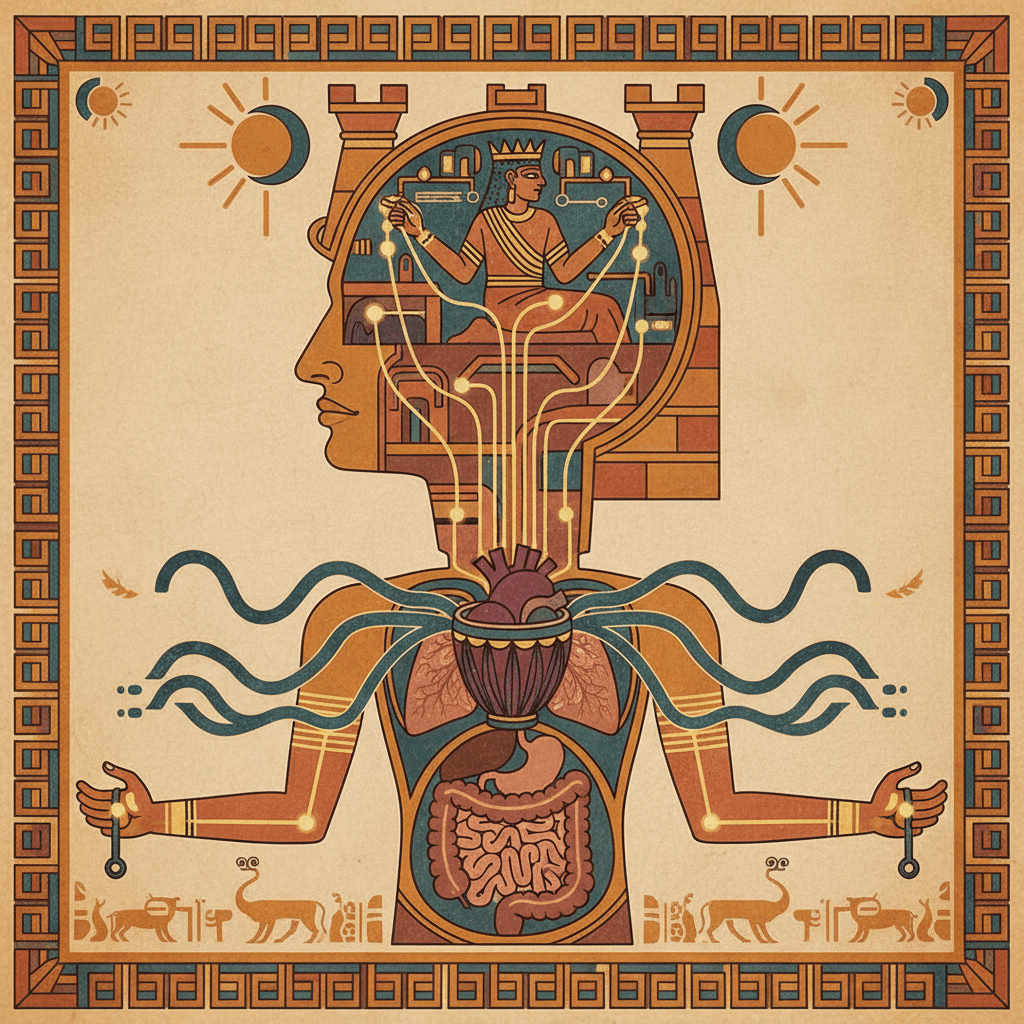
The voluntary commander sits in the head, inside the hard dome of the skull. The automatic controllers — the ones running the pump and the food-tube — operate independently, somewhere below.
The skull, Crivsola realized, was not just protection. It was a fortress built around the most important thing in the body. The hard dome she and Tszuvok had mapped months ago — pressing through the skin, noting its unyielding thickness — existed because what it contained could not be replaced.
But a commander was useless without a way to send orders. The signal paths she had discovered ran the length of the body. What were they made of? How did they carry their messages?