
Part 8 of 43
The Rot in the Bucket
By Madhav Kaushish · Ages 12+
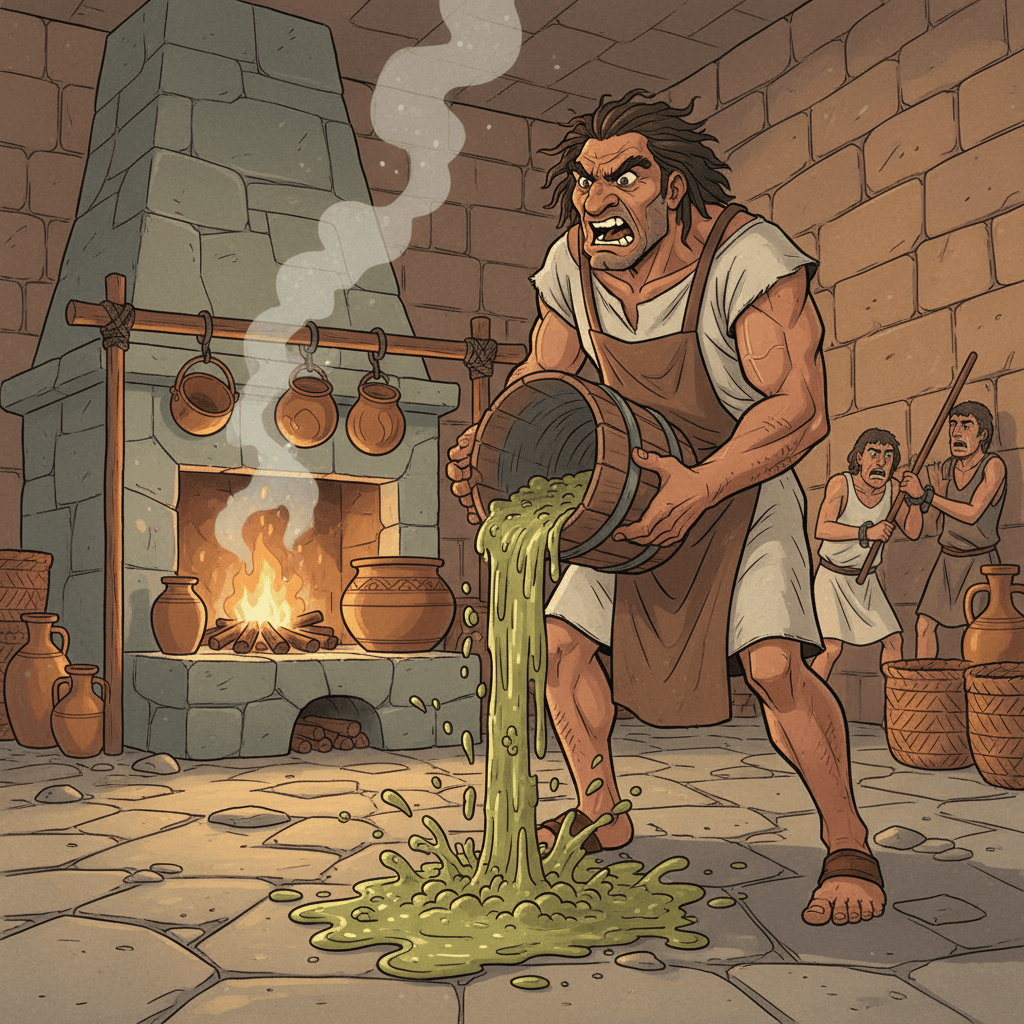
The prison cook was named Dvushak, and he was furious.
He burst into the corridor outside Crivsola's cell carrying a wooden bucket, which he slammed down on the floor with enough force to slosh its contents onto the stone. "Look at this," he said. "Look at it."
The Spoiled Porridge
Crivsola and Lomytguya looked. The bucket contained — or had once contained — porridge. It had been left out overnight in the warm kitchen, and what remained was a foul-smelling, semi-liquid mush. The colour had changed from grey to a yellowish brown. The texture had gone from thick to watery. And the smell was remarkable.
"I made this last night," Dvushak said. "Fresh. Good porridge. And now look. Ruined. The whole batch."
He stormed off, leaving the bucket behind, apparently as a monument to his grievance.
Crivsola stared at the bucket for a very long time.
The Analogy
"Lomytguya," Crivsola said quietly. "Look at what happened to this porridge."
Solid food had become a foul liquid. The substance had been transformed — not just broken into smaller pieces, but changed into something entirely different. And it had happened through no mechanical action at all. Nobody had crushed or ground the porridge. It had simply sat in a warm, wet place, and the transformation had occurred on its own.
Perhaps the body does something similar to rotting.
This was the dissolving model. Inside the tube, the body was warm and wet — Crivsola could verify this easily; the inside of the mouth was both warm and moist, and there was no reason to think the rest of the tube was different. Perhaps these conditions caused food to break down, the way food left out in warm air broke down into foul-smelling liquid.
The Power of Analogy
Crivsola recognised what she was doing. She was reasoning by analogy — taking a process she could observe in the world (food rotting) and proposing that a similar process occurred inside the body (food being dissolved).
Analogies were powerful. They let you borrow understanding from one domain and apply it to another. But they were also dangerous. Just because two processes looked similar on the surface did not mean they worked the same way underneath.
What the Analogy Gets Right — and Wrong
The rotting analogy captured something important: food could be transformed into a different substance by chemical means, not just by mechanical crushing. This was a genuine insight.
But Crivsola was already uncomfortable. Rotting was slow and uncontrolled. Food left in a warm place took days to decompose. The human body, on the other hand, seemed to process a meal in a matter of hours. She had eaten Dvushak's porridge for breakfast and produced waste by the evening.
If the body was rotting food, it was doing so at extraordinary speed. Either the analogy was wrong, or the body had found a way to accelerate the process dramatically.
She suspected the answer involved some kind of liquid. The mouth produced saliva — a liquid that mixed with food during chewing. Perhaps deeper in the tube, the body produced a much stronger liquid. Something that could dissolve food the way strong vinegar dissolved certain materials.
But how fast could such a liquid work? That was the question she needed to answer next.