
Part 11 of 18
The Unexpected Print
By Madhav Kaushish · Ages 12+
Wrinje read the newspaper more carefully the next morning and found what he was looking for, buried in the fourth paragraph. The forensic team had found a second set of fingerprints — unidentified — on the object used to kill Glerna. The article described the murder weapon as a heavy brass candlestick from Glerna's mantlepiece. Jansu's prints were not on it. The unidentified prints did not match anyone in the police's initial database search.
Wrinje: Mum, there are fingerprints on the murder weapon that do not belong to Jansu.
Vilila: Whose are they?
Wrinje: They do not know yet. They are running them through a larger database.
Vilila: Well, when they find a match, they will have the killer.
Wrinje: Will they?
Vilila: If your fingerprints are on the weapon that killed someone, you killed that person. That is not complicated, Wrinje.
Wrinje was not so sure. He called Glagalbagal.
Glagalbagal: The unknown prints are interesting. But your mother's conclusion is too fast. Let me ask you something. If they run the prints through a database of, say, a hundred thousand people and find a match, does that mean the matched person is the killer?
Wrinje: It means their fingerprints match the ones on the weapon.
Glagalbagal: Right. But does a match mean they actually touched the weapon?
Wrinje: Fingerprints are unique, are they not? Everyone's fingerprints are different.
Glagalbagal: Fingerprints are believed to be unique, yes. But fingerprint matching is not perfect. The prints found at a crime scene are often partial — smudged, incomplete, overlapping. An examiner compares them to prints in a database and makes a judgment about whether they match. Studies have shown that examiners sometimes make errors.
Wrinje: How often?
Glagalbagal: It depends on the study, but false positive rates — saying prints match when they actually belong to different people — have been measured at roughly 0.1% in controlled tests. That is 1 in 1,000.
Wrinje: One in a thousand? That seems very low. So if there is a match, it is almost certainly real.
Glagalbagal: It does seem low. But think about what happens when you search a large database.
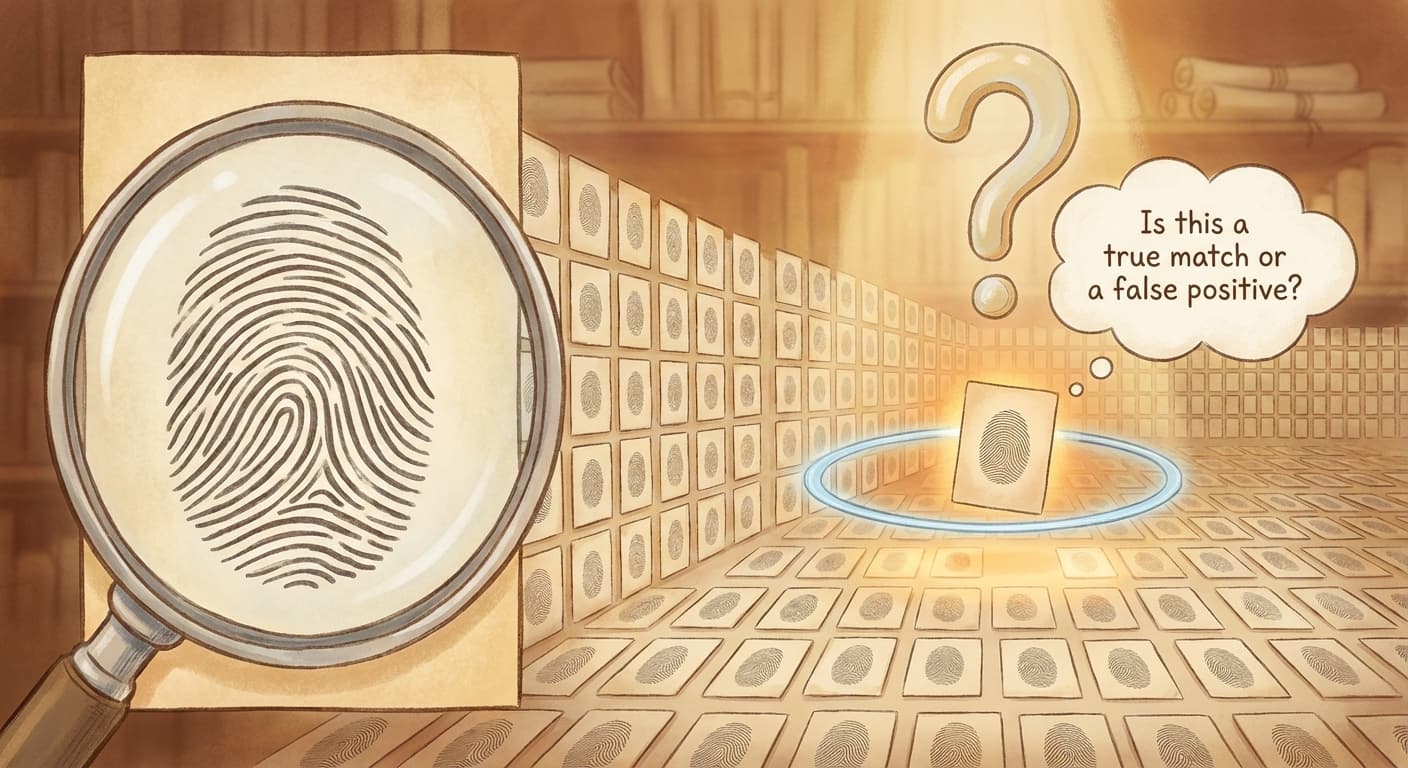
Wrinje: What do you mean?
Glagalbagal: Suppose the database has 100,000 people in it, and suppose the real killer is not in the database. You search the prints against all 100,000 people. The false positive rate is 1 in 1,000. How many false matches would you expect?
Wrinje: 100,000 divided by 1,000... that is 100 false matches?
Glagalbagal: Roughly, yes. If the killer is not in the database, you might still get a hundred people whose prints appear to match.
Wrinje: That is a lot of innocent people being flagged.
Glagalbagal: Now suppose the killer is in the database. You would get the real match plus those hundred false matches. So you would have about 101 matches total. Only one is the real killer. If you pick a match at random, you have less than a 1% chance of picking the right person.
Wrinje: But surely the examiners look more carefully after the initial search. They do not just accept the first match.
Glagalbagal: They do, and that helps. A more careful examination reduces the false positive rate significantly. But the principle remains: when you search a large database, even a very small error rate can produce many false matches. The probability that any one match is genuine depends on how many people you searched.
Wrinje: So if the police find a match in the database, it is not automatic proof.
Glagalbagal: Not automatic, no. It is evidence. A match in a large database should raise your suspicion, but it does not, by itself, tell you how likely it is that person is the killer. You need other evidence too.
Wrinje: What if the prints are not in the database at all?
Glagalbagal: Then the police would need to collect prints from specific individuals — people who had reason to be near the house.
Wrinje: Like the suspects we identified.
Glagalbagal: Exactly. And if the prints match one of them — someone who was not already in the database and was specifically tested — that is much stronger evidence. Because you are no longer searching through a hundred thousand people hoping for a match. You are testing a specific hypothesis against a small number of candidates. The false positive problem largely disappears.
Wrinje: I hope they test Fliba. And Klimpan. And Lagard.
Glagalbagal: They might. But that takes time. The police have to have a reason to collect someone's prints.
Wrinje: Having a key to a dead woman's house seems like a reason.
Glagalbagal: You would think so.