
Part 16 of 18
The Timeline
By Madhav Kaushish · Ages 12+
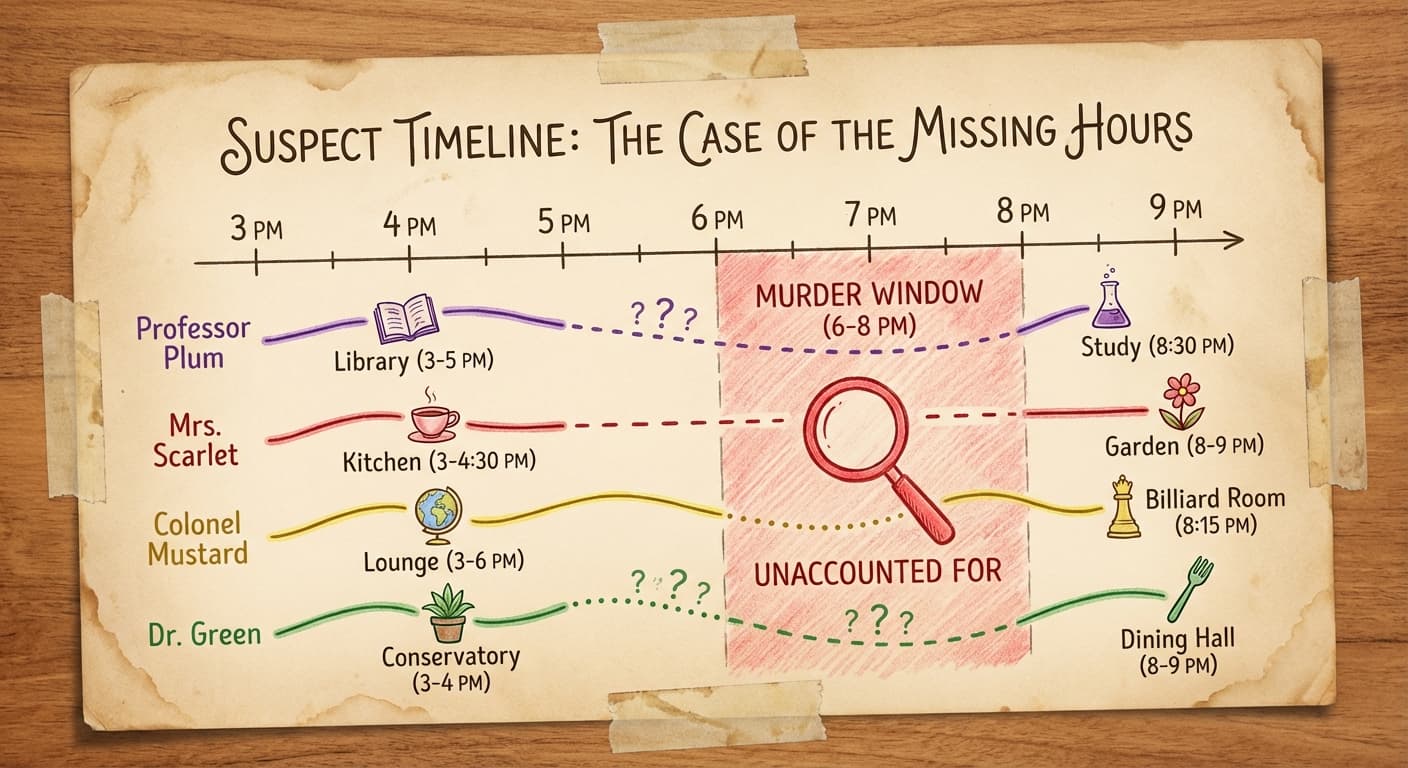
Wrinje decided to do something that, in retrospect, he should have done much earlier. He sat down at the kitchen table with a piece of paper and tried to reconstruct the timeline of the evening Glerna was murdered.
Vilila: What are you doing?
Wrinje: Making a timeline.
Vilila: Is this for school?
Wrinje: No. This is for the murder.
Vilila: Of course it is.
He wrote down what he knew, gathered from the newspaper reports and from Hyjop:
- 3:00 PM: Lagard, the handyman, finishes work on Glerna's fence and leaves.
- 4:00 PM: Jansu arrives at Glerna's house to visit.
- 5:00 PM: Jansu says she left.
- 6:00 PM - 8:00 PM: The estimated time of the murder, based on the forensic report.
- 7:00 PM: Hyjop claims he saw Jansu near the house (though we know eyewitness testimony is unreliable).
He then wrote down what he knew about each suspect's whereabouts:
- Jansu: Says she went home at 5pm. No confirmed alibi for 6-8pm, but she lives across town.
- Fliba: Says she went home at 4pm after her daily work. No alibi for 6-8pm.
- Klimpan: A regular at the Tvorjig bar — the newspaper reported that the bartender confirmed Klimpan was there from 6pm to about 9pm.
- Lagard: Left at 3pm. No specific alibi, but no particular reason to return to the house.
Wrinje: Klimpan has an alibi.
Vilila: Who is Klimpan?
Wrinje: The grumpy neighbor. He was at a bar from 6 to 9. The murder happened between 6 and 8. He could not have done it.
Vilila: Unless he snuck out of the bar.
Wrinje: The bartender confirmed he was there the whole time. Multiple people saw him.
Vilila: People lie.
Wrinje: Multiple independent witnesses are unlikely to all lie about the same thing. The probability of the alibi being false is very low.
He thought about what this meant for his probability estimates. Klimpan had been a suspect — a small one, but still in the running. His prior was maybe 0.5%. The alibi evidence was very unlikely if Klimpan was guilty (he would have needed to be at the house during the murder, not at a bar) and very likely if he was innocent (innocent people go to bars). The ratio was extreme — maybe 1% to 95%.
When you run that through Bayes' theorem, Klimpan's probability drops to nearly zero.
Wrinje: Klimpan is effectively eliminated.
He looked at the remaining suspects. Lagard left at 3pm — three hours before the murder window. He had no known reason to return. His probability was already low, and nothing had raised it.
That left Jansu and Fliba as the primary suspects. And one significant difference stood out:
Jansu lived across town. For her to be the killer, she would have had to leave at 5pm, go somewhere, and then return by 6pm — or never have left at all.
Fliba lived nearby. She said she went home at 4pm. She had no alibi for the murder window. And she had a key to the house — she could have walked in at any time without forcing entry. The police had noted that there was no sign of forced entry.
Wrinje: Fliba had a key. There was no forced entry. She has no alibi for the murder window. She had just been removed from the will.
Vilila: Are you trying to convince me or yourself?
Wrinje: I am trying to follow the logic. Alibis are like evidence in reverse — they make certain possibilities much less likely. If Klimpan was at the bar, he almost certainly was not at the house. That is a logical constraint. It does not just reduce his probability — it nearly eliminates it.
He stared at the timeline. Two suspects with no alibis for the critical window. One with a strong motive. One who was the police's initial focus.
Wrinje: I need to talk to Glagalbagal about how to put all of this together.
Vilila: You need to do your homework first.
Wrinje: This is more important than homework.
Vilila: Nothing is more important than homework. Except maybe food. Do your homework, eat your food, and then you can play detective.