
Part 17 of 18
The Combination
By Madhav Kaushish · Ages 12+
Glagalbagal came over on a Wednesday evening, which was unusual. She said she had a feeling Wrinje was close to an answer and she did not want him to get it wrong at the last step.
Wrinje: I think it is Fliba.
Glagalbagal: Show me your reasoning. All of it.
Wrinje laid out his notes on the kitchen table. Vilila sat in the corner pretending to read a magazine but clearly listening.
Wrinje: Let me go through each suspect and what the evidence says.
He started with Klimpan. Alibi at the bar from 6 to 9, confirmed by multiple witnesses. Probability effectively zero. Eliminated.
Lagard. Left at 3pm. No reason to return. No motive. Low prior, no evidence raising it. Probability very low — maybe 0.1%.
Jansu. The police's initial suspect. Prior was about 1% based on her being an acquaintance. The eyewitness testimony raised it, but we showed that a 70% reliable witness only pushed it to maybe 7-8%. Her fingerprints in the house told us nothing — expected either way. The unknown hair at the scene did not match her, which lowered the probability slightly. She has no known motive — she was still in Glerna's will. On the other hand, she has no confirmed alibi for the murder window, which keeps her in the running.
Fliba. Prior was about 3% based on daily access and a key. The will change — being removed the week before the murder — was strong evidence, with a likelihood ratio of about 14 to 1. No alibi for the murder window. She had a key, which explains the lack of forced entry. And then there were the unidentified fingerprints on the murder weapon — prints that did not match Jansu, did not match Glerna, and had not yet been matched to anyone.
Glagalbagal: Good. Now let us put the numbers together properly. You have been updating informally, but let us be explicit. Start with the priors and apply each piece of evidence in sequence.
She drew a simple table on a piece of paper.
Glagalbagal: We will track Jansu and Fliba, since they are the main contenders. Starting priors: Jansu 1%, Fliba 3%, Others 96%.
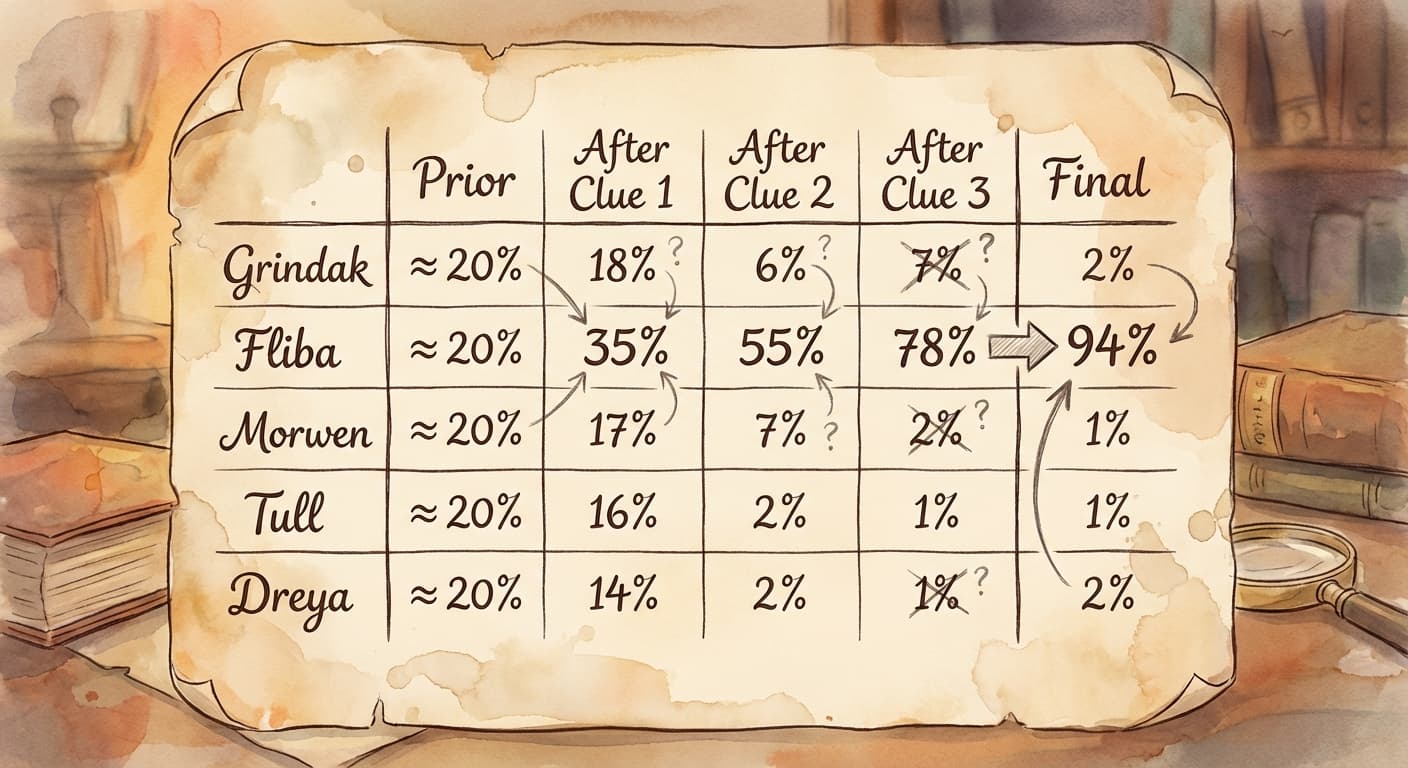
Glagalbagal: First update — the eyewitness testimony. This mainly affects Jansu. Her probability goes up to roughly 7-8%. Fliba is not affected by this evidence — it was not about her. Others drop proportionally.
Wrinje: Okay.
Glagalbagal: Second update — the fingerprints on the weapon do not match Jansu. This is modestly surprising if Jansu is guilty and expected if she is innocent. Small shift away from Jansu. She drops a bit, say to around 5-6%.
Wrinje: And Fliba?
Glagalbagal: Fliba is not directly affected by Jansu's prints not being on the weapon. But the existence of unidentified prints that do not match any known person is slightly more likely if the killer is someone whose prints are not in the system — like Fliba, who was never arrested and whose prints were never formally collected. A small increase for Fliba.
Glagalbagal: Third update — the will change. This is the big one. Strong evidence for Fliba. Likelihood ratio of 14 to 1 or more. Fliba's probability jumps significantly. After this update, she might be at 30% or higher.
Glagalbagal: Fourth update — alibi evidence. Klimpan eliminated. Lagard effectively eliminated. The probability they held gets redistributed to the remaining possibilities. Some goes to Jansu, some to Fliba, some to "unknown." Fliba climbs further.
Glagalbagal: Fifth update — no forced entry. The killer had a key or was let in. This is very likely if Fliba did it (she had a key) and less likely if a stranger did it. Another shift toward Fliba. Less informative for Jansu — Glerna might have let her niece in.
Wrinje: So where does it end up?
Glagalbagal: The exact numbers depend on the specific likelihoods you assign, and reasonable people might assign them slightly differently. But with conservative estimates, Fliba is now the most probable suspect by a significant margin. She might be at 50% or higher, with Jansu well below that, and "unknown" accounting for the rest.
Wrinje: No single piece of evidence was enough. But together they all point the same way.
Glagalbagal: That is the power of combining independent evidence. Each piece of evidence on its own was uncertain — the will change could be a coincidence, the lack of an alibi could be unremarkable, the unmatched prints could belong to anyone. But when multiple independent pieces all point toward the same person, the combined effect is much stronger than any individual piece. This is because independent evidence compounds — each new piece multiplies the previous probability rather than just adding to it.
Wrinje: Like compound interest, but for suspicion.
Glagalbagal: That is actually a good analogy.
Then Glagalbagal said something that made Wrinje uncomfortable.
Glagalbagal: I want you to notice something about your investigation. When did you first consider Fliba as a suspect?
Wrinje: When I talked to Hyjop, in Part 7 — I mean, when I visited his shop a few weeks ago.
Glagalbagal: And before that, who were you focused on?
Wrinje: Jansu. Because the police arrested her.
Glagalbagal: Right. You spent the first several weeks of this investigation evaluating only one suspect — the one the police handed you. You did not consider alternatives until you happened to visit the neighbourhood and hear about other people in Glerna's life.
Wrinje: I suppose that is true.
Glagalbagal: This is called confirmation bias. When you start with a theory — "Jansu did it" — you tend to look for evidence that confirms that theory and interpret ambiguous evidence in its favor. The arrest made you focus on Jansu. The eyewitness testimony seemed to support it. You almost did not look further.
Wrinje: But I did look further. Eventually.
Glagalbagal: You did. And that is to your credit. But think about the police. They arrested Jansu and they may have stopped looking. They had a suspect, they had an eyewitness, they had a case. Why look further? That is confirmation bias at the institutional level, and it is how wrongful convictions happen.
Vilila: So the police got it wrong?
Glagalbagal: We do not know that yet. But the evidence is pointing somewhere they may not be looking.
Wrinje: We need those fingerprints on the murder weapon to be matched.
Glagalbagal: Yes. That would be the piece that ties everything together — or overturns it entirely. If the prints match Fliba, combined with everything else, the case is very strong. If they match someone else entirely, we have to start over.
Vilila: And if they are never matched?
Glagalbagal: Then we have a probable answer but not a certain one. Which, unfortunately, is how most real investigations end — with probability, not proof.